REVIEW · OSAKA
Sharpen Japanese Knives in Osaka
Book on Viator →Operated by JLB Tours · Bookable on Viator
Knife skills, taught like a craft.
In Osaka’s knife city Sakai, this short, hands-on experience shows how blades are made by hand and how professionals keep them working well. I like that you start with context at the Sakai Traditional Industrial Hall, then move straight into a practical whetstone sharpening lesson at Wada Store. One thing to consider: the whole timing is tight—about 2 hours—so you’ll want to show up ready to focus.
The biggest plus for me is how direct the instruction feels, especially with the guide Yuji meeting you on time and walking you through what’s in front of you. I also like that you’re not just watching; you get to sharpen and learn the traditional way of fitting a handle to a blade. A possible drawback: it’s non-refundable and depends on good weather, so check your schedule before you book.
In This Review
- Key highlights worth planning for
- Knife city Sakai: why this part of Osaka feels different
- Sakai Traditional Industrial Hall: the 30 minutes that sets the stage
- Walking to Wada Store and meeting Yuji on time
- Wada Store sharpening lesson: whetstones, tools, and real technique
- What you actually learn: sharpening plus handle fitting
- 1) Sharpening with whetstones
- 2) Fitting handles traditionally
- Duration, group size, and why that changes the feel
- Price and value: what $213 buys you in real terms
- Where this fits in your Osaka plan
- Practical tips before you go (so you enjoy it more)
- Who this tour is best for
- Should you book Sharpen Japanese Knives in Osaka?
- FAQ
- How long is Sharpen Japanese Knives in Osaka?
- What does the tour cost?
- Where do I meet for the experience?
- Is admission included for both stops?
- What’s included in the sharpening workshop?
- Do I need to bring my own knife?
- What if bad weather cancels the experience?
- Is it refundable if I cancel for my own reasons?
Key highlights worth planning for
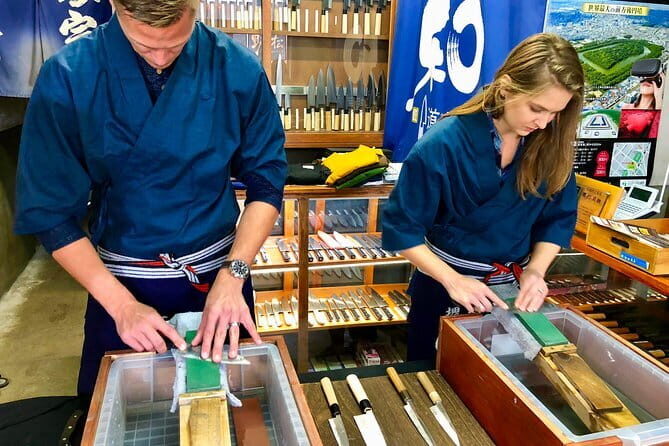
- Small group size (max 5): more time for questions and getting your technique checked
- Two-part experience: museum context first, hands-on sharpening second
- Whetstone lesson at Wada Store: learn proper sharpening steps with the tools provided
- Handle fitting practice: you’ll learn the traditional way to attach handles
- You leave with your own knife work: your knife is part of the lesson
- Coffee or tea included: a small comfort between careful work and learning
Knife city Sakai: why this part of Osaka feels different
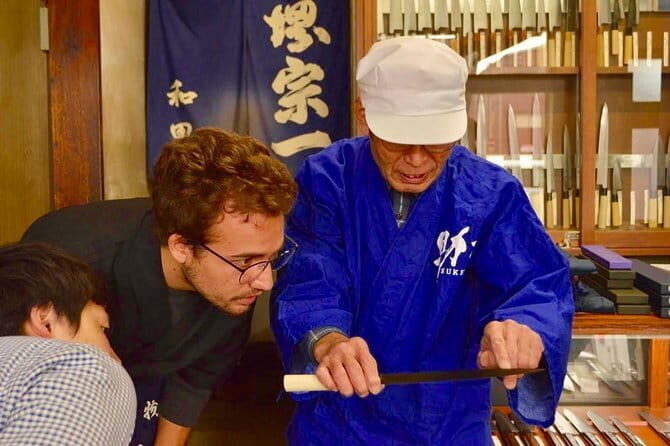
Osaka can be loud, fast, and easy to rush through. Sakai is the opposite vibe. It’s known for knives from centuries ago, and the important part here is that this craft still matters in real daily work, not just as museum decoration.
What I like about this experience is the way it uses your senses. You see the variety of knives and how they’re made. Then you go from looking at metal to touching it, sharpening it, and learning how handles fit in the traditional way. That combination makes the story of Sakai feel practical instead of like a history talk you forget later.
This is also a good choice if you’re tired of tours that feel like a checklist. Here, your hands do the work. And when your hands learn something, you remember it.
You can also read our reviews of more tours and experiences in Osaka.



Sakai Traditional Industrial Hall: the 30 minutes that sets the stage
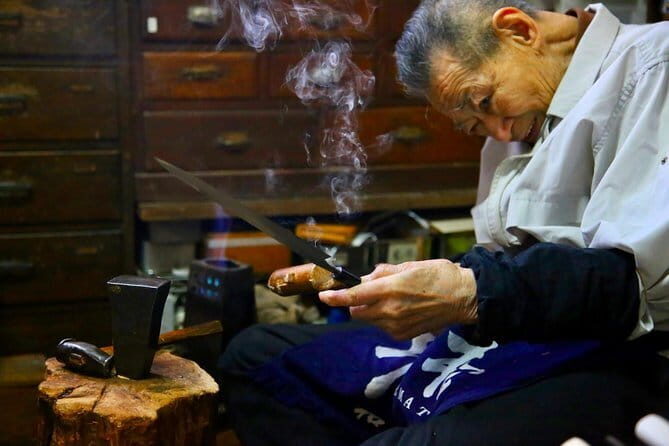
Your first stop is the Sakai Traditional Industrial Hall for about 30 minutes. The point is not to cram you with everything about metallurgy. It’s to help you notice what matters: knives have different purposes, and they’re made by hand with those jobs in mind.
You’ll look at knives in different forms and think about why shape and use matter. Even if you’ve never cared about knife types before, you’ll start noticing the logic: this design fits that task. That matters later when you’re sharpening, because sharpening isn’t just rubbing a blade on stone. It’s doing the right motion and keeping the edge true to what the knife is built to do.
One practical note: this part is admission free, so you’re not paying extra to walk around for a bit. It’s included as a focused introduction before you get your own hands-on time.
The drawback: 30 minutes goes quickly. If you like to read every label, you’ll have to skim a bit and rely on the guide’s explanations to catch what’s most important.
Walking to Wada Store and meeting Yuji on time
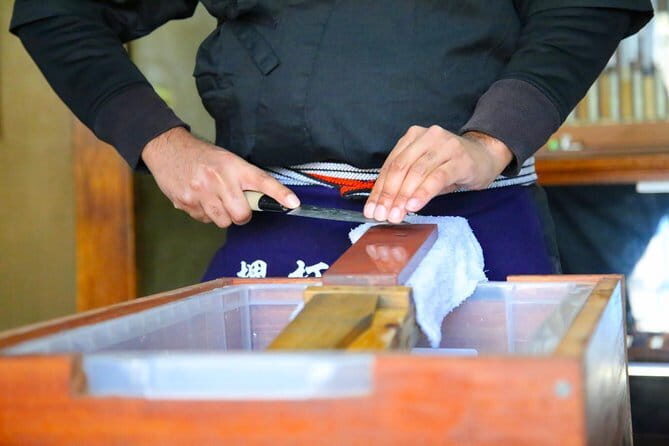
After the museum stop, you head to Wada Store for the sharpening lesson. The meeting point is at Wada Store, 1-chōme-1-1 Shinmeichōhigashi, Sakai Ward, Sakai, Osaka 590-0935, Japan, and the activity ends back there.
You should plan for some walking as you move between stops. In past visits, groups have been guided from the station area with about a half-mile walk to reach the knife museum. That’s not hard hiking, but it is real walking. Wear shoes you’d use for a full city afternoon.
This is where Yuji tends to make a difference. He’s described as arriving on time and speaking very good English, which helps when the explanation is tied to hand movements you’ll repeat later. If you’re rusty with Japanese, this kind of clear instruction is a big deal.
Wada Store sharpening lesson: whetstones, tools, and real technique
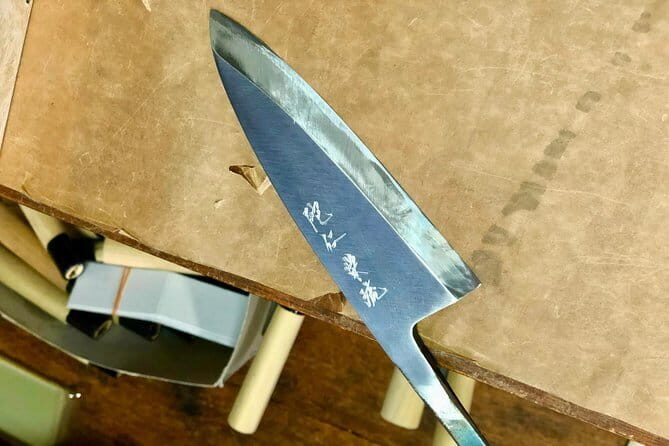
This is the heart of the experience: about 1 hour 30 minutes at Wada Store. You’ll sharpen using whetstones, and you’ll learn how to sharpen your knife properly, not just how to make it slightly less dull.
You’ll also get instruction on something many people never learn: how to fit the handles into the blades traditionally. That means you’ll be paying attention to alignment and the parts that connect, not only the cutting edge.
Here’s what makes this section valuable. Knife sharpening often gets treated like a gimmick. People either buy a gadget or they rely on a vague guess about angles. A guided lesson changes that. You see the tools in use, you get coaching while you try, and you practice until the motion feels controlled.
Included with the lesson are an apron, tools for sharpening knives, and coffee and/or tea. The apron matters more than you’d think, because sharpening can be messy. Having the right gear also signals that the workshop expects you to actively participate.
What you bring: your own knife. That’s the smart part for value. You aren’t learning on a random demo blade that doesn’t match what you own.
Possible drawback: because the session is hands-on, you’ll want to come with a knife you actually use. If you only own a decorative knife, you might still learn technique, but the payoff will feel smaller.
What you actually learn: sharpening plus handle fitting

Let’s break down the two skills you’re learning.





1) Sharpening with whetstones
You’ll practice proper sharpening with the provided stones and tools. The big win is guidance during the process, so you can correct your grip, your pace, and your pressure instead of guessing and hoping for the best. You’ll likely leave with a clearer mental checklist for what to do next time.
Even if you’ve sharpened before, this kind of workshop helps you compare your habits to a more traditional workflow. And when the instructor can adjust what you’re doing in real time, it saves you from slow trial and error later.
2) Fitting handles traditionally
This is the part that surprised me in a good way. Many knife workshops focus only on the blade. Here, you also learn how handles attach to blades in a traditional way.
That teaches you that a knife is a system. If the handle is fitted well, you get better control while cutting. If it’s not, you can end up with awkward use that makes even a sharp edge feel wrong.
So even though it sounds like a minor workshop skill, it affects comfort and performance.
Duration, group size, and why that changes the feel

The tour runs for about 2 hours (approx.) and caps at 5 travelers. Small groups are not just a luxury. They change how much feedback you can get.
In a group of five, you can ask questions without feeling like you’re holding up a whole bus. You’re also more likely to get your technique noticed while you work, which is the difference between learning in theory and learning something you can repeat later.
The time format is also realistic. Two hours is long enough to learn the basics and practice, but short enough that it won’t wipe out your entire Osaka day.
Price and value: what $213 buys you in real terms
At $213, this isn’t the cheapest thing you can do in Osaka. But it’s also not priced like a big sightseeing bus tour. You’re paying for workshop access, tools, and instructor time—plus the fact that you’re working on your own knife.
Here’s what your money covers:
- Workshop instruction in sharpening with whetstones
- Tools you can use during the lesson
- Apron so you can participate without worrying
- Coffee and/or tea to make the session easier
- The included training on handle fitting
- You get to take home the practical skill to use right away
If you already travel with a serious interest in food tools—chef knives, Japanese kitchen knives, or just good cooking—you’ll value this more. If you mainly want photos and a quick story, you might decide this is too hands-on.
To me, the value lands because you leave with a skill, not just a souvenir.
Where this fits in your Osaka plan

You’re starting at Wada Store and ending back at the meeting point. That makes it easier to plan the rest of your day. You don’t have to worry about transportation back to a different area after the workshop.
Because the session is tight and workshop-focused, I recommend pairing it with lighter plans afterward. Avoid scheduling a long museum hopping marathon immediately after. Your hands may be tired from sharpening motions, and you’ll likely want time to clean up and reset.
Also, note the weather requirement. The experience needs good weather, and if it’s canceled due to poor conditions you’ll be offered a different date or a full refund. If you’re visiting in rainy season, consider booking earlier in your trip window so you have flexibility.
Practical tips before you go (so you enjoy it more)
You’ll enjoy this more if you go in prepared for hands-on learning.
- Bring a knife you care about and actually use, so the sharpening work feels meaningful.
- Wear comfortable shoes for short walking between areas and to keep your feet happy.
- Plan to listen and watch closely. Sharpening instruction works best when you copy the motion right away.
- If you’re nervous about metalwork, that’s normal. The workshop setup suggests you’re expected to learn through doing.
One more small comfort: having coffee or tea included gives you a breather. It can help you reset your focus if you find your attention slipping halfway through the workshop.
Who this tour is best for
This is a great fit if you like practical craft experiences and want to learn something you can use at home.
It especially suits:
- cooks who use Japanese-style knives
- people who like skill-based tours over “look-and-leave” sightseeing
- anyone interested in Sakai’s knife reputation beyond slogans
- travelers who value small-group attention
If you’re expecting a long guided walk with lots of big landmarks, you may find the format too focused and skill-driven. This is a working workshop experience, not a scenic photo tour.
Should you book Sharpen Japanese Knives in Osaka?
I think you should book it if you want real take-home value. The strongest reason is the combination: museum context for 30 minutes, then a whetstone sharpening lesson plus traditional handle fitting with your own knife for about 1.5 hours, in a small group of up to 5.
It’s not ideal if your schedule is fragile. The session is short, weather-dependent, and it’s non-refundable, so only book if you’re confident you can make the date.
If you do book, you’ll likely come away with two things: a sharper knife and a better understanding of why Sakai knives are built and cared for the way they are.
FAQ
How long is Sharpen Japanese Knives in Osaka?
It runs for about 2 hours (approx.), with a 30-minute first stop and about 1 hour 30 minutes for the sharpening lesson.
What does the tour cost?
The price is $213.
Where do I meet for the experience?
The meeting point is Wada Store, 1-chōme-1-1 Shinmeichōhigashi, Sakai Ward, Sakai, Osaka 590-0935, Japan.
Is admission included for both stops?
The first stop at Sakai Traditional Industrial Hall is admission free. The sharpening lesson at Wada Store includes admission.
What’s included in the sharpening workshop?
You’ll get an apron, tools for sharpening knives, coffee and/or tea, and the session includes your sharpening lesson. You also bring your own knife.
Do I need to bring my own knife?
Yes. The tour includes your knife as part of the lesson, and you’ll sharpen your own knife during the session.
What if bad weather cancels the experience?
The experience requires good weather. If it’s canceled due to poor weather, you’ll be offered a different date or a full refund.
Is it refundable if I cancel for my own reasons?
No. This experience is non-refundable and cannot be changed for any reason. If you cancel or request an amendment, the amount you paid will not be refunded.