REVIEW · KUMAMOTO
Discover the Spirit of the Greatest Samurai, Miyamoto Musashi
Book on Viator →Operated by Attractive JAPAN · Bookable on Viator
Samurai training, with tea and a sword. In Kumamoto, you practice Iaido in a small group while connecting the movements to Miyamoto Musashi’s ideas about art and discipline. You also dress up in traditional Edo-era style and end with a certificate and photo.
I especially like the hands-on sword practice—you’re not just watching. The instructor works with you through a full kata-style flow using practice equipment, so you leave feeling what those concepts look like in motion. I also love that the session starts with matcha and Japanese sweets, then links what you’re doing to why Musashi trained the way he did.
One thing to consider: you use replica (practice) swords, not live blades, and the focus is on form and controlled technique rather than freewheeling sparring. If you’re after a hardcore weapons workout, this is more precise and ritual-based than that.
In This Review
- Key things I’d circle on your plan
- Miyamoto Musashi and Iaido: what you’re really learning in Kumamoto
- Your first 10 minutes: dogi, matcha, and the Musashi mindset
- The Edo costume moment and how the room sets expectations
- Seeing the master demonstrate: where kata starts to make sense
- Practicing Iaido with replica swords: the real work is timing and control
- Certificate, photo, and small “real life” keepsakes
- Price and logistics: is $162.88 good value for what you get?
- Who should book this Musashi Iaido experience (and who might not)
- Should you book? My straight answer
- FAQ
- FAQ
- How long is the Miyamoto Musashi Iaido experience in Kumamoto?
- What’s included in the price?
- Do I use a real katana?
- What should I wear?
- Is there a minimum height requirement?
- Where is the meeting point?
- Is hotel pickup included?
Key things I’d circle on your plan
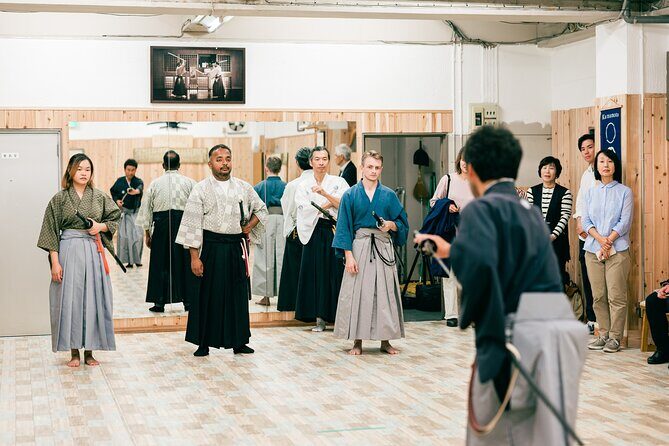
- Replica sword training (Iaido) instead of just sightseeing
- Musashi’s two themes: artistry and protecting what matters
- Edo-era costume, certificate, and a keepsake hand towel
- Matcha and Japanese sweets included before you move
- Maximum 5 people, so you actually get coaching
- English support through an English-speaking guide/interpreter
Miyamoto Musashi and Iaido: what you’re really learning in Kumamoto
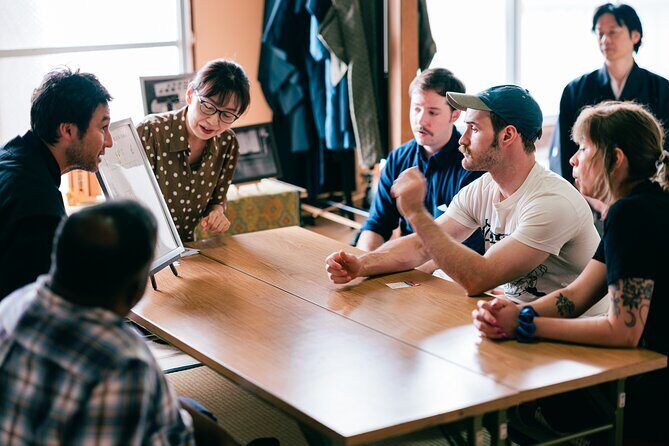
This experience is built around Miyamoto Musashi and the sword art often grouped under Iaido—the practice of responding with sword technique in a calm, controlled way. The big idea isn’t violence. It’s self-mastery: you learn how Musashi’s mindset shaped his swordsmanship, then you translate that mindset into practiced movements.
Musashi is one of those figures who shows up in Japan at two levels at once. On one level, he’s famous for combat skill. On another, he’s tied to creative work: his ink paintings and sword fittings (including tsuba) are kept at the Shimada Museum of Art in Kumamoto City. That matters here because your lesson isn’t only physical. It’s also about what Musashi thought made a fighter sharper—developing an artistic sense, not just muscles.
You’ll also hear how the historical shift mattered. The Sengoku era was war-focused. The Edo period leaned more toward peace and self-discipline. Iaido fits that mindset: people trained to keep peace through readiness, not to chase battles.
You can also read our reviews of more tours and experiences in Kumamoto.



Your first 10 minutes: dogi, matcha, and the Musashi mindset
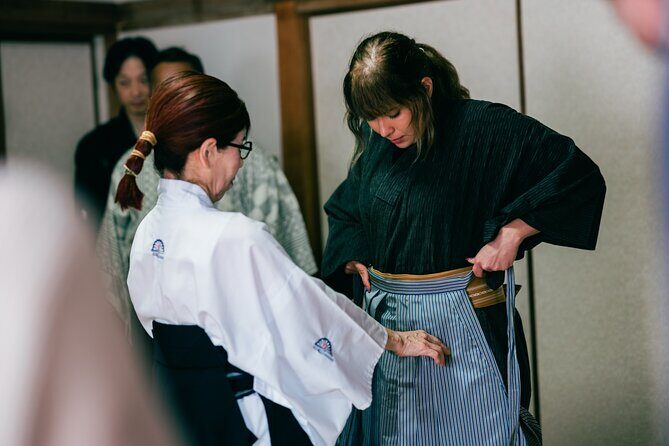
Right when you arrive, you change into training clothes (a dogi). It’s a small moment, but it’s also part of the ritual. You’re signaling to your body that you’re switching from tourist mode to practice mode.
Next comes matcha in a Japanese-style room and a talk about Musashi’s two most repeated traits for this style:
- He treated artistry like a training tool, believing better artistic perception improves sword skill.
- He mastered his own sword technique with a purpose: protecting family and master, especially as society moved from constant war into a calmer era where maintaining readiness mattered.
This is the part I think many visitors underestimate. The tea break isn’t just a snack stop. It’s how the instructor frames what you’ll do with your hands and timing. You’ll drink matcha, then learn why the body mechanics connect to the mental focus.
You’ll get Japanese sweets too, included as part of the experience. If you have any allergies or dietary restrictions, tell the organizers in advance so you can consume the provided items safely during the session.
The Edo costume moment and how the room sets expectations
At some point during the experience, you’ll dress in authentic costume. That’s not a gimmick here—it helps you understand the setting you’re learning in. Traditional clothing changes posture and movement, even if only slightly, so it reinforces the feel of being in a different time period.
Timing-wise, you’re working on a tight rhythm. After tea and the introduction, the lesson moves quickly into a demonstration and then your own practice. That short schedule is part of the value: you get context first, then you use it right away.
Also note the simple clothing rules that make a big difference:
- Wear clothing that’s easy to move in (pants are fine).
- Skirts or dresses aren’t recommended.
- During the Iaido session, remove jackets or heavy outerwear before changing into the training keikogi.
- You can keep a T-shirt or a light top underneath while the staff helps with fitting.
If you show up in something flexible and comfortable, you’ll glide through the changing process and focus on the lesson instead of fussing with your outfit.
Seeing the master demonstrate: where kata starts to make sense
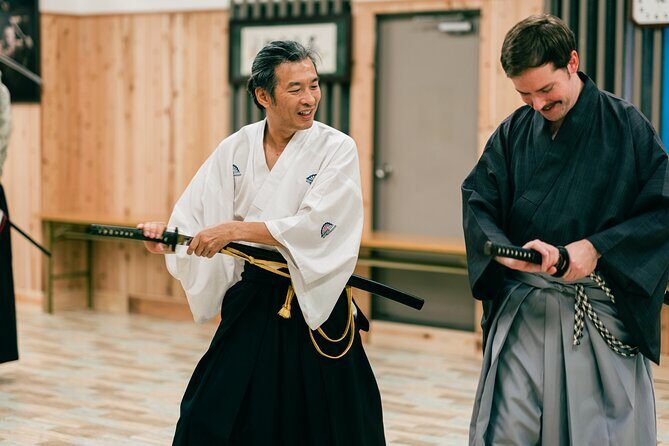
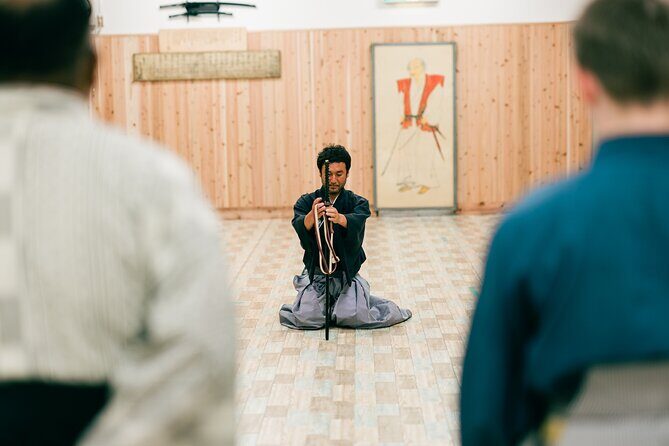
Around the midpoint of your session, there’s a special demonstration by the master/instructor. One of the instructors is described as an 18th generation Miyamoto Musashi instructor, and even without focusing on the title, you can feel the structure: the demonstration sets the standard for timing, control, and form.
This is the moment to watch with purpose. Don’t only look at where the sword ends up. Watch when the movement starts. In Iaido-style practice, small changes in posture and intent matter. The instructor’s job in the demonstration is to show you how the movement flows, not just the final pose.
Then, after the demonstration, you shift into your own practice. The transition is quick, which is good. You don’t have time to overthink, and you get more repetition while the lesson is still fresh.
Practicing Iaido with replica swords: the real work is timing and control
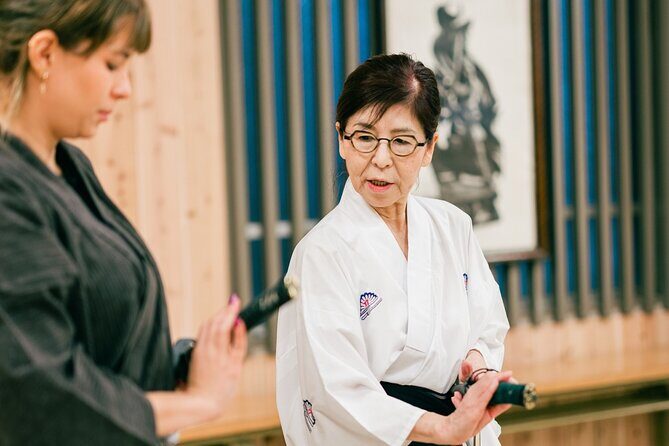
Now for the main event: Iaido experience. You’ll practice techniques as taught by a laido instructor whose teachings are connected to Miyamoto Musashi’s lineage. Your equipment is a replica (practice) sword, and safety is taken seriously—follow the instructor’s guidance and handle the tools with care.
What you’ll do (in practical terms) is learn and perform a kata-style sequence with a focus on controlled form. Even when the sword is a replica, it’s still a training weapon. That means:
- you move when prompted,
- you keep control through the sequence,
- and you pay attention to the spacing and positioning your instructor corrects.
One of the most useful takeaways from doing this type of practice is how hard the basics actually are. A real-sword feeling isn’t the point; the precision is. People often assume sword practice is all about strength. In Iaido, strength is just one ingredient. Timing, calm posture, and clean transitions are what make the movement look right—and what make it feel right to you.
You’ll likely get coaching while you repeat parts of the sequence. With a maximum group size of 5 travelers, the instructor has a real chance to adjust your form instead of giving only broad corrections.


Certificate, photo, and small “real life” keepsakes
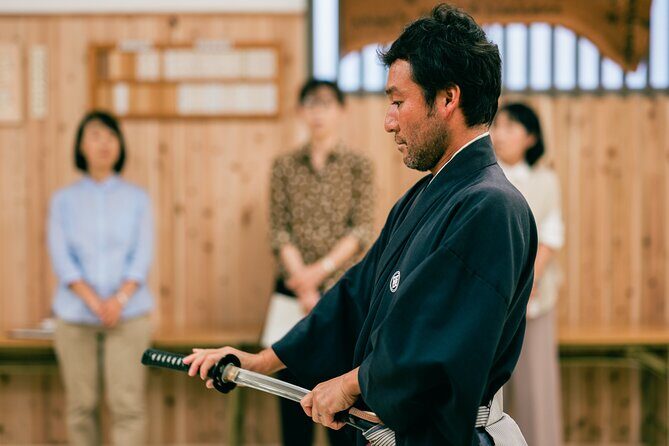
Near the end, you get a completion certificate and a photograph. That’s a nice touch because it makes the experience feel tangible. It’s easy to remember a museum visit. It’s also easy to forget a class you did in passing. A certificate and photo give you a clean marker: you trained, not just watched.
After that, you change back into your regular clothes and wrap up.
You also receive a Japanese hand towel, plus the included matcha and sweets earlier in the session. These extras are small, but they add up. They turn the experience into something you can carry with you—literally in a towel, emotionally in the feeling of having learned something physical and specific.
Price and logistics: is $162.88 good value for what you get?
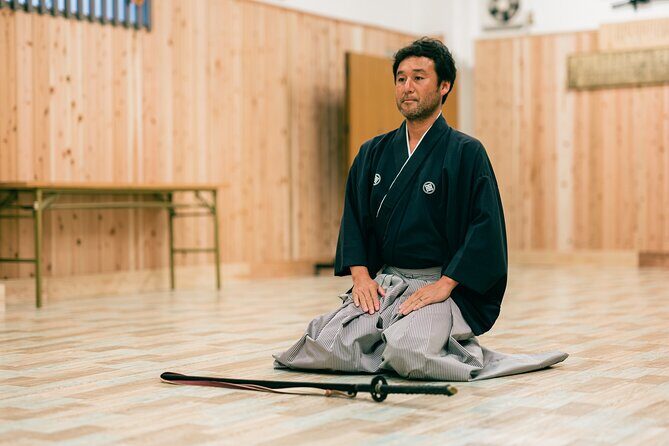
At $162.88 per person for about 1 hour 40 minutes, you’re paying for more than entertainment. You’re paying for instruction, a structured demonstration, hands-on coaching, and included cultural elements.
Here’s where the value comes from:
- Small group size (up to 5): you get closer attention during practice.
- English-speaking guide/interpreter support: this matters because sword arts are full of timing and nuance. If you miss the explanations, you’ll only half-get the movement.
- What’s included: dogi rental, matcha, Japanese sweets, certificate, photo, and a hand towel.
- The lesson format: tea and philosophy first, then demonstration, then your own training. It’s not random; it builds.
The main practical downsides are also straightforward. There’s no hotel pickup and drop-off, so plan to get to the meeting point on your own. The meeting point is in Chuo Ward, Kumamoto, and it’s described as near public transportation, which is a big relief. Also, there’s a height requirement of 150cm or more, so if your group includes someone shorter, double-check before you plan your schedule.
As for the cancellation rules, keep in mind this experience is non-refundable and can’t be changed for any reason. That’s not unusual for smaller, instructor-led training sessions, but it does mean you should only book if your Kumamoto schedule is solid.
Who should book this Musashi Iaido experience (and who might not)
This experience is a great match if you want:
- a hands-on activity tied to a famous samurai,
- a structured lesson where you practice a kata-style sequence,
- a small-group setting with coaching and English support,
- and a cultural add-on (costume, matcha, certificate) that feels part of the training rather than a separate show.
It may feel less ideal if:
- you want real sharp steel or live-blade handling (you won’t—this uses replica practice swords),
- you’re looking for long free-form sparring,
- or you only want passive sightseeing with no physical participation.
Should you book? My straight answer
I’d book this if you like the idea of connecting Musashi’s mindset to movement, not just reading about it. The session is compact, the group is small, and the included extras make it feel complete. Even if you’re a beginner, the format is clear: tea and philosophy first, then a master demonstration, then you practice under safety rules.
If you’re in Kumamoto anyway and you want one activity that’s both cultural and physical—something you’ll remember because your body learned it—this is a solid pick.
FAQ
FAQ
How long is the Miyamoto Musashi Iaido experience in Kumamoto?
It runs for about 1 hour 40 minutes.
What’s included in the price?
Matcha, Japanese sweets, dogi rental, your samurai training certificate, a Japanese hand towel, and an English-speaking guide/interpreter.
Do I use a real katana?
No. The experience uses replica (practice) swords for safety. You’ll be guided on how to handle the equipment.
What should I wear?
Wear clothing that’s easy to move in. Pants are fine, but skirts or dresses aren’t recommended. During the Iaido session you should remove jackets or heavy outerwear before changing into the keikogi training attire.
Is there a minimum height requirement?
Yes. You need to be 150cm or more to participate.
Where is the meeting point?
The start location is 1-chōme-6-4 Shimotōri, Chuo Ward, Kumamoto, 860-0807, Japan, and the activity ends back at the meeting point.
Is hotel pickup included?
No. Hotel pickup and drop-off are not included.