REVIEW · OSAKA
Osaka: Private Vibrant Nighttime Photoshoot (Dotonbori)
Book on GetYourGuide →Operated by PhoenixJP合同会社 · Bookable on GetYourGuide
Neon is fun, but photos can be a mess. This private night shoot in Dotonbori is built to fix that. You’ll move through the iconic glow of Osaka while your photographer handles light, angles, and timing.
I especially like the focus on Dotonbori’s real street atmosphere instead of just one landmark. And I like the pacing: you’ll hit multiple photo setups, not one rushed stop and off you go.
One thing to consider: night crowds and weather can be unpredictable, so you’ll get the best results if you’re flexible with the exact route and locations your photographer chooses.
In This Review
- Key things I’d watch for before booking
- Dotonbori at night: why this photo walk works
- Meeting point and how the 90 minutes to 4 hours plays out
- Ebisu-bashi Bridge and the Glico Sign: the two “start here” anchors
- Dotonbori street and the neon-to-alley mood shift
- America mura and the side-street energy you might miss
- Posing, patience, and the photo counts that matter
- How much is $109 worth for a private shoot?
- Who should book this Dotonbori night photoshoot
- Should you book it, or skip it?
- FAQ
- FAQ
- How long is the Osaka Dotonbori private night photoshoot?
- Where does the photoshoot start?
- What famous spots will we visit in Dotonbori?
- How many photos do I receive?
- When will I receive the edited photos?
- How long can I download the photos?
- Are raw files included?
- What languages are available for the guide?
- Is the experience private and wheelchair accessible?
- Can I cancel and get a refund?
Key things I’d watch for before booking
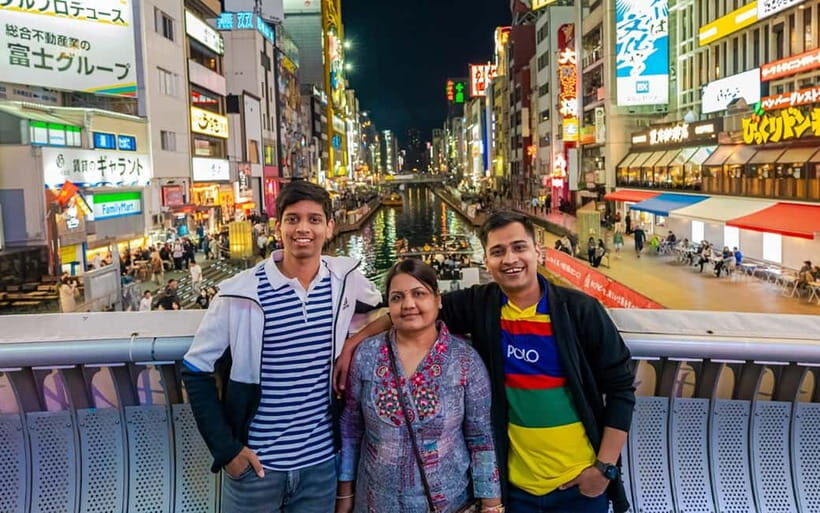
- 5+ locations in the Dotonbori area with route tweaks based on your vibe
- Glico Sign, Ebisu-bashi Bridge, Hozenji Yokocho, and America mura as the core anchors
- Guided posing and composition so you’re not just standing there hoping selfies work
- Big photo volume: about 200 standard JPGs per hour plus 30 polished edits
- Night street variety: neon storefront energy plus lantern-lit traditional lanes
- Food wrap-up near a street-food spot, where you can refuel after shooting
Dotonbori at night: why this photo walk works
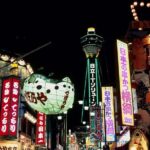
Osaka at night has attitude. Dotonbori in particular is loud with light, signs, and people moving in every direction. That’s a gift for photos, as long as you’re not trying to do it all yourself with a phone on a timer.
This experience is designed for that exact problem: you get a private guide who knows where the light lands and how to turn busy streets into clean compositions. Instead of you hunting for the perfect angle, you get stops that make sense for nighttime photography, then you get direction for what to do with your body.
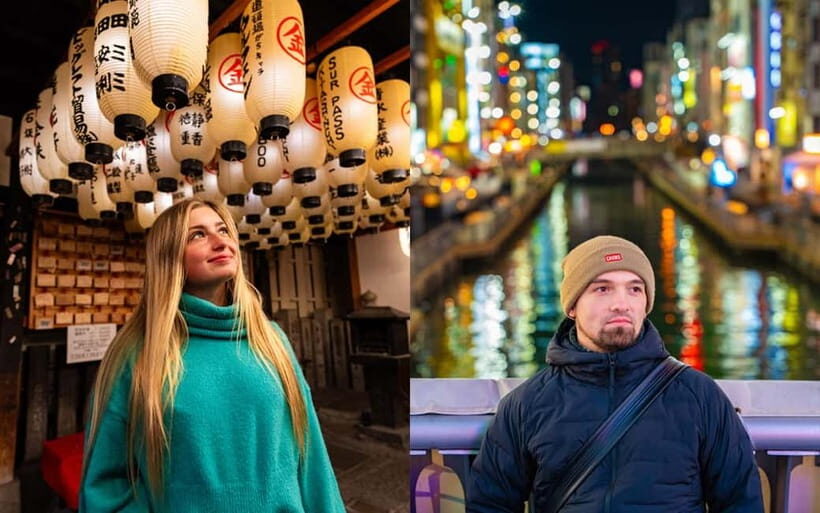
I also like that the route mixes styles. You’re not stuck in only neon shopping streets. You get contrast, including a traditional alley feel near Hozenji Yokocho, where lantern lighting changes the mood completely. That contrast is what makes a set of photos look like a real night out in Osaka, not just a stack of similar pictures.
One more practical reason this works: in a dense area like Dotonbori, timing matters. Your photographer can wait for the right gap in foot traffic and reposition you quickly. That’s hard to do solo without feeling like you’re fighting the street instead of enjoying it.
You can also read our reviews of more private tours in Osaka
Meeting point and how the 90 minutes to 4 hours plays out
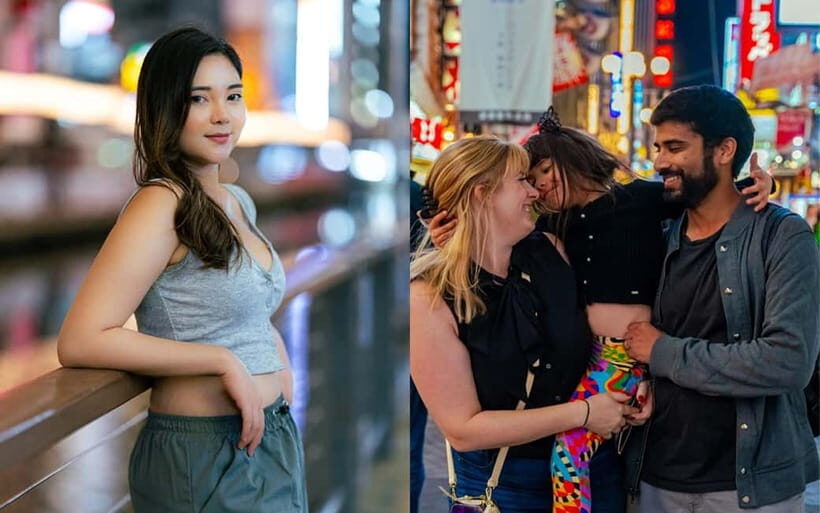
You’ll meet at 大阪市消防局中央消防署道頓堀出張所. From there, the shoot is built around walking through the Dotonbori district and nearby lanes. The duration can range from 90 minutes to 4 hours, depending on what you book and what you want from the experience.
A typical flow is: you’ll visit about 5 iconic locations within roughly 1.5 hours, and you’ll get extra flexibility if your group wants a slower pace or a specific vibe. The key word here is adjustable. If you want more neon-sign energy, your photographer can bias toward the main street scenes. If you want darker, moodier alley shots, you’ll likely spend more time on lantern-lit and side-street compositions.
You also get a break built into the session for re-centering and regrouping. That sounds small, but it helps a lot at night because posing can get tiring. When people are cold, rushed, or out of breath, photos start looking stiff. A planned break makes it easier to keep your energy up.
Finally, your shoot ends at a street-food spot, which is a smart way to close the night. You don’t leave with your stomach empty and your battery dead.
Ebisu-bashi Bridge and the Glico Sign: the two “start here” anchors
If you come to Osaka and don’t photograph the Dotonbori glow, you’ll spend the rest of the trip wondering what you missed. This shoot starts by putting you where the action and the visuals already line up.
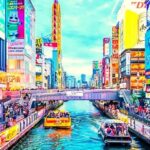
Ebisu-bashi Bridge is often the heart of the district. It’s a natural framing point with high visibility and lots happening in the background. For nighttime photos, that matters. You want depth, reflections, and layered signage. A bridge area gives you all of that.
Then you move into the universe around the Glico Sign. This is Osaka’s most famous neon billboard look, and it’s a reliable landmark for creating that instant-photo memory. What your photographer adds is the hard part: choosing where you stand and how you angle your body so the sign reads clearly without turning the photo into a bright blur.
Here’s what you can expect in practice:
- You’ll likely get multiple takes at the same zone from slightly different angles.
- You’ll be guided on posture and hand placement, not just told to smile.
- You’ll get help timing shots when the background is right, not just when you’re ready.
This is one place where solo travelers benefit. If you try to do Glico Sign shots alone, you usually end up with awkward tripod struggles or faces cut off. Here, you can focus on getting the shot to look like you planned it.
Dotonbori street and the neon-to-alley mood shift
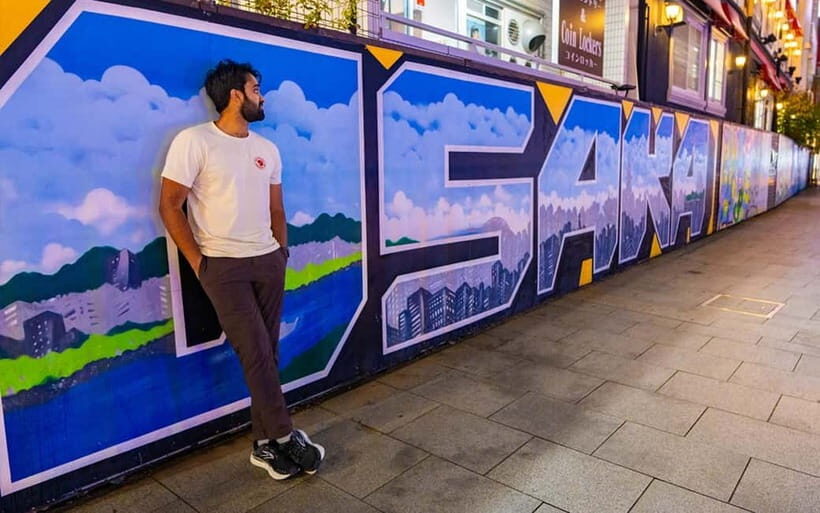
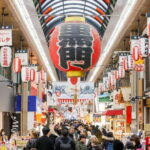
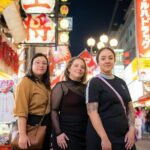
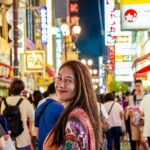
After the main anchors, the route keeps moving through Dotombori street energy—lots of signage, storefront lights, and people. This part is where you get the “I’m actually here” feeling that you can’t recreate later from memory.
Night street photos are tricky because they mix harsh light with shadow. Your photographer’s job is to help you work with that. Instead of you fighting overexposure or dark faces, you’re set up for lighting that holds your features while keeping the background lively.
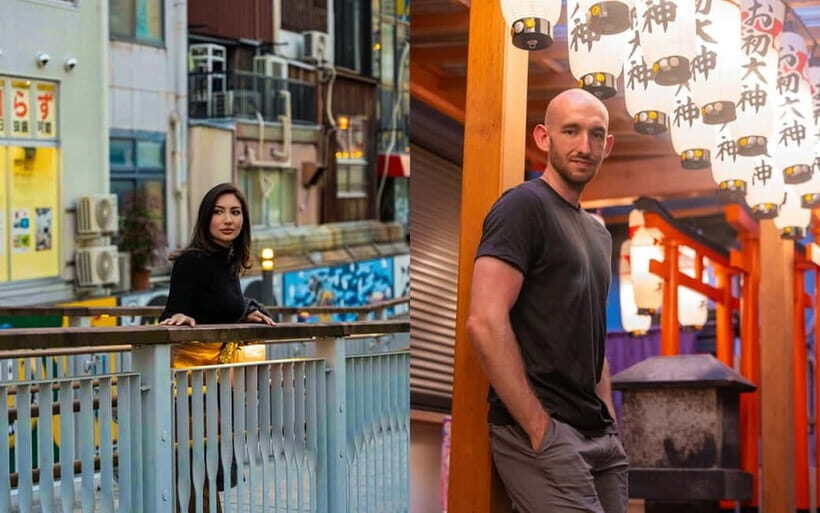
Then comes the mood shift that I think makes this shoot feel like a real Osaka night: you’ll get time at Hozenji Yokocho (often written as Houzenji Yokocho). This is a narrower, lantern-lit alley experience. It’s a different world from the big neon signage scenes.
Why that matters for your photo set:
- Neon scenes tend to look high-energy and graphic.
- Lantern alley scenes look softer and more atmospheric.
- Combining both gives your gallery variety, which makes the whole story more believable.
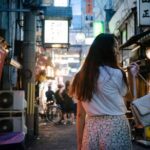
Also, this kind of lane is where posing looks more natural. You’re not always doing the “stand in front of the sign” move. Instead, you can do more casual walking, turning, and close framing.
America mura and the side-street energy you might miss
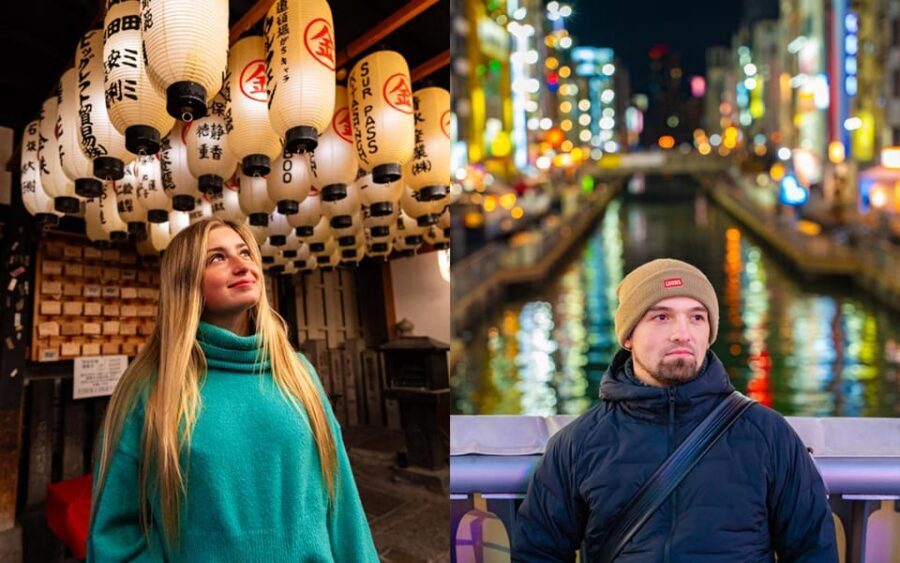
Dotonbori is famous. America mura is the kind of nearby area that feels like a different Osaka mode—more street-culture, more trend, more texture. It’s an easy addition to a night shoot because it’s close enough for walking but different enough to stop your photos from repeating themselves.
In a shoot like this, America mura works best when you’re open to street-style compositions:
- photos that feel like you’re exploring
- frames with street texture and signage
- angles that show the district’s vibe rather than only a landmark
You’ll also get some personal selection of smaller cozy streets in the broader area. That part is especially valuable because Dotonbori has famous corners, but the quiet lanes between them often look better in photographs. Your photographer can choose spots that match your desired mood and how your group wants to look in the photos.
One small caution: side streets can mean more walking, and nighttime weariness is real. If you’re the type who gets tired fast, go for the lower end of the time range and tell your photographer you want maximum photo impact with minimum rushing.
You can also read our reviews of more photography tours in Osaka
Posing, patience, and the photo counts that matter
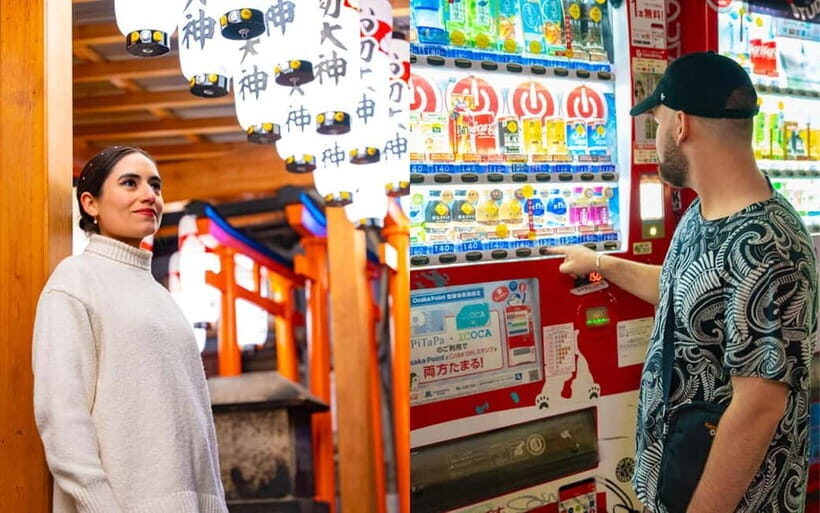
The quality of a street photoshoot depends on two things: where you stand and what you do with your body. This experience leans hard into both.
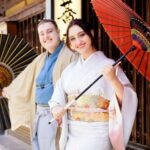
Across the feedback I saw, photographers like Mina and Josh are praised for being friendly and supportive, then turning that into solid posing direction. That combination matters. If you feel awkward, you’ll move stiffly. If you feel comfortable, you’ll naturally find poses that look real, not forced.
What you’ll get photo-wise:
- All photoshoot images: about 200 per hour in standard-quality JPG format
- Edited photos: 30 professionally edited high-quality JPG photographs
- Edited delivery target: within 24 hours, though busy seasons can cause delays
- Download window: photos are downloadable for 2 weeks after the link is sent
The photo volume is a big deal for value. You’re not limited to a small number of “maybe good” images. You’ll likely end up with multiple winners across different angles and facial expressions.
Also, you have the option to upgrade. Raw files aren’t included, but you can get them for an extra ¥10,000 per booking. If you’re editing seriously or printing large, that upgrade might be worth asking about before you start.
How much is $109 worth for a private shoot?
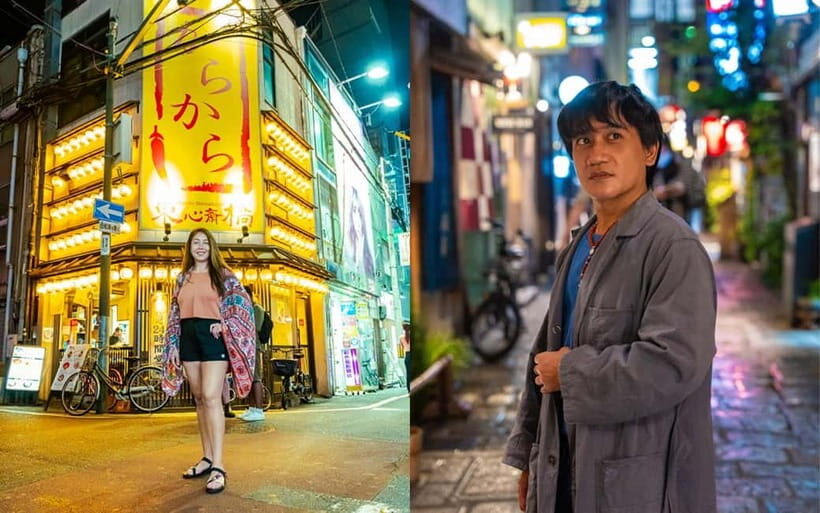
$109 can sound like a lot until you break it down in a realistic way. This is a private night walk, not a group tour. That matters because the photographer can:
- adjust the pace for you
- focus on your compositions
- give you posing help without waiting for others
- move quickly between setups without repeating the same shots
You also get a lot of output: roughly 200 standard images per hour plus 30 edited. If you’ve ever tried taking your own night photos in a place like Dotonbori, you know how quickly results fall apart due to motion blur, bad lighting, and missed moments.
One more value point: the shoot ends at a street-food area, so you get an easy “what next” built into the plan. It’s small, but it keeps the experience from feeling like only work.
That said, your total value depends on group size and the time you book. The listed price is $109 per group up to 1. If you’re traveling as a couple, family, or group, confirm the exact pricing for your headcount before you lock it in. Private photoshoots can scale differently depending on how the provider counts people.
Who should book this Dotonbori night photoshoot
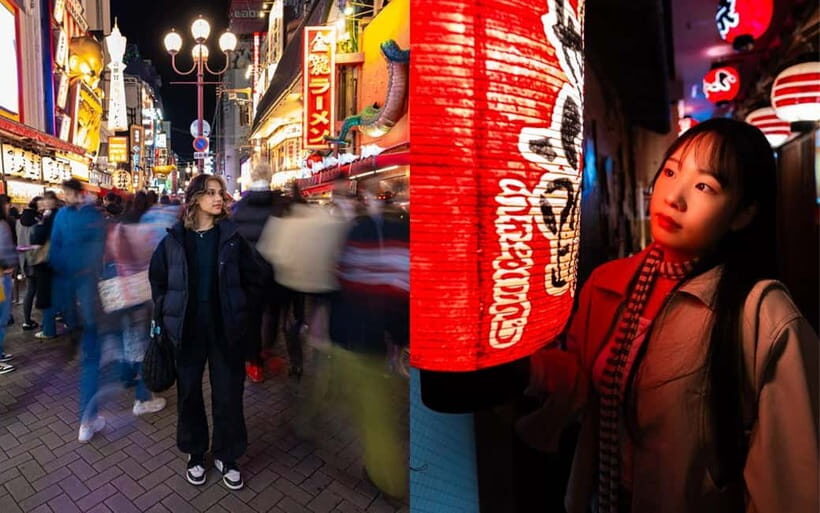
This is a strong fit if you want your Osaka photos to look intentional. It’s especially good for:
- Solo travelers who don’t want selfie chaos
- Couples who want directed couple shots in a real street setting
- Families who need patience and structure (so everyone’s in the frame)
- People short on time who want multiple key looks in one night
It’s also a solid choice if you’re the type who likes walking and doesn’t mind a bit of night movement. This is an active experience, not a sit-down photo session.
From an inclusivity standpoint, the experience is wheelchair accessible, and guides are available in English, Arabic, Japanese, and Spanish. If language comfort is important to you for posing and communication, that’s a big plus.
Should you book it, or skip it?
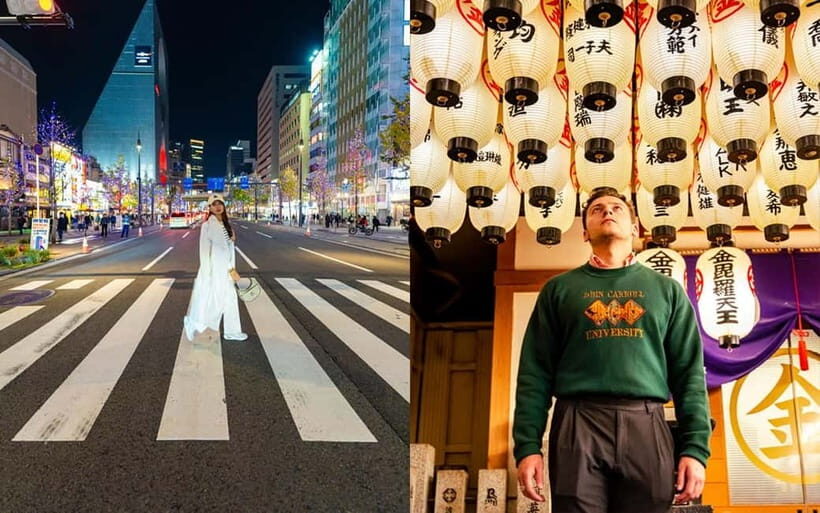
Book it if you want photos that actually capture Osaka street life without spending your whole night fighting settings and timing. The mix of Glico Sign, Ebisu-bashi Bridge, Hozenji Yokocho, America mura, plus lesser-known lanes gives you variety that you can’t easily recreate alone.
Skip it only if you’re extremely budget-sensitive and you’re happy relying on your own phone skills. Also consider shorter booking time if you get tired easily, because night streets are active and walking adds up.
If you do book, I’d send your photographer your preferred vibe ahead of time. The experience is flexible, and that personalization is where your gallery will feel most like your Osaka story.
FAQ
FAQ
How long is the Osaka Dotonbori private night photoshoot?
It runs from 90 minutes to 4 hours, depending on availability and the time slot you choose.
Where does the photoshoot start?
The listed starting location is 大阪市消防局中央消防署道頓堀出張所.
What famous spots will we visit in Dotonbori?
Common stops include Glico Sign, Dotombori street, Ebisu-bashi Bridge, Hozenji Yokocho, and America mura, plus additional smaller streets nearby chosen to match your vibe.
How many photos do I receive?
You get all photoshoot images in standard-quality JPG (about 200 per hour), plus 30 professionally edited high-quality JPG photos.
When will I receive the edited photos?
The plan is to deliver edited photos within 24 hours, though delays can happen during busy seasons.
How long can I download the photos?
The photos are downloadable for 2 weeks after you receive the link. After that, they’re deleted.
Are raw files included?
No. Raw files are available for an additional ¥10,000 per booking.
What languages are available for the guide?
The photoshoot offers a live guide in English, Arabic, Japanese, and Spanish.
Is the experience private and wheelchair accessible?
Yes, it’s a private group experience, and it is wheelchair accessible.
Can I cancel and get a refund?
Yes. You can cancel up to 24 hours in advance for a full refund.