REVIEW · TOKYO
Experience the Sumo World in Tokyo
Book on Viator →Operated by Omotenashi-Japan · Bookable on Viator
Sumo is one thing; sumo training is another. This half-day tour gives you exclusive access to a real training stable and the kind of hands-on cultural experience you usually can’t plan on your own. I especially like that the meal is part of the package, with chanko nabe lunch (including vegetarian options if you request in advance).
The best part for me is the sequence: you watch, you learn, then you get to participate. You’ll sit close during practice, take photos at the end, and even try a playful “push” challenge against the rikishi. The one trade-off to keep in mind is the early start—plan for the 7:45am meet and a separate JR train cost that isn’t included in the tour price.
- Asahiyama-beya practice access: you’re not just watching from afar
- Up-close viewing from chairs: clear sightlines without craning
- Try-your-strength moment: you can attempt to push the wrestlers and get photos afterward
- Chanko nabe included: full meal time, not a snack stop
- Group capped at 26: smaller-feeling experience for Japan
- Meet at Ueno Station: easy launch point for Tokyo public transit
If your Japan trip includes even a little interest in sport, tradition, or discipline, this tour hits the sweet spot. You’re not treated like a distant spectator. You’re guided into the rhythm of a working training day—morning practice, stable culture, then food with the athletes.
The stable you’ll visit is 朝日山部屋 (Asahiyama-beya), and that matters. Different stables have different personalities and teaching styles, so the experience feels specific, not generic. From the moment you arrive, it’s about seeing sumo as daily life: training routines, physical focus, and the quiet intensity that sits behind the dramatic match-day energy.
And yes, there’s a fun side. The tour includes time at the end where you can try sumo firsthand and get photos. It’s not a gimmick; it’s a controlled, playful moment that helps you understand how strong these athletes are—while giving you a story to tell for the rest of your trip.
The day begins at Ueno Station, meeting at 7:45am at the specified address (7 Chome-1 Ueno, Taito City). Ueno is a solid choice because it’s transit-friendly. If you’ve already been using trains around Tokyo, you’ll find this part straightforward.
The schedule is tight enough that you’ll want to treat it like a tournament start time. Show up early, not because you’ll be rushed by the tour, but because morning trains and station navigation can still surprise you. Also note: the tour runs about 4 hours, so everything is designed to stay moving.
One practical bonus: you’ll have a mobile ticket, so you’re not hunting for paper confirmations in the chaos of your Tokyo morning.
You don’t just hop straight to the stable. You’ll travel by JR train with your guide through:
- Matsudo Station (about 19 minutes by train)
- Kunugiyama Station (about 15 minutes by train)
Why does this matter? Two reasons.
First, it frames sumo training as real life outside the tourist bubble. The stable isn’t a photo backdrop in the middle of the city—it’s part of the rhythm of the area and the athletes’ routine. Second, the commute gives you time to settle in. Your guide uses that travel time to explain sumo history and culture and, in many cases, set you up with helpful terms before you get to the ring area.
Also keep your budget in mind: round trip JR train cost is about ¥1060 (roughly $7) and is not included in the tour price. It’s not a deal-breaker, but it’s a cost you should plan for so you’re not doing mental math mid-trip.
Once you reach the stable, you get the part most people can’t easily replicate: a front-row view of training.
You’ll be comfortably seated on chairs with an up-close sumo training view. That detail is key. Standing for long stretches is tiring, especially early in the morning. Sitting means you can focus on what’s happening—footwork patterns, timing, and the way wrestlers move through drills.
The tour is built around a sense of “watch closely, then ask questions.” Your guide explains what you’re seeing as practice goes on, helping you connect the motions to the larger world of sumo culture and rules. This is also where you’ll notice the contrast between the size you expect and the control you actually see.
At the end of the session, photography is allowed. That gives you a clean moment to capture the setting and the wrestlers without the scramble that can happen in other attractions.
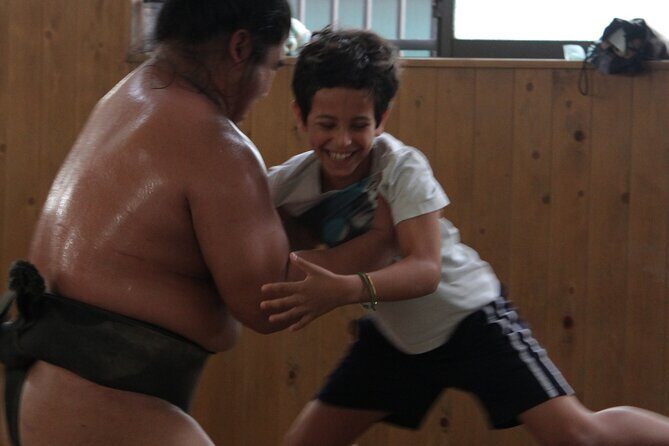
Here’s the piece that turns the tour into a memory, not just a viewing experience: you get to try sumo wrestling firsthand against the wrestlers.
This is typically described as a playful challenge—your chance to step in and push while the rikishi respond in a safe, controlled way. People often realize two things very quickly:
1) the athletes’ balance is ridiculous, and
2) sumo isn’t just strength—it’s positioning and timing.
That’s why this part works even if you’re not a die-hard sumo fan. It turns “I watched” into “I understand what it takes,” even if you don’t actually win (and trust me, you probably won’t). The joy is in the attempt and the friendly interaction.
Then comes the photos at the end. It’s usually a more relaxed setup because practice has already wrapped, and the stable can shift into a welcoming mode.
After training, you share a meal that’s closely tied to sumo life: chanko nabe.
This is traditionally designed to help wrestlers stay fueled for heavy training. In a practical sense, it’s also the kind of meal that makes sense after morning practice: warm, filling, and easy to eat at a comfortable pace while you chat with your guide.
Vegetarian diners can request a vegetarian lunch—but the important detail is timing. Vegetarian service requires notice at least 3 days in advance. If you’re traveling with dietary needs, make the request early so the kitchen has time to plan.
One more real-world benefit: lunch makes the tour feel complete. You’re not left figuring out where to eat after a long morning.
The guides make the experience feel personal and human. Names you’ll see connected with this tour include Ryoko, Haru, Tomer, and Tammy.
What I like about this style is that the guide work isn’t limited to a script. People get help navigating the day, and the best guides also share context in plain language—sumo terms on the train, what stable life looks like, and how to interpret the routines you’re watching.
In particular, multiple guides are credited with friendly, attentive service and the ability to answer questions after the training ends. That’s a big deal for first-timers. If you’re new to sumo, you’ll appreciate having a translator/teacher who can connect what you’re seeing to why it matters.
At $105.71 per person, this isn’t a cheap “add-on.” But it also isn’t just paying for tickets and a seat. You’re paying for access, timing, and structure.
Here’s the value math that makes sense:
- Practice viewing in a real training stable (not a staged performance)
- Hands-on interaction, including a push attempt and photos
- Lunch included, with vegetarian option if requested 3+ days ahead
- Guided context on history, culture, and what you’re observing
- Small group size (maximum 26 travelers), which usually keeps the experience from feeling like mass tourism
Then remember the one extra cost: JR train fare about ¥1060 round trip (roughly $7). If you’re comparing total costs to other “cultural tours,” this remains strong value because lunch and stable-time are built in.
Is it worth it? If you care about authentic access and want more than a surface-level sumo lesson, I’d say yes. If you only want a tournament-style spectacle, you might prefer a match day instead.
This is best for:
- Sumo fans who want more than what you see in a stadium
- Sports-and-culture travelers who like practical, face-to-face experiences
- Families: the training setting is fascinating for kids, and the activity component helps keep energy up
- First-timers to sumo who need explanations and context before they get overwhelmed by details
It’s also a good fit if you like morning plans. You’ll get the day going early, then you’ll likely have energy left to explore Tokyo afterward.
Plan around the early start, and keep your comms ready. There’s evidence that communication may shift to WhatsApp on the day of the tour, so if you don’t use it, you may want to make sure you’re checking messages another way.
Also, be ready for minor schedule changes due to weather, transportation, or stable scheduling. This is normal for real-world operations, especially with outdoor/early-morning timing.
Finally, bring your energy for interaction. The push attempt and photo moment are part of the fun—show up with a playful mindset.
Book it if you want real training access, guided explanation, and an experience that goes past the usual sumo photo-op. The combination of Asahiyama-beya practice, included chanko nabe lunch, and the push-and-photo finale makes it feel like a full morning event, not a quick stop.
Skip it only if early mornings and train transfers stress you out, or if you’re strictly budget-focused and don’t want additional JR costs.
If you’re the kind of traveler who likes seeing how traditions work on ordinary days, this is a very strong choice.
In This Review
FAQ
Where do I meet for the tour?
You meet at Ueno Station, located at 7 Chome-1 Ueno, Taito City, Tokyo 110-0005, Japan, with the start time at 7:45am.
You can also read our reviews of more tours and experiences in Tokyo.



What time does the tour start and how long is it?
The tour starts at 7:45am and runs for about 4 hours (approx.).
Is lunch included, and can I request vegetarian?
Yes, lunch is included. Vegetarian lunch is available if you notify the operator at least 3 days in advance.
What happens at the sumo stable?
You’ll watch the wrestlers training from comfortable chairs, and photography is allowed at the end. You also get a chance to try sumo wrestling firsthand against the wrestlers.
Are train tickets included in the price?
No. The tour price does not include the round trip JR train fare, which is listed as ¥1060 (about $7).





How big is the group?
This activity has a maximum group size of 26 travelers.
Do I need any special ticket format?
You’ll receive a mobile ticket, so you’ll be using your phone rather than paper tickets.