REVIEW · OSAKA
Kyoto One Day Sightseeing Tour from Osaka or Kyoto
Book on Viator →Operated by F Trip · Bookable on Viator
Kyoto can feel like a whole trip by itself. This one-day tour gives you the hits—Nijo Castle, Fushimi Inari, Arashiyama, and Kinkaku-ji—without you wrangling trains all day.
I like that it’s structured enough to keep you moving, yet it still gives real time at the big visual moments. You also get an air-conditioned ride and a guide, and you may even hear standout commentary from guides named Theodore Chan or Jay, based on past guests.
One thing to weigh: it’s an ambitious day. If you want slow, deep museum-style time, the pacing can feel hectic, and one past guest noted the experience didn’t feel fully guided at every step.
In This Review
- Key Things I’d Note Before You Go
- A Day That Starts in Osaka or Kyoto and Stays Focused
- Nijo Castle and Ninomaru Goten: What You Actually See
- Fushimi Inari’s Senbon Torii Walk: How to Walk It Smart
- Arashiyama Bamboo Forest and the Short Stops That Add Up
- Kinkaku-ji Golden Pavilion: The Best Way to End the Day
- Price, Tickets, and Group Pacing on a 45-Guest Tour
- Guide Quality and What to Watch For
- Who Should Book This Tour (and Who Might Prefer DIY)
- Should You Book This One-Day Kyoto Tour From Osaka or Kyoto?
- FAQ
- How long is the Kyoto one-day sightseeing tour?
- What’s included in the $65.00 per person price?
- Are tickets included for Nijo Castle and Kinkaku-ji?
- Is lunch included?
- Are there any stops with free admission?
- Do I receive a mobile ticket?
- What’s the maximum group size?
- What if I’m traveling with a stroller or large luggage?
- When can I cancel for a full refund?
Key Things I’d Note Before You Go
- A full Kyoto highlights circuit with eight major stops in about nine hours
- Free admission for several sights, including Senbon Torii and multiple Arashiyama photo stops
- Paid entry for the big-ticket temples, with clear costs for Nijo Castle and Kinkaku-ji
- Air-conditioned bus + guide support, capped at 45 travelers
- Arashiyama time is split between bamboo forest and several short, photo-friendly stops
- Guide quality can vary, so show up ready to follow along and ask questions
A Day That Starts in Osaka or Kyoto and Stays Focused
This tour is built for one goal: help you see famous Kyoto landmarks in a single day, whether you’re starting from Osaka or Kyoto. Expect a long, guided touring day that uses a comfortable, air-conditioned vehicle to connect the dots.
What makes this plan smart is that it strings together places you’d otherwise need to piece together with multiple train and bus routes. You’re not just “going to Kyoto.” You’re doing a tight loop of power (Nijo), pilgrimage (Fushimi Inari), nature-and-icons (Arashiyama), then ending with one of Japan’s most photographed temples (Kinkaku-ji).
Another practical plus: it’s a smallish group for a bus day trip, with a maximum of 45 people. That size usually means you aren’t stuck shoulder-to-shoulder for every stop, and you’re more likely to keep track of your group when you hop on and off.
A few more Osaka tours and experiences worth a look
Nijo Castle and Ninomaru Goten: What You Actually See
Your first major stop is Nijo-jo Castle, built in 1603 as the Kyoto residence of Tokugawa Ieyasu, the first shogun of the Edo Period. This matters because you’re not looking at a castle for the postcard view only—you’re seeing palace-style feudal architecture designed for rule, ceremony, and status.
The centerpiece to plan for is the Ninomaru Goten Palace area, since the ticket listed for this tour is 1,300 yen for Nijo Castle & Ninomaru Goten Palace. If you’re only going to pay for one paid attraction on this tour, this is likely the one that feels most “Kyoto-history specific.”
Time is about 1 hour, so here’s how I’d use that hour:
- Walk the rooms and corridors first without overthinking. You’ll get the layout fast.
- Then slow down for the details that separate castles from regular buildings: formal lines, gate approaches, and palace-style structure.
- If your guide is speaking, listen early. You often learn the little context that makes the place click—like why the castle functioned as a shogun residence, not just a fort.
Practical consideration: since the ticket is extra, make sure you budget that into your total day. Also, weather matters in Kyoto—if it’s rainy, plan to move between indoor and outdoor areas quickly without losing your place.
Fushimi Inari’s Senbon Torii Walk: How to Walk It Smart
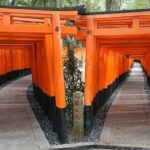
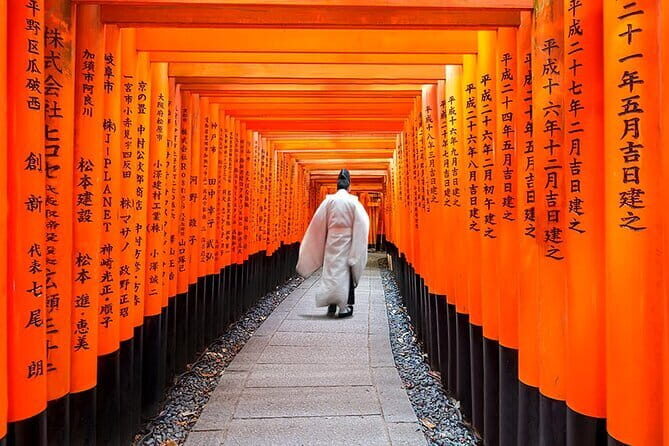
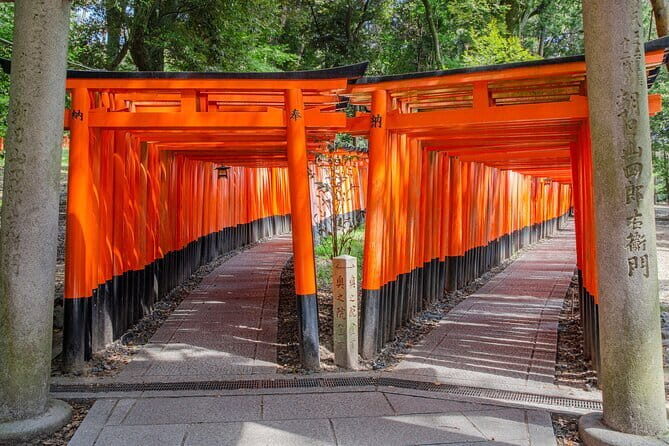
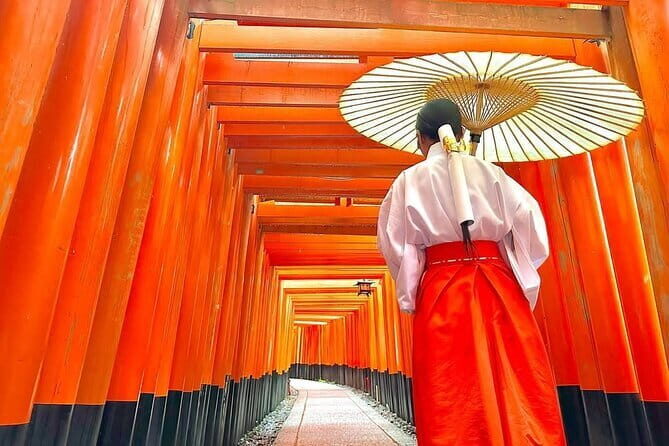
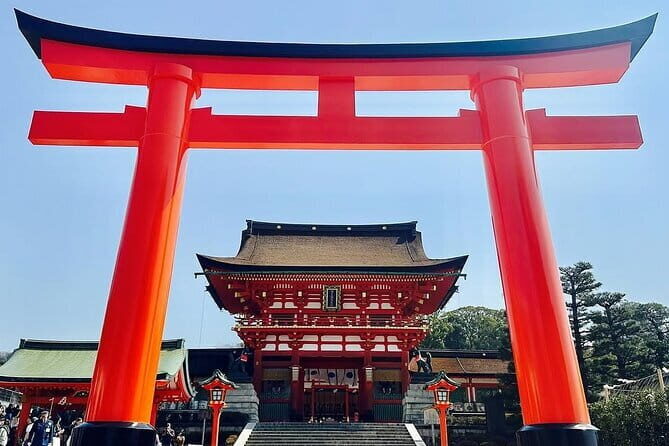
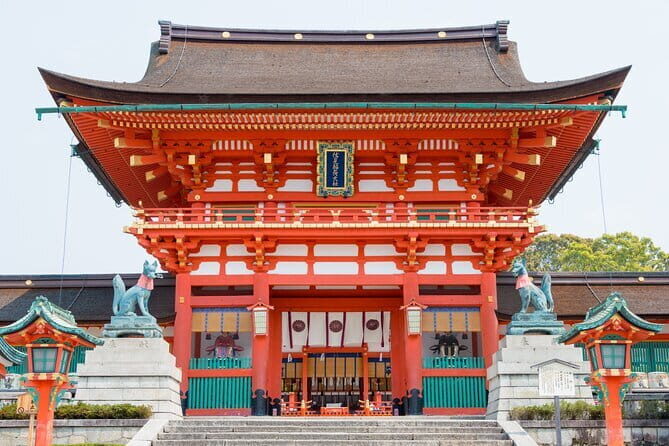
Next comes one of Kyoto’s most distinctive sights: Fushimi Inari Taisha and its famous Senbon Torii—thousands of red torii gates. This tour gives about 1 hour 10 minutes here, and I think that time is the difference between a quick photo sprint and a real experience.
Those torii gates exist because Inari is tied to worship of the Shinto god of rice, Inari, and the site is known for its sea of vermilion gates—often described as close to 30,000 Inari shrines across Japan, with Fushimi Inari as the head shrine. Standing at the entrance, you can feel how the ritual world turns into a walking world.
How to get the best experience with limited time:
- Start by looking for the rhythm: gate after gate, each one framing a slightly different view.
- Decide what you want: the most classic entrance shots or the deeper path feeling. With this time window, you can do a partial walk and still feel like you went “into” it.
- Use footwear you don’t hate. That route can add up.
Good to know: the torii-gate stop is listed as free admission. That keeps the day’s cost down and lets your money go toward the places with ticketed entry.
Arashiyama Bamboo Forest and the Short Stops That Add Up
After Fushimi Inari, the tour shifts west to Arashiyama, a Kyoto district known for scenic beauty plus a cluster of places you can string together without losing your day to travel. The tour plan gives you multiple short stops here, which is ideal if you want variety more than one long, single-purpose visit.
You get a quick jump into the area (about 20 minutes), then a dedicated 40 minutes at the Arashiyama Bamboo Forest. Even if you’ve seen photos before, walking through bamboo that tall still hits differently. It’s quieter than you expect, and the walk gives you that classic Kyoto “soundtrack” feeling—footsteps, wind through stalks, and that cool light under the plants.
Then you continue with smaller but interesting, very photo-friendly stops:
- Nonomiya Shrine (about 20 minutes), including its distinctive black torii gate design.
- Arashiyama Kimono Forest (about 20 minutes), built from 600 clear acrylic cylinders with kimono fabric patterns.
- Togetsukyo Bridge (about 20 minutes). This is the iconic bridge over the Katsura River area, with a reconstruction history tied to the 1930s.
Here’s the tradeoff: Arashiyama works best when you wander longer. This tour doesn’t give you endless wandering time, so you’ll want to treat these stops like “high-signal moments.” Look, take photos, and absorb what each place is for—shrine identity, bamboo atmosphere, fashion-art installation, then the bridge perspective.
Also worth noting: Arashiyama’s attraction list can be tourist-heavy in general. With a guide and set timing, you’ll usually avoid the worst guesswork. Still, if you’re the type who hates crowds, go with the mindset that this is a highlights run, not a quiet nature retreat.
Kinkaku-ji Golden Pavilion: The Best Way to End the Day
The day ends with Kinkaku-ji, the Golden Pavilion—a Zen Buddhist temple and UNESCO World Heritage site. In the real world, it’s one of those places where the look matches the reputation, and the contrast between ornate surfaces and calm gardens gives it emotional pull.
Your allotted time here is about 40 minutes, and the temple entry ticket is listed as 500 yen. For me, this is exactly the kind of paid stop that helps justify the whole tour: you’re paying a relatively small amount for a globally famous Kyoto landmark, and the experience is fast enough to fit a long day without breaking the schedule.
If you want Kinkaku-ji to feel like more than a photo:
- Arrive with patience for the crowd flow.
- Spend a few minutes just taking in the garden framing, not only the golden building.
- Use the guide’s timing to avoid getting stuck in the most chaotic angles.
This is a great finish because it gives you a clean visual memory. Even if you feel tired from the earlier torii-gate walking and bamboo forest strolling, the pavilion tends to re-focus your attention.





Price, Tickets, and Group Pacing on a 45-Guest Tour
The advertised price is $65.00 per person for a tour of about 9 hours with an air-conditioned vehicle and a guide, using a mobile ticket. For many people coming from Osaka, that kind of all-in transport and guided timing can be a good deal—especially when you don’t want to build your own route.
But here’s the part you should budget: major entries are not included.
- Nijo Castle & Ninomaru Goten Palace: 1,300 yen
- Kinkaku-ji: 500 yen
Lunch is also not included.
So your “true cost” depends on how you handle food and those admissions. Still, when I think about value, I weigh this tour’s strength: it compresses multiple headline sights into one day without you guessing trains, bus transfers, or timing between areas.
Pacing is the main make-or-break element. With multiple stops—some with around 20 minutes—you’ll be moving often. The comfort bus helps a lot. The bigger question is how you handle rapid transitions between locations.
One small detail I found reassuring from past feedback: a few guests praised guides for being organized and keeping things running smoothly. One person even mentioned receiving a spreadsheet with bus seat numbers in advance. That’s not about sightseeing romance—it’s about reducing stress, and that matters on a packed day.
Guide Quality and What to Watch For
A guided day can be gold—when the guide is active and you learn something new each stop. And this tour can deliver that. Names that came up in past feedback include Theodore Chan and Jay, and multiple reviews pointed to professional, friendly, and organized guidance.
At the same time, one past guest said the experience felt mostly unguided at times. That’s a real consideration for you. It doesn’t mean the tour is bad; it means your best results may depend on how you engage:
- Ask questions when you have them, especially on the paid entry stops.
- If your guide gives context, listen at the start of each stop. The payoff usually comes quickly.
- Use bathroom and snack moments wisely. When you’re in a group schedule, small delays can snowball.
If you’re a solo traveler, you might prefer more freedom. If you’re traveling with friends or want someone to herd the timeline, the guide role becomes more valuable.
Who Should Book This Tour (and Who Might Prefer DIY)
This tour fits best if you:
- Want the big-name Kyoto sights in one day
- Prefer guided logistics over figuring out public transport between Kyoto neighborhoods
- Like a structured “see it all” day more than a slow wander
It’s also a reasonable choice if you’re short on time after arriving in Japan and don’t want to waste your Kyoto day chasing directions.
You might consider DIY instead if you:
- Want long, unhurried time at fewer sites
- Get grumpy when a day includes multiple quick stops
- Know you strongly prefer learning through deep onsite explanations rather than quick context
Also, if you’re traveling with stroller or large luggage, the info asks you to indicate it when booking. That’s the kind of heads-up that can make the difference between an easy day and a day where you feel like you’re constantly adapting.
Should You Book This One-Day Kyoto Tour From Osaka or Kyoto?
Yes—if your goal is “Kyoto highlights, efficiently,” this tour is a strong match. I like that it combines headline sights (Nijo-jo Castle, Fushimi Inari torii gates, Arashiyama bamboo, Kinkaku-ji) into one plan that’s hard to replicate cleanly without extra planning.
Book with clear expectations: it’s a packed day with multiple short stops, plus two ticketed attractions. If you go in ready to move, take photos, and learn a little at each place, you’ll leave with a very complete Kyoto snapshot.
FAQ
How long is the Kyoto one-day sightseeing tour?
The tour is about 9 hours.
What’s included in the $65.00 per person price?
The price includes an air-conditioned vehicle and a guide.
Are tickets included for Nijo Castle and Kinkaku-ji?
No. The tour lists extra tickets for Nijo Castle & Ninomaru Goten Palace (1,300 yen) and Kinkaku-ji Temple (500 yen).
Is lunch included?
No, lunch is not included.
Are there any stops with free admission?
Yes. The stops for Senbon Torii (Fushimi Inari) and several Arashiyama sights (including the bamboo forest area and specific shrines/bridge/photo stops) are listed as free in the tour details.
Do I receive a mobile ticket?
Yes. The tour uses a mobile ticket.
What’s the maximum group size?
The tour has a maximum of 45 travelers.
What if I’m traveling with a stroller or large luggage?
You’re asked to indicate during booking if you’re traveling with a stroller or large luggage.
When can I cancel for a full refund?
You can cancel for a full refund up to 24 hours in advance of the experience’s start time.