REVIEW · KYOTO
Kyoto: Tea Ceremony with Maiko Premium
Book on GetYourGuide →Operated by B.B.Advisors Inc. AN KYOTO · Bookable on GetYourGuide
A Maiko tea ceremony moves fast and feels intimate. You make matcha with a Maiko, then get a rare, up-close look at her world through direct questions and a photo moment you won’t forget.
I especially love the hands-on matcha step, where you learn, then make your own cup; and I love the chance to take a close photo beside the Maiko, plus the lucky charm she hands out. One thing to keep in mind: the setting isn’t a traditional tatami ochaya house—it’s in a building with tables and stools, and there’s no elevator (stairs only).
In This Review
- Key highlights worth your time
- Kyoto Maiko Premium Tea Ceremony: what makes it feel different
- Finding the venue near Gojo Station and what the building feels like
- The 90-minute flow: greeting, matcha making, sweets, and Q&A
- What the Senjyafuda charm and photo moment really mean
- The two dances: how to watch so you actually get something from them
- Interactive games with your Maiko: why this part matters
- Premium value: what you’re really paying for at about $50 per person
- Who should book this and who might want to skip it
- Practical tips to make the most of your visit
- Should you book the Kyoto Maiko Premium tea ceremony?
- FAQ
- How long is the Kyoto Maiko Premium tea ceremony?
- What is the price per person?
- Where do I meet for the experience?
- What happens during the program?
- Do I make matcha, or just watch?
- Will I definitely see a Maiko?
- Is the venue a traditional tea house?
- Are snacks and drinks included?
- What about children under 2 years old?
- What is the cancellation policy?
Key highlights worth your time
- Hands-on matcha you make yourself with Maiko guidance, not just a demonstration
- Direct Q&A so you can ask about training, daily life, and what the kimono routines mean
- Close photo opportunity right beside your performer, plus a Senjyafuda lucky charm
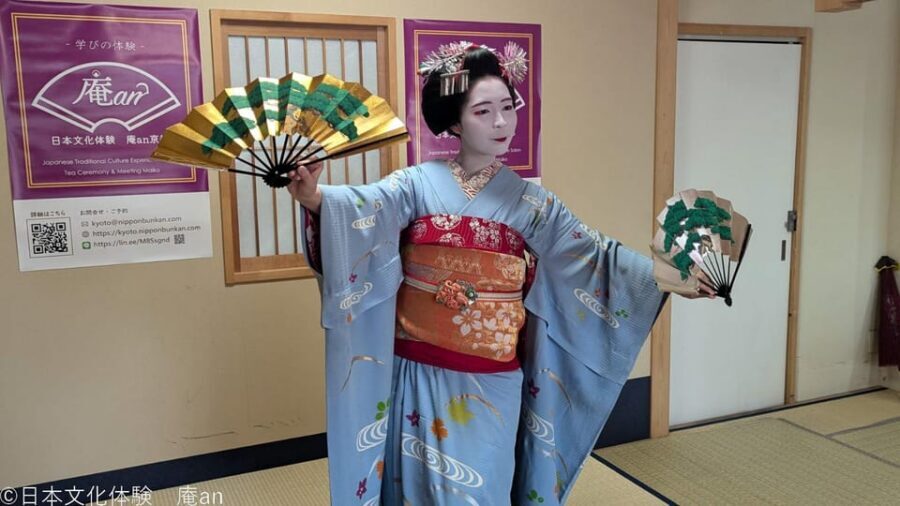
- Two traditional dance performances that cover seasons, love stories, and everyday life
- Interactive game time where the mood turns playful and you can cheer along
Kyoto Maiko Premium Tea Ceremony: what makes it feel different
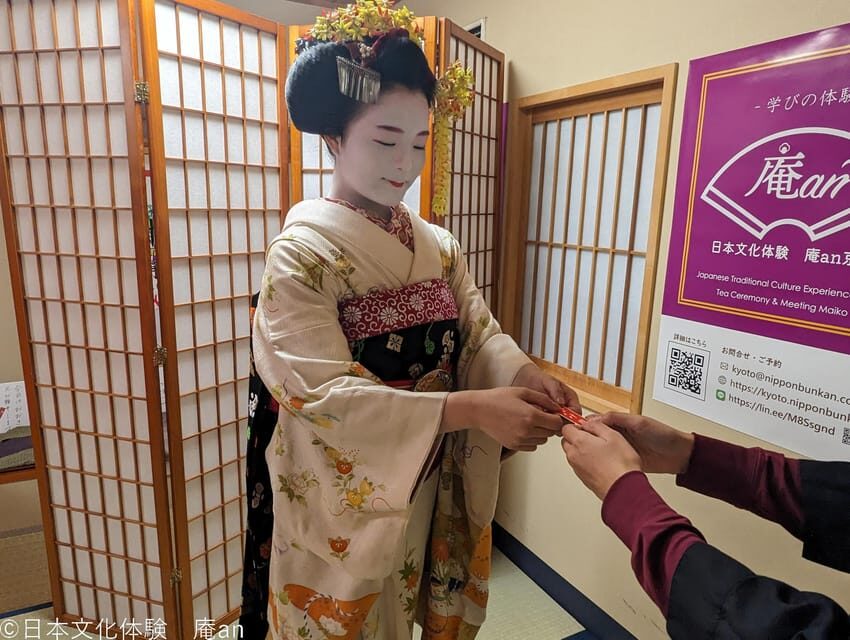
Kyoto has a million ways to see tradition. This one is different because it doesn’t stop at a show. You spend your time with a Maiko—learning tea basics while her presence turns the experience into a living moment, not a museum clip.
The core idea is simple: Maiko training is built on discipline, etiquette, and performance. Tea ceremony, dance, and conversation all connect to that same foundation. You end up understanding not only what you’re seeing, but why it’s done that way—down to the pace, the gestures, and the tone of voice.
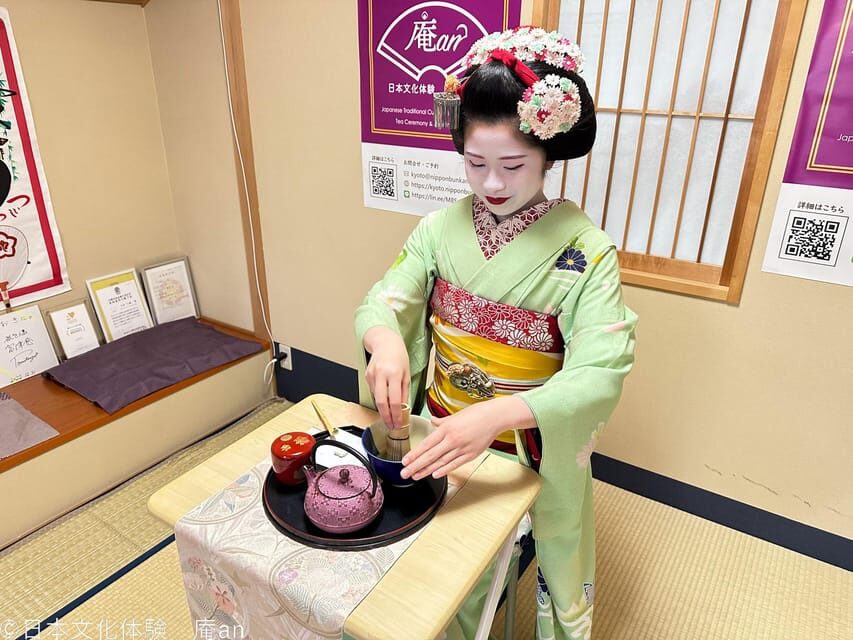
And yes, the matcha is real. Not the watered-down tourist version. You learn how to make it and then do it yourself, with the Maiko leading you through the steps.
You can also read our reviews of more tours and experiences in Kyoto.


Finding the venue near Gojo Station and what the building feels like
Your meeting point is convenient: about a 1-minute walk from Exit 1 of the Karasuma Line Gojo Station. The store entrance faces Gojo-dori, so you’re not wandering around hunting for a side alley.
Now the honest part: this isn’t an ochaya-style house, and it’s not set up like a classic tatami tea room. The venue is in a building and the experience uses a more straightforward room layout with tables and stools. That’s one reason people often describe it as friendly and relaxed rather than formal.
Two practical impacts of that:
- Photo backgrounds may look busy. Some people have had trouble getting clean-looking photos because signage is visible behind the stage/photo area. If you care about pictures, frame tightly and shoot from angles that keep the background tidy.
- Plan for stairs. There’s no elevator, so you’ll be going up flights to reach the room.
The good news: you don’t need special preparation. No formal clothing, no special tea tools from home, no stress. Just show up on time and be ready to participate.
The 90-minute flow: greeting, matcha making, sweets, and Q&A
The program is designed like a short evening class plus a mini performance—everything connected, nothing dragged out.
Here’s the usual rhythm:
- Greeting from the Maiko
- Tea ceremony with Maiko: you get matcha preparation guidance and two dried-type Japanese sweets
- Q&A session
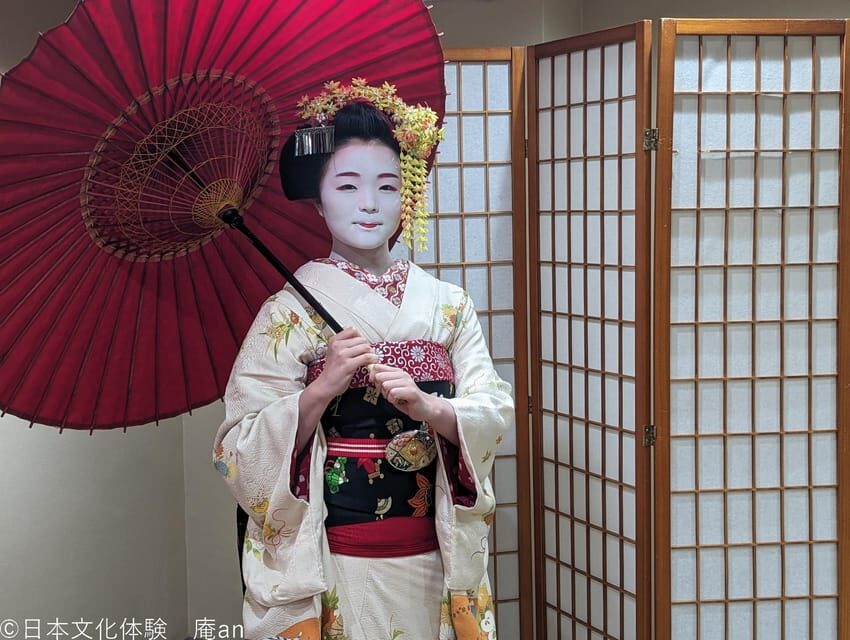
- Photo with the Maiko right beside her
- Senjyafuda lucky charm presentation (a nice souvenir with meaning)
- Dance performance (two dances)
- Interactive game with the Maiko
- Chatting time before the Maiko leaves the room
One of the best parts is the Q&A. You’re not stuck watching from a distance—you can ask questions directly. That’s where the experience shifts from cultural “content” into personal understanding.
Based on what you’ll likely hear, expect topics like:
- what it takes to train (and how long it can take)
- why kimono and hairstyles matter so much
- how daily routines shape performance
- what being a Maiko is like, beyond the costumes
Language-wise, English translation is provided as much as possible. If you want extra help, the operator mentions you can contact them to request it.
And then there’s the matcha moment. You don’t just watch someone whisk. You get guided and then make your own tea. That’s a big deal because tea ceremony is all about attention—grip, rhythm, and focus. When you do it, even at a basic level, you pick up the tone of the tradition.
What the Senjyafuda charm and photo moment really mean
The photo opportunity isn’t a random picture-taking stop. It’s built into the emotional arc of the program: you learn, you talk, you participate—and then you’re invited into the close-up moment.
Right after the photo, the Maiko presents you with Senjyafuda, described as a lucky charm. That turns your souvenir from a product into a personal interaction. It’s small, but it adds weight to the whole experience.
Quick photo advice from the realities of the room:
- Use your phone camera in landscape mode to keep the framing clean.
- Try to keep the performer centered and the background minimal, since signage can show up.
- If you’re traveling with family, decide in advance who goes first—moving smoothly makes the moment feel smoother for everyone.
Also, if you see a Geiko instead of a Maiko on your day, that can happen depending on the situation. Some sessions are known to include a Geiko dance and expanded activities, and the experience is still presented as the full premium program.
The two dances: how to watch so you actually get something from them
The dance segment isn’t just there to fill time. It’s the cultural language of the evening—movement as storytelling.
You’ll watch two traditional dances, described as covering:
- beauty of Japan’s seasons
- love stories
- everyday life
If you tend to think you need deep background knowledge to enjoy Japanese performing arts, this is a good place to start. The performances are designed to be approachable within a short program. Even if you don’t know every symbol in the choreography, you can still “read” the basics: the slow precision, the controlled transitions, and the way the body communicates emotion.
And because you’ve already spoken with the performer and made matcha, you’re not starting cold. You’ll be more likely to notice how dance and etiquette share the same discipline.
If the room feels a bit more modern than you expected, treat the dances as the anchor. The stage setup may be practical, but the choreography still delivers the core beauty of the tradition.



Interactive games with your Maiko: why this part matters
The final act isn’t only performance—it becomes participation.
After the dances, there’s an interactive game with the Maiko. The operator notes volunteers may join, but simply watching can still be fun. Either way, you get a sense of hospitality and how these performances can include audience connection without turning into chaos.
This game segment often does two things well:
- It breaks the tension that can build in formal-sounding cultural experiences.
- It gives you a shared laugh with strangers, which is rare on a “cultural education” ticket.
If you’re traveling as a couple, it’s a way to avoid feeling like you’re just taking a class. If you’re traveling with kids, it’s often the part that makes the adults relax too.
You’ll still want to follow cues. These are professionals, and the whole point is to keep the flow respectful.
Premium value: what you’re really paying for at about $50 per person
Let’s talk value, not just price.
At around $50 per person, you’re buying a package that combines:
- a guided tea ceremony where you make your own matcha
- sweets included with the tea experience
- a direct Q&A with a Maiko (or sometimes a Geiko)
- a close photo moment
- a Senjyafuda lucky charm
- two dance performances
- an interactive game
- free snacks and a free drink during the event
Many “tea experiences” online stop at watching tea steps done once, then hand you a cup. Here, the center is interaction: making the tea, asking questions, and getting the photo close-up.
One more value detail: seat tiers can matter. The listing information includes add-on seating options—SS first row (3,300 JPY), S2 second row (2,200 JPY), and S3 third row (1,100 JPY). If you care about seeing the expressions and gestures clearly (especially during dances and for photo angles), paying for a better row can be worth it.
And remember: the setting is not a traditional tatami house. That doesn’t make it worse, but it does mean the premium value is more about the performer interaction than about architectural authenticity.
Who should book this and who might want to skip it
This works best for:
- people who want more than a tea class—specifically conversation + photos + dance
- families who want an experience that feels structured but not stiff
- couples who want a Kyoto memory that’s interactive, not just scenic
- solo travelers who like asking questions and learning from a real performer
It may be less ideal if:
- you’re chasing a perfectly traditional room setup (tatami-only, tea-house-only vibe)
- you’re very photo-sensitive and want zero background distractions
- you dislike group-format cultural activities, since it’s still organized as a program with others in the room
Practical tips to make the most of your visit
A few small moves can change your experience a lot:
- Arrive early. A tip that comes up: arriving about 15 minutes early can help you catch the Maiko arriving by taxi before entering.
- Bring good questions. The Q&A is where you get personal value. Ask about training length, daily routines, or what specific kimono details mean.
- Plan your participation mindset. The game is interactive. If you’re nervous, it’s okay to volunteer only if you feel comfortable.
- For photos, think framing. Because signage can appear in the background, shoot with tighter composition to keep the image clean.
- Build in a buffer. The event says they won’t hold it for delays, so arrive with time to spare and avoid rushing through the last minute.
Also note the schedule is listed as 10:00 to 17:00 operation hours. Reservations after 17:00 are processed the next day. If you’re planning around dinner, pick a time that won’t make you sprint from another Kyoto stop.
Should you book the Kyoto Maiko Premium tea ceremony?
Yes, I think it’s a strong booking if you want a Kyoto experience that combines matcha-making, direct Q&A, close photo time, and dance—within a short 90-minute window. The “premium” value is the full package, not just tea skills.
Book it if you’re excited by the idea of learning from a performer you can speak to, and if you like interactive cultural events. Skip it only if your priority is a perfectly traditional ochaya atmosphere and you’re unwilling to accept a building-room setting, stairs, and the chance of busy photo backgrounds.
If you want a Kyoto memory that feels personal instead of passive, this is the kind of program worth making room for.
FAQ
How long is the Kyoto Maiko Premium tea ceremony?
The experience lasts 90 minutes.
What is the price per person?
The price is $50 per person.
Where do I meet for the experience?
You meet about 1 minute walk from Exit 1 of Subway Karasuma Line Gojo Station. The store entrance faces Gojo-dori.
What happens during the program?
You start with a greeting, then a tea ceremony with the Maiko (including matcha and two dried-type Japanese sweets), followed by a Q&A, a close photo opportunity, and a lucky charm presentation. After that, there are two dance performances and an interactive game, with chatting time at the end.
Do I make matcha, or just watch?
You will make matcha tea yourself after the Maiko explains how to do it.
Will I definitely see a Maiko?
Depending on the situation, they may invite a Geiko instead of a Maiko.
Is the venue a traditional tea house?
No. The venue is located in a building and is described as a relaxed atmosphere rather than a traditional ochaya. There’s no elevator, and you use stairs.
Are snacks and drinks included?
Yes. Free snacks and a drink are included.
What about children under 2 years old?
Children under 2 years old are free of charge if they sit on a parent’s lap. If a seat or meal is required, the same fee as 1 person will be charged.
What is the cancellation policy?
You can cancel up to 8 days in advance for a full refund. A cancellation fee may apply if you cancel later, and travel expenses to the venue are not compensated.