REVIEW · OSAKA
Osaka Traditional Performing Arts Heritage Night
Book on GetYourGuide →Operated by Yamamoto Noh Theater · Bookable on GetYourGuide
Lasting memories can fit into a short night. Osaka Traditional Performing Arts Heritage Night strings together major forms like Noh and Rakugo in a tight 2-hour format that’s friendly for beginners. I especially like the way the show gives hands-on audience participation, not just passive watching, and the on-screen support that keeps non-Japanese speakers on track. The one thing to consider is that it’s not a quiet show for kids under 7, and there’s no filming inside.
This is run by Yamamoto Noh Theater, in the kind of setting where you can really see how performance tradition works up close. I love that you’ll get a guided tour through multiple Osaka-area traditions, including humor-heavy acts like Kyogen and story-driven forms like Rakugo, all with multilingual explanations. The drawback: with so many short segments, you’ll want to arrive ready to pay attention from the start, because each art has its own rhythm and style.
In This Review
- Key things to look for before you go
- A 2-hour “try the classics” format that actually makes sense
- What you’ll see: Noh, Kyogen, Bunraku, Rakugo, and more named arts
- The Noh stage moment: why the white-sock invite is worth it
- How the English support and subtitles keep you from getting lost
- Price and value: is $32 worth it for this many arts?
- Who should book Osaka Traditional Performing Arts Heritage Night
- Should you book it?
- FAQ
- How long is the Osaka Traditional Performing Arts Heritage Night?
- What traditional performing arts are included?
- Is it suitable for children?
- Are photos or videos allowed during the show?
- Do you get English support?
- Is the venue wheelchair accessible?
Key things to look for before you go
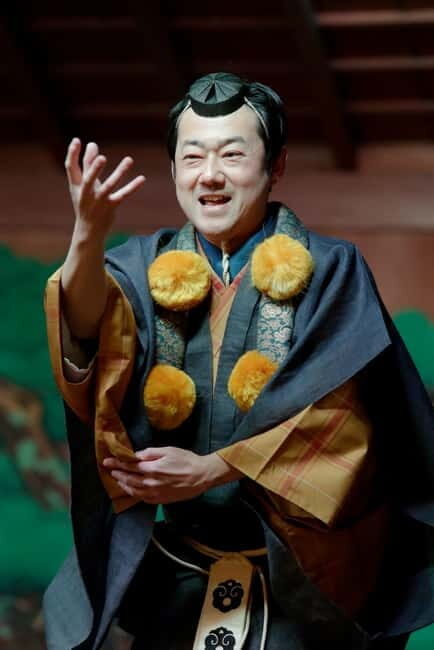
- A packed 2-hour omnibus: multiple arts in one night, so you don’t need to hunt down separate shows
- Hands-on Noh stage moment: a couple of audience members in white socks get invited up
- Real explanations, not just subtitles: guidance before smaller performances to help you follow what you’re seeing
- A full Osaka mix: Noh, Kyogen, Bunraku, Rakugo, and other named forms beyond the usual two
- No photos or video inside: you’ll watch with your eyes, like the culture intends
A 2-hour “try the classics” format that actually makes sense
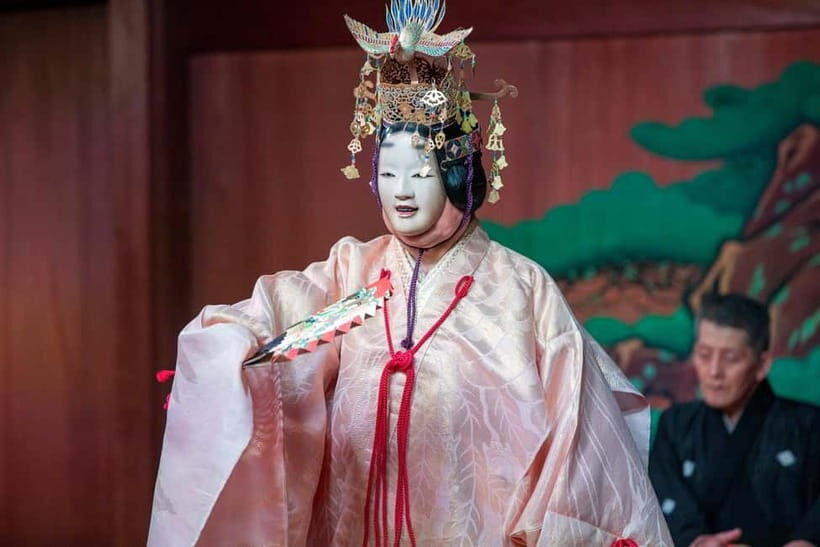
Osaka Traditional Performing Arts Heritage Night is built like a sampler plate, but it’s not random. The whole point is that you get several traditional performing arts in one sitting, so you can understand how they differ in mood, pace, and purpose without spending a whole day jumping between venues.
In practical terms, the 2-hour duration matters. Long cultural shows can feel like a lecture marathon, especially if you’re not fluent in Japanese. Here, you’re getting a sequence of shorter segments, each introduced with multilingual explanations and subtitles/materials. That structure helps you stay oriented, instead of hoping you’ll pick up meaning on the fly.
The other thing I like is that the night isn’t only “spectacle.” There are hands-on experiences with some of the performing arts, and that changes how you remember the evening. When you try something simple—movement, rhythm, or a role in the stage process—you start understanding why tradition is taught through repetition and form, not just storytelling.
One note on expectations: this is performance-focused, not a museum walkthrough. If you’re the type who needs constant historical context before you can enjoy art, the show does provide explanations, but it still moves at performance speed. You’ll have the best time if you settle in and watch, even when one style feels unfamiliar at first.
You can also read our reviews of more historical tours in Osaka
What you’ll see: Noh, Kyogen, Bunraku, Rakugo, and more named arts
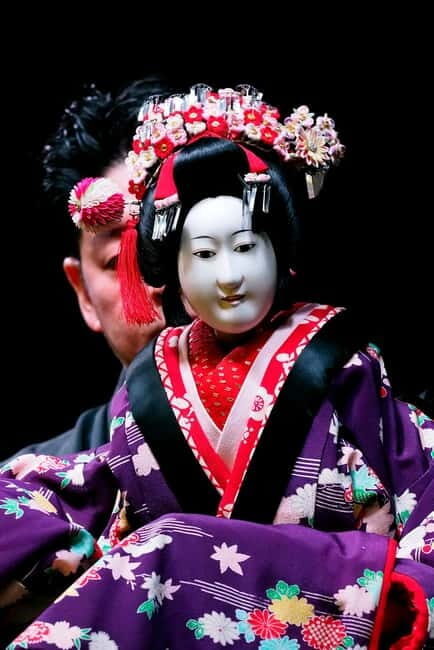
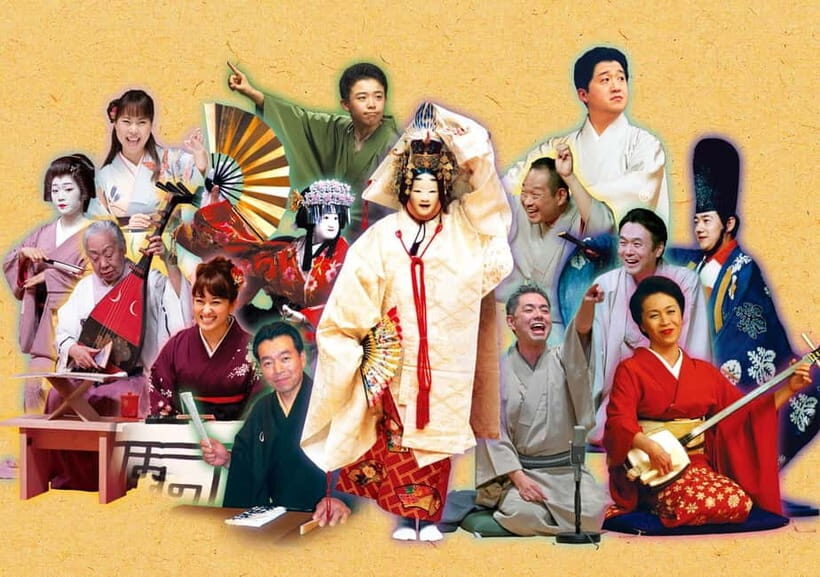
This night gives you a long list of arts by name, which is great because it lets you mentally place what you’re watching. Even better, each one has a different “job” in Japanese tradition.
Here’s what’s on the program:
- Noh: slow, stylized drama with strong use of gesture and atmosphere
- Kyogen: the lighter, comedic counterpart that often sharpens your sense of timing and contrast
- Bunraku: traditional puppet theater tied to narration and music (even if you’re new to puppetry, the performance energy is clear)
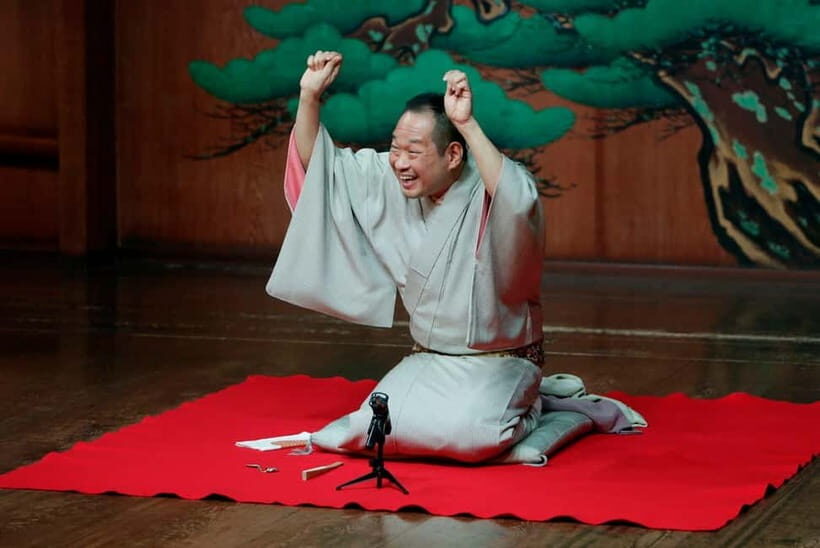
- Rakugo: seated storytelling, usually with a single performer using voice and physical shifts to create multiple scenes
- Rokyoku and Kodan: narrative performance styles that lean on recitation and vocal technique
- Kamigata Mai: a dance style associated with the Kansai/Osaka region
- Gagaku: classical court music and performance traditions
- Onna Doraku: another named performing art included in the lineup
- Chikuzen Biwa: a performance featuring the biwa (a traditional lute), where the music carries emotion and plot
The value in getting all of these together is contrast. Noh and Kyogen show how tradition can be both formal and funny. Rakugo teaches how meaning can come from voice alone. Bunraku reminds you that storytelling doesn’t always mean acting with your face—you can tell it with structure, puppetry, and narration working as one unit.
And because the show provides multilingual explanations and subtitles/materials, you’re not stuck guessing. You can pay attention to the elements that make each form distinct: pacing, vocal style, musical backing, stage presence, and the relationship between performers and audience.
If you’re shopping for one night that gives you a real sampling of Japanese traditional performance—especially with an Osaka-friendly angle—this lineup does that job.
The Noh stage moment: why the white-sock invite is worth it
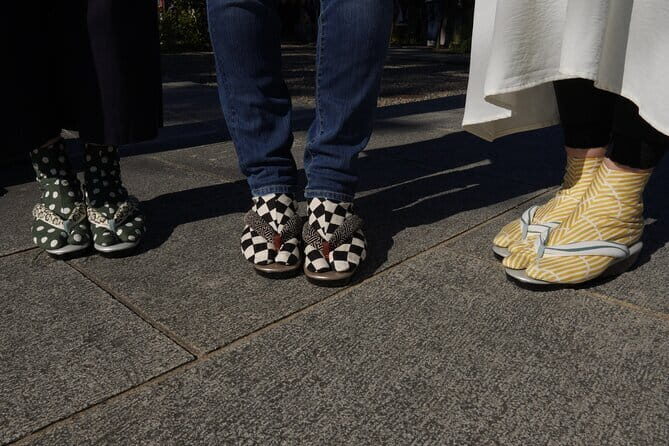
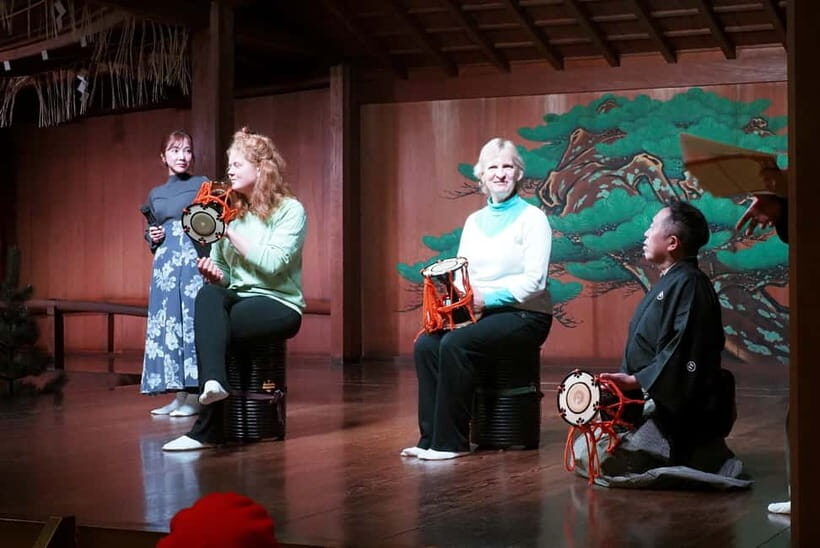
One of the most memorable parts is also the most straightforward: a couple of audience members wear white socks and are invited up to the Noh stage to experience the Osaka traditional performing arts.
That kind of participation isn’t just a gimmick. Noh is famously formal, and a big part of what makes it work is precision—movement that looks simple only after you understand how controlled it has to be. When the show brings audience members on stage, you get a quick, guided taste of how attention and posture matter. Even if you don’t perform like a trained artist, you can feel the difference between casual motion and stage-ready form.
This is also one of the reasons the show is effective for beginners and foreigners. Watching Noh from the audience seat can feel distant because the style is so stylized. But a hands-on moment helps you connect to the logic of the performance. You start to understand why performers train their bodies and voices in a specific way.
What to expect in terms of behavior: you’ll be asked to follow stage instructions during the experience portion. That means listening carefully, staying relaxed, and doing what you’re told. The show also includes multilingual support, so you’re not likely to be totally lost about what’s happening, even if your Japanese is basic.
There’s also a subtle cultural benefit. By participating, you’re treating the performance with respect rather than just consuming it. That makes the whole show feel less like entertainment and more like shared cultural practice—without turning serious or stuffy.
How the English support and subtitles keep you from getting lost
If you’ve ever tried to watch a traditional performance in Japan without support, you know the fear: Will I understand anything, or will I just watch costumes and hope for the best?
This show addresses that directly. You get:
- multilingual explanations
- subtitles
- materials
That means you can track what the performance is doing, why it’s structured a certain way, and what to notice in the acting, pacing, and narration. Importantly, the show doesn’t just translate in one place. It’s designed so explanations appear around the segments, so the context arrives before confusion does.
In practice, this matters for your enjoyment in two ways. First, it helps you follow the transitions between very different art forms. Going from Noh to Kyogen to Rakugo can feel like switching channels—unless you know what each segment is aiming to do. Second, it keeps you from relying purely on entertainment instincts. You can enjoy it as art, but you also learn as you watch.
You’ll also likely appreciate that the explanations make the smaller performances less intimidating. When a show gives you a short setup before a segment, you stop treating each art like an unbreakable mystery box. Instead, each segment becomes a mini lesson you can experience through your eyes and ears.
One more practical detail: photography and video recording inside are not allowed. That’s not a negative—just a reminder. Go in ready to watch closely and take in the atmosphere in real time.
Price and value: is $32 worth it for this many arts?
At about $32 per person for a 2-hour program, this is priced like a cultural event—not like a private lesson, and not like a single-genre show where you’d have to pay again for every art form you want to try.
The value comes from three things you don’t often get together:
- Multiple named performing arts in one sitting
- Hands-on audience participation (not just a lecture)
- Multilingual explanations and subtitles/materials, which are part of what makes the show usable for non-Japanese speakers
If you tried to assemble the same experience on your own, you’d spend money and time separately for different performances, and you might still run into the language barrier. Here, the support is built in. That’s what turns the price into a good deal for many visitors: you’re not paying only for “access to performers,” you’re paying for an experience designed so you can actually understand what you’re seeing.
That said, it’s still a show with multiple short segments, so your enjoyment depends on attention span and curiosity. If you want one deep performance with long stretches of the same style, this may feel brisk. But if you want one night where you can sample a broad Osaka/Gansai-adjacent tradition set and leave with clear favorites, it’s a strong use of your time.
You can also read our reviews of more evening experiences in Osaka





Who should book Osaka Traditional Performing Arts Heritage Night
This works best if you fit one of these profiles:
- You’re new to Japanese traditional performing arts and want a guided introduction rather than a tough-to-follow deep cut.
- You like variety and enjoy switching gears: comedy (Kyogen), storytelling (Rakugo), music (Gagaku, Chikuzen Biwa), and dance (Kamigata Mai).
- You want something your whole group can enjoy, including teens and adults. The show’s mix of explanation and performance style is built for people who might not share the same background.
It may not be ideal if:
- You’re traveling with children under 7, since it’s not suitable for that age group.
- You’re hoping to record or photograph inside (you can’t).
- You’re looking for a very slow, contemplative show with no quick changes between styles.
I also think it’s a nice “culture bridge” night. If your Osaka trip already has food markets and temples, this gives you a different kind of authentic experience—one tied to technique, voice, and stage discipline. And because the show highlights Osaka traditional performing arts specifically, it feels local rather than generic Japan.
Should you book it?
Book it if you want a 2-hour, beginner-friendly introduction to a wide range of Osaka traditional performing arts, with the support you need to understand the show. The mix of Noh, Kyogen, Bunraku, Rakugo, and named additions like Gagaku and Chikuzen Biwa gives you real contrast, and the hands-on Noh stage moment is the kind of memory that sticks.
Skip it if you need a long single-genre performance, or if you’re bringing a child under 7. Also consider the no-photo rule: if you need to document everything, this may frustrate you.
If you’re on the fence, I’d lean toward booking. For the price, the combination of variety + explanations + participation is exactly the sort of structured cultural night that pays off when you only have a limited amount of time in Osaka.
FAQ
How long is the Osaka Traditional Performing Arts Heritage Night?
The performance lasts 2 hours.
What traditional performing arts are included?
The show includes Noh, Kyogen, Bunraku, Rakugo, Rokyoku, Kodan, Kamigata Mai, Gagaku, Onna Doraku, and Chikuzen Biwa, among other highlights.
Is it suitable for children?
It is not suitable for children under 7 years.
Are photos or videos allowed during the show?
No. Video recording and photography inside are not allowed.
Do you get English support?
Yes. There are multilingual explanations, subtitles, and materials, and the host or greeter is listed as English and Japanese.
Is the venue wheelchair accessible?
Yes, it is wheelchair accessible.