REVIEW · TOKYO
Personal prayer at Meiji Shrine!
Book on Viator →Operated by 明治神宮 古代祈祷ツアー Meiji shrine ancient prayers tour · Bookable on Viator
Two bows, then a wish on paper. At Meiji Jingu, this guided personal prayer experience helps you do Shinto correctly and calmly, not guess your way through an ancient ritual. I especially like the way you get clear direction—from the torii gates to the worship steps—so you feel confident walking in. And I really enjoyed the ceremony’s sensory side: priests, bells, and gagaku court music with a miko dance.
There’s one thing to keep in mind. The prayer portion involves a Japanese form and seated ceremony elements, so it’s not recommended if you have pain in sitting straight. If you’re good with that, this tour is a very direct, meaningful way to experience Meiji Jingu beyond the photo spots.
One more plus: it’s a private group, and you get a mobile ticket. With the guide translating the application process and helping with etiquette, you can focus on what you came for: asking for safety, health, and peace in a tradition that’s still practiced today.
In This Review
- Key things you’ll notice right away
- Why a guided personal Shinto prayer feels different at Meiji Jingu
- The walk from the second torii gate: photos, poems, and correct paths
- Practical tip
- Purification at the fountain: hands, mouth, and a little peace
- Kaguraden: the moment your wishes become part of the ritual
- What you’re really doing
- Watching the ceremony: drum purification, gagaku music, and miko dance
- Leaving with omiki and shinsen: what you take home
- Photo rules and etiquette: how to avoid the usual awkward moments
- Price and value: what $98 covers, and what you still need to pay
- Timing, weather, and how punctual you should be
- Who this private prayer tour is best for
- Should you book this personal prayer at Meiji Jingu?
- FAQ
- How long is the personal prayer tour at Meiji Jingu?
- Where do we meet for the tour?
- Is the shrine admission fee included in the tour price?
- What extra cost should I budget for the personal prayer?
- What do you do during the prayer?
- Is the application form in English?
- Are photos allowed during the ceremony?
- Is this tour suitable if I have trouble sitting straight?
- What happens if the weather is bad or I need to cancel?
Key things you’ll notice right away
- You start under the second torii gate and learn what you’re looking at before you even step deeper in
- Torii and approach etiquette is taught so you don’t accidentally do the wrong ritual behavior
- You cleanse your hands and mouth and follow the standard worship rhythm at the main shrine area
- You write prayer intentions first, then watch the purification and ceremony unfold
- UNESCO gagaku and miko dance are built into the program, not just sightseeing
- You leave with an Ofuda tied to your wishes after the ceremony
Why a guided personal Shinto prayer feels different at Meiji Jingu
Meiji Jingu is one of those Tokyo places that looks simple from the outside. Massive torii gates, forested paths, lots of visitors, big signs. But once you’re inside, Shinto can feel like a closed book if you haven’t seen the basics: where to walk, how to worship, and what different ceremony moments actually mean.
That’s where this experience helps. Your guide slows you down just enough to explain the key movements and etiquette, so you’re not spending the whole time trying to copy what you see. You get the feeling that you’re participating, not just observing.
I also like how the tour doesn’t treat the shrine as a museum. You’re led into the Kaguraden area for a personal prayer process, then you watch ritual elements like purification, gagaku, and a miko dance. It’s a structured route through the parts that matter most for your intentions.
The best part for me is the mindset shift. Instead of saying, I hope my prayers are understood, you’re doing the steps clearly and respectfully, and you know what comes next.
You can also read our reviews of more tours and experiences in Tokyo.



The walk from the second torii gate: photos, poems, and correct paths
The tour meets at the Big Torii area in Shibuya, and the first real action starts under the second torii gate. Before you go further, your guide points out details people often miss—like the torii’s unique features—and they also highlight nearby sake and wine barrel displays. There’s even a waka poem you’ll be shown, which gives you an anchor for the atmosphere.
This first stretch is also your photo warm-up. It’s a good place to get shots without rushing, and your guide will help you find angles that make sense.
Then you move toward the next gates. Along the way, you learn the correct etiquette for approaching and passing through torii gates. This matters more than you’d think. The guide specifically notes that many foreign visitors perform rituals incorrectly, which can come across as disrespectful. Having someone guide you through it helps you avoid the common mistakes and gives you a smoother, calmer walk-in experience.
You’ll also stop to look at waka poems and buildings you pass. You’re encouraged to photograph those locations too, as long as you follow any restrictions the guide points out.
Practical tip
Wear shoes you can walk in. Even though this is a short tour (about 1 hour 30 minutes), you’re moving steadily between ritual points.
Purification at the fountain: hands, mouth, and a little peace
Before you reach the main shrine worship area, you’ll come to the purification fountain. This is one of the most recognizable Shinto practices, but it’s also one of the easiest to do wrong if you’re not sure of the order.
Your guide walks you through cleansing your hands and mouth before proceeding. Then you experience the standard worship rhythm done by the general public: you make an offering (using a coin), followed by the sequence of two bows, two claps, and one final bow.
If you’ve ever wondered what to do with your hands during a temple moment, this is exactly that problem solved. You don’t just watch—you do it with guidance. That’s why it tends to feel grounding rather than awkward.
Photography note: there are areas where photos are not allowed, and your guide will tell you where those are. So keep your camera accessible, but be ready to tuck it away at the right time.
Kaguraden: the moment your wishes become part of the ritual
Once you’re in the Kaguraden area, the experience shifts from sightseeing to participation. This is where the program earns its name as a personal prayer session.
At the entrance, you fill out an application form. On the form, you write your prayer intentions and include your address and name. The guide provides examples of what people commonly pray for, including:
- world peace
- household safety
- travel safety
- recovery from illness
- business success
- finding a good match
- safe childbirth
- academic achievement
Two things I find important here. First, you choose intentions ahead of time in a thoughtful way, not at the last second. Second, even though the forms are available only in Japanese, your guide will help you make sure everything is handled smoothly. Translation is part of what you’re paying for in the tour fee.
Then you submit the form along with the offering fee, which starts from 5,000 yen for personal prayer. This is not included in the tour price, so plan on adding it to your day budget.





What you’re really doing
You’re not just making a wish in your head. You’re writing it in a way the ceremony can acknowledge. For many people, that simple act—putting intentions into words—makes the ritual feel more focused and personal.
Watching the ceremony: drum purification, gagaku music, and miko dance
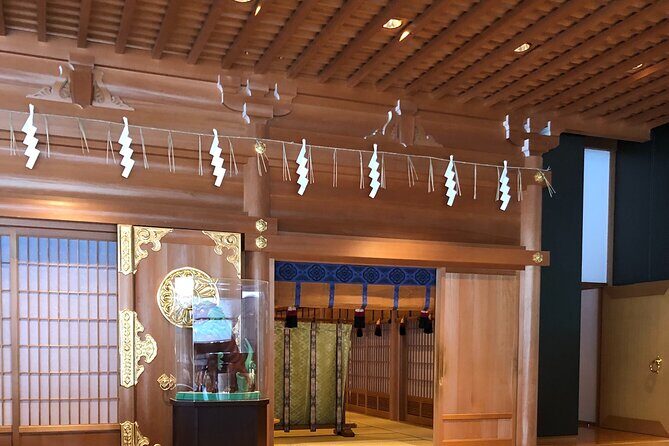
After registration, you’re brought to the altar in the Kagura Hall where the ceremony takes place. This portion is where the tour becomes something you can’t replicate with a few photos.
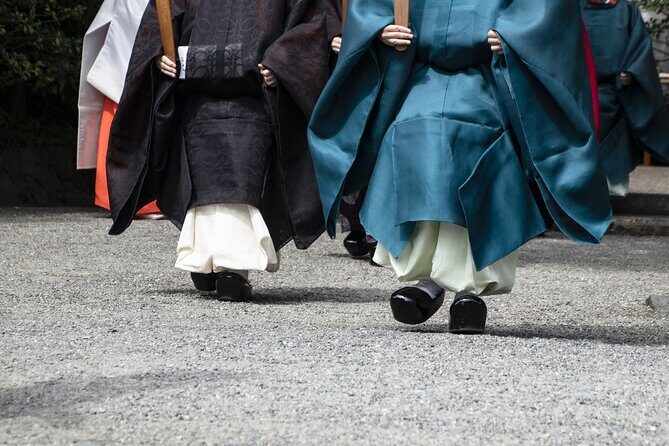
You’ll hear a drum as shrine priests in traditional attire perform purification using sacred tools. This cleansing ritual is designed to bring a sense of peace and fulfillment, and it’s presented in a formal, paced way. You’re not rushed through it; you’re guided through what’s happening so your attention doesn’t scatter.
Then you’ll experience gagaku—traditional court music—performed on ancient instruments and flutes. This tradition is designated as a UNESCO Intangible Cultural Heritage. Seeing it in a shrine setting matters. It’s not a performance separated from context; it’s part of the ritual environment.
After the music, a miko (shrine maiden) dance performance takes place. The costumes and choreography give the ceremony a visual language that sits alongside the sound of bells, drums, and court music. It’s one of those moments where even if you can’t explain every symbol, you can feel the structure and seriousness.
Leaving with omiki and shinsen: what you take home
When the ceremony concludes, the ritual wraps up with sacred offerings and drinking sacred sake. You’ll hear terms like shinsen and omiki, and the experience explains how each fits into the meaning of the prayer.
- Shinsen are offerings presented to the deities during the ceremony, which are later shared with participants. The program notes that it is often in the form of nori (seaweed). You take it home as a souvenir tied to the ritual.
- Omiki is sacred sake offered to the deities, and a portion is shared with participants. At the exit, you receive a small cup, and a shrine maiden pours the sake for you to drink on the spot.
The tour frames the idea plainly: items offered to the deities are believed to carry spiritual power, and consuming those offerings is a way to pray for good health and other blessings.
In practice, what I like about this ending is that it gives you a closing action. You’re not left to wander away unsure what you actually received. You know what you’re taking, and you know why it’s connected.
Photo rules and etiquette: how to avoid the usual awkward moments
Photography at shrines can be a mixed bag. This experience is clear about that: there are specific areas where photography is not allowed, and your guide will direct you accordingly.
For me, that reduces stress. You can keep your camera ready during the more photo-friendly parts—like near the torii gate and buildings your guide points out—and then switch off the camera when you reach restricted zones. It helps you stay in the moment.
Etiquette is the bigger issue than camera settings. The guide teaches correct behavior for torii approach and worship steps, which means you’re not improvising in a place where small actions can carry meaning. If you’ve ever worried about accidentally being disrespectful somewhere sacred, this kind of guidance is a relief.
Price and value: what $98 covers, and what you still need to pay
The listed price is $98.00 per person, for about 1 hour 30 minutes, and it’s a private experience. The tour includes translation-related support (information and application form translation fees).
What it does not include is the shrine personal prayer offering fee, starting from 5,000 yen. It also doesn’t include any amulets or other items you may want to purchase privately.
So is it worth it?
For me, the value comes from three places:
- You get correct ritual guidance. That’s not just convenience; it changes how the experience feels.
- You get access to a structured ceremony setting where gagaku and miko dance are part of the program, not just something you hope to catch by chance.
- You handle the Japanese paperwork with help, which is a real obstacle if you’re traveling with limited language.
If you’re the kind of traveler who likes to understand what you’re doing, not just see a place, this format tends to pay off. If you want only casual wandering and don’t care about etiquette, it might feel more structured than you need.
Timing, weather, and how punctual you should be
This experience requires good weather. If it’s canceled due to poor weather, you’re offered a different date or a full refund. The tour also runs on a schedule, and there’s a strong incentive to arrive on time.
It’s a short program with ritual moments built in, so being late can throw off the flow. If you think you’ll be delayed, handle communication early and assume you’ll need enough time to find the exact meeting point under the correct torii gate.
On timing, there’s another practical detail: the average booking window is about 65 days in advance. That’s a signal that dates can fill up, so book sooner rather than later if your trip has fixed plans.
Who this private prayer tour is best for
This tour fits best if you want a guided, respectful way to experience Shinto at Meiji Jingu, especially if you’re not already familiar with shrine etiquette.
It’s also a good match if you like ritual structure. You write intentions, you see purification steps, you watch gagaku and miko dance, and you leave with sacred items connected to your prayer.
It may not be ideal if you:
- have difficulty with seated ceremony elements (the tour specifically says it’s not recommended if you have pain in sitting straight)
- prefer totally unguided freedom with no formal steps
- get uncomfortable following instructions in a setting where photography may be restricted
Should you book this personal prayer at Meiji Jingu?
If you want Meiji Jingu to feel personal and meaningful—not just iconic—this is a strong choice. The guidance on torii etiquette and worship steps removes a lot of uncertainty, and the ceremony experience (including gagaku and miko dance) gives you more than a casual visit.
I’d say yes especially if you’re the type who likes to participate fully and you value having someone help with the Japanese paperwork. The extra shrine offering fee is the main additional cost, but that’s part of how the personal prayer actually works.
If you’re sensitive to sitting during ceremonies or you prefer to roam freely without a schedule, consider whether the format fits your comfort level.
In short: book it when you want a guided Shinto prayer experience that ends with a tangible, ritual connection to what you asked for.
FAQ
How long is the personal prayer tour at Meiji Jingu?
It runs for about 1 hour 30 minutes (approx.).
Where do we meet for the tour?
You meet near the Big Torii at 1-1 Yoyogikamizonochō, Shibuya, Tokyo 151-8557, Japan, and you’ll start under the second torii gate.
Is the shrine admission fee included in the tour price?
Admission is free for the parts listed in the experience, but the personal prayer offering fee is not included.
What extra cost should I budget for the personal prayer?
You’ll need to pay the shrine offering fee for personal prayer, starting from 5,000 yen. Amulets or other purchases made privately are not included.
What do you do during the prayer?
You write down your wishes, then you participate in a ceremony setting that includes purification, gagaku court music, and miko dance, and you receive an Ofuda afterward.
Is the application form in English?
No. The form is available only in Japanese, but the tour includes help and translation support to complete it.
Are photos allowed during the ceremony?
There are areas where photography is not allowed. Your guide will tell you where photography is restricted.
Is this tour suitable if I have trouble sitting straight?
It is not recommended if you have pain in sitting straight. Most travelers can participate, but this is an important limitation to consider.
What happens if the weather is bad or I need to cancel?
The experience requires good weather. If it’s canceled due to poor weather, you’ll be offered a different date or a full refund. You can cancel for free up to 24 hours in advance for a full refund.