REVIEW · TOKYO
Tokyo Samurai Experience: Kyudo (Archery) and Swordsmanship
Book on GetYourGuide →Operated by BUB Activity Center · Bookable on GetYourGuide
One hour, and you feel like a samurai. In Asakusa, you step into a hakama outfit and learn Kyudo archery in a way that feels very different from Western bow practice. I especially like how the staff make the whole thing easy to follow in English, and I love that you’re not just watching—you’re actually doing the movements.
The only drawback is time: this is a tight 1-hour session, so you’ll build a solid starting feel for Kyudo and katana basics, but you’re not going to walk out as a master. Think of it as a fun, respectful introduction with photo-worthy moments, not a multi-day training camp.
In This Review
- Key Things You’ll Remember From This Samurai Class
- Asakusa’s Heiwa Building: How the Experience Starts
- Hakama Suit-Up: Real Costume, Real Confidence
- The Samurai Mini-Game: Learning With a Playful Mission
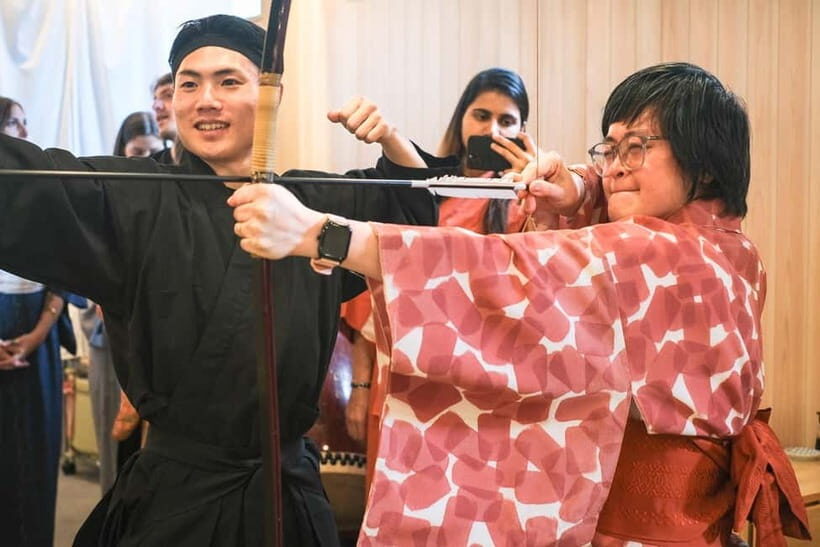
- Kyudo in 60 Minutes: Why This Bow Feels Different
- Katana Basics: The Pose and Grip That Make It Look Real
- Staff Coaching, Photos, and the English That Actually Helps
- Snacks and Small Breaks That Keep the Pace Tourist-Friendly
- Where the $96 Value Really Comes From
- Who Should Book This (and Who Might Want Something Else)
- Practical Tips for a Smoother Session in Asakusa
- Should You Book the Kyudo and Swordsmanship Session?
- FAQ
- Where is the meeting point for this experience?
- How long does the activity last?
- Is prior experience required?
- What’s included in the price?
- Is the instruction available in English?
- What should I wear or bring?
- Can I cancel and get a refund?
- Is this experience family-friendly and wheelchair accessible?
Key Things You’ll Remember From This Samurai Class
- Hakama fitting for different heights and sizes so you can really look the part
- Kyudo training with a traditional Japanese bow, not a Western-style “range day”
- Katana pose and grip practice focused on form for photos and basic handling
- A samurai rank mini-game that teaches the ideas behind samurai life in a playful way
- Bilingual staff support that adapts to your English level
- Snacks and plenty of picture time so you leave with more than memories in your head
Asakusa’s Heiwa Building: How the Experience Starts
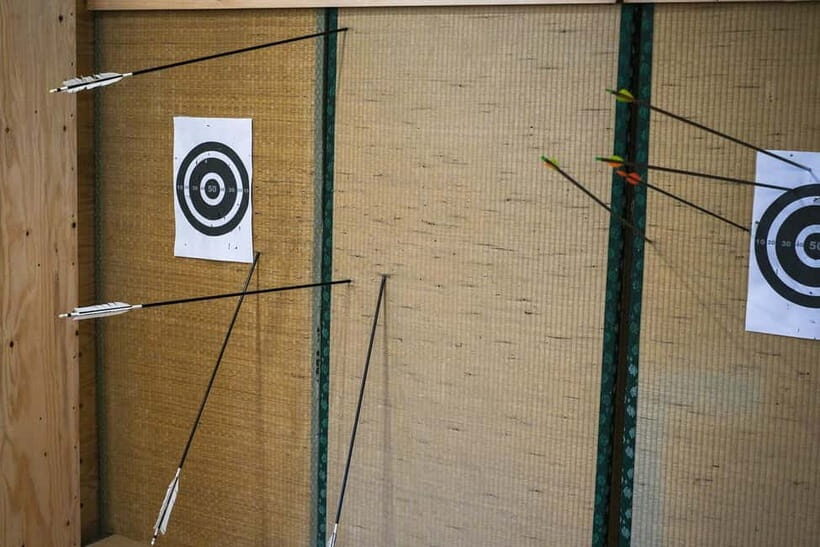
This is one of those Tokyo activities where the meeting point matters, because it’s not on the street like a lot of pop-up shops. You meet in Taito-ku, Asakusa at 2 Chome 6-11, Heiwa Building. Take the elevator up to the 5th floor.
Plan to arrive about 10 minutes early. It helps you get settled, choose comfortable clothes, and handle anything like the final size fitting without rushing. If you’re standing outside looking around, ask for help right away rather than waiting—this place is easy to miss if you’re expecting a street entrance.
Once you’re inside, the vibe turns quickly from tourist mode to role-play mode. That shift is part of the value: you start with a costume that looks real, then you’re coached into the movements.
You can also read our reviews of more tours and experiences in Tokyo.



Hakama Suit-Up: Real Costume, Real Confidence
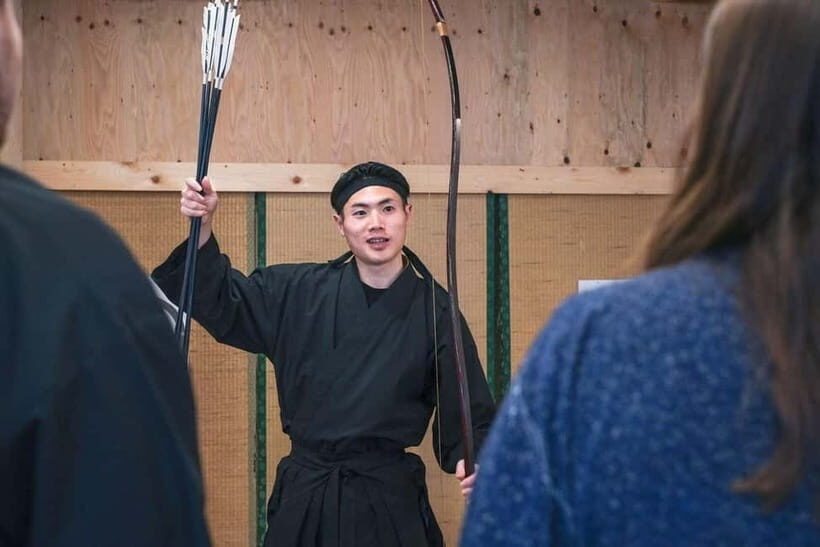
The first big moment is changing into traditional hakama clothing. You’ll find different heights and sizes are available, which matters more than people think. A good fit helps you move better, and it also makes the photos look sharper.
This isn’t just dress-up. The staff guide you through it so you can walk, stand, and hold the bow and sword properly. Even if you’re not used to wearing traditional garments, you’ll get quick, clear help.
I like this portion because it lowers the mental barrier. You don’t have to “perform” right away; the outfit cues your body to stand differently, which sets you up for the bow and sword training that comes next.
The Samurai Mini-Game: Learning With a Playful Mission
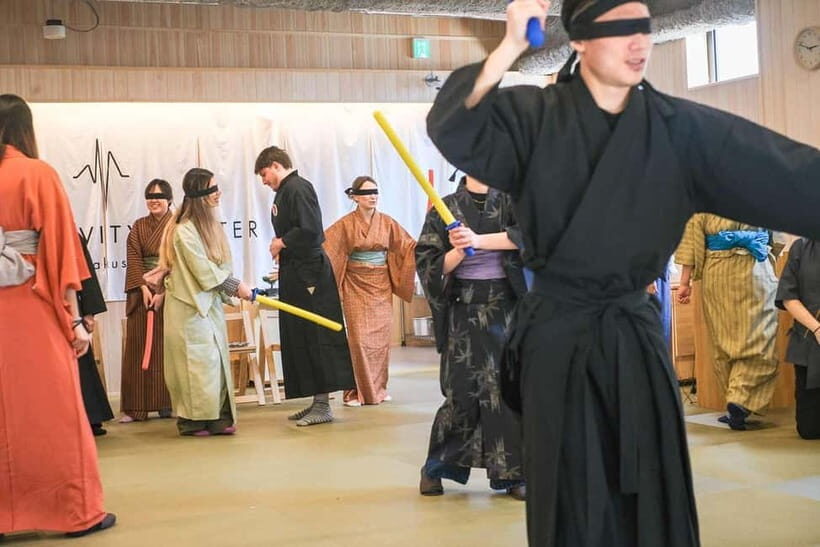
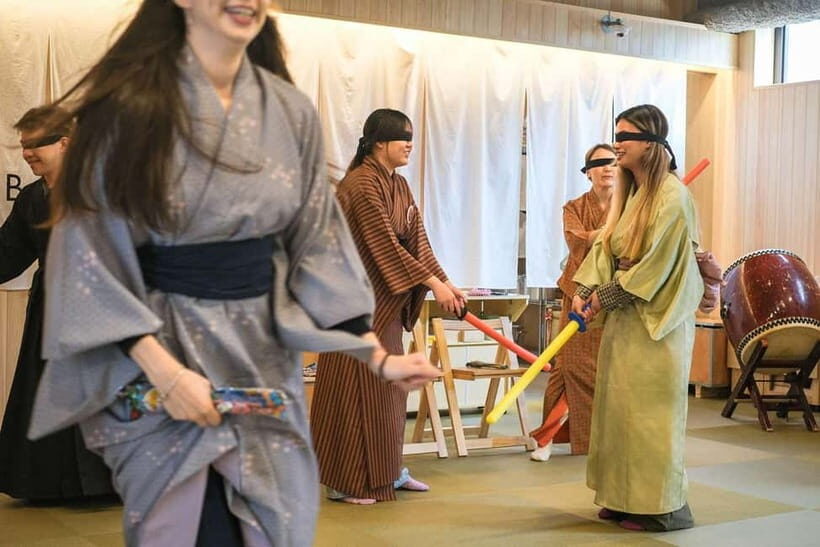
Before you touch equipment, you get a short introduction into the traditions and philosophy of samurai life. Instead of drowning you in lectures, you play a mini-game that determines your samurai rank.
The game also has a competitive twist: you compete with friends for the general or shogun position. The point isn’t whether you win. The point is that the concepts stick because you’re using them while playing.
If you’re traveling with kids, teens, or a mixed group, this format is a big win. Everyone can participate even if they’re brand new to Japanese culture. And if you lose, you’re not stuck—training starts right away, and you keep moving.
Kyudo in 60 Minutes: Why This Bow Feels Different
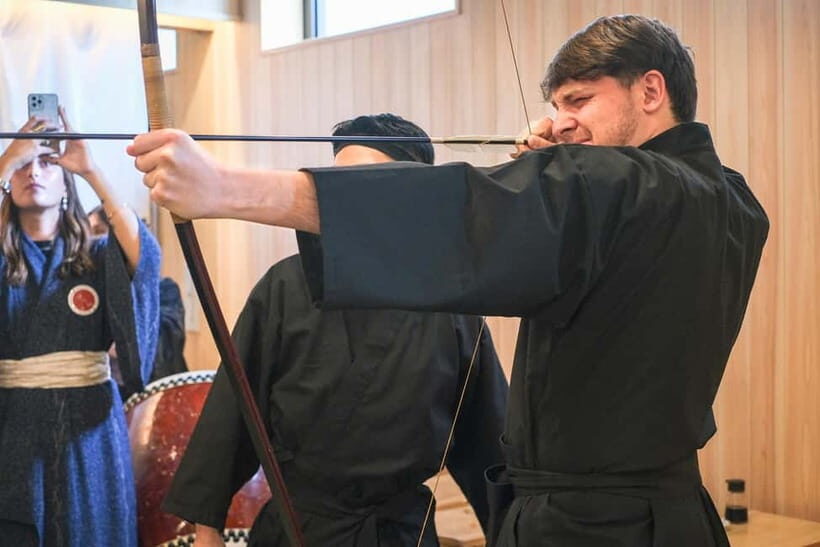
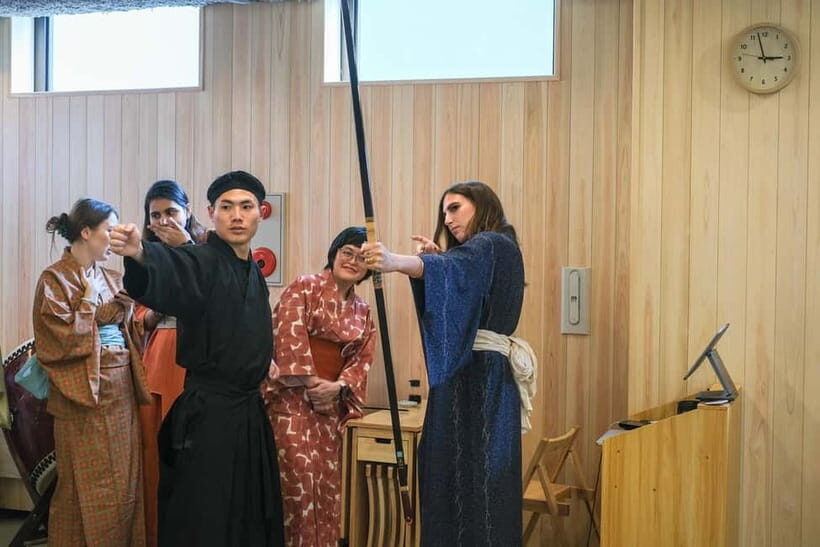
Kyudo is the headline activity, and it’s where this class becomes more than costume and selfies. You learn archery techniques using a traditional Japanese bow, and the style is notably different from what most people expect.
In Western archery, the focus is often on aiming mechanics and release. Kyudo tends to emphasize controlled form and the overall process—how you prepare, how you draw, and how you hold the stance. You’re not just firing arrows; you’re practicing a sequence of movements designed to train posture and discipline.
Even if you’ve never tried archery, the class is built for beginners. Staff guide your form and help you understand what to do in a clear, step-by-step way. This is also where English support really matters, because the difference between doing it wrong and doing it right can be as small as how you set your feet or angle your bow.
Katana Basics: The Pose and Grip That Make It Look Real
After Kyudo, you shift to swordsmanship. You practice techniques with a single-edged sword (katana), with an emphasis on posture and holding the blade correctly.
What I like here is that the class doesn’t treat the katana as a scary prop. You learn the correct way to hold it and master the pose—the exact kind of positioning that makes photos look convincing and movements feel stable. The goal is to become the strongest samurai in Asakusa, and honestly, the way they frame it makes people relax enough to try.
Staff help you take lots of pictures while you practice. That means you don’t just do one take and move on—you get chances to adjust, refine your stance, and capture the moment with better angles.
A small practical note: wear comfortable clothes you can move in. You’ll be standing, posing, and handling equipment, so nothing stiff or restrictive works best.






Staff Coaching, Photos, and the English That Actually Helps
A big part of the experience is the instruction style. The staff are bilingual and keep explanations simple, adapting to your English level. That matters because Japanese martial arts have terms and body mechanics that can get lost if the teaching is overly technical.
From the way the class is run, you can tell the staff are trying to make your time productive. They’re also clearly used to groups coming in at different comfort levels. One highlight that pops up in feedback is that instructors are patient—Coach Mori is specifically mentioned as nice and patient, and instructor Joe is called out as friendly and instructive.
That kind of coaching changes the whole feel of the hour. If you’ve ever tried an activity where you’re always waiting for someone to correct your form, you’ll appreciate how quickly they help you get unstuck here.
And yes, the photos really matter. The staff take lots of pictures, and the results tend to look great, including photo and video moments. You’re leaving with something better than blurred group snaps.
Snacks and Small Breaks That Keep the Pace Tourist-Friendly
Traditional clothes are included, and so are Japanese snacks. This is a small thing, but it helps the pacing. It keeps the session from feeling like a nonstop training block.
You’ll likely find the snack moment comes at a natural transition point—after intro steps or between activities—so it doubles as a reset for energy and concentration.
If you have a sensitive stomach, you might still want to keep snacks in mind, since food is part of the included package. But based on the setup, it’s meant to be casual and family-friendly.
Where the $96 Value Really Comes From
At $96 per person for a 1-hour session, you’re paying for more than archery practice. You’re paying for a full “samurai experience loop” that includes:
- Outfit setup with hakama
- Use of traditional archery and sword gear (bow and katana)
- Staff-led coaching with English support
- Japanese snacks
- Photo time with staff helping you capture the experience
If you tried to recreate this on your own, you’d usually spend time figuring out where to rent equipment, how to book instruction, and how to get a guide who can explain the movements clearly in English. This package removes that friction.
Also, the value isn’t only the tools—it’s the structure. You get a mini-game, a ranked goal, and then guided form work. That mix makes it feel like a guided experience rather than random practice.
Who Should Book This (and Who Might Want Something Else)
This experience fits best if you want hands-on fun with Japanese martial arts that doesn’t require prior experience.
You’ll probably enjoy it most if:
- You want a short, well-paced activity during a Tokyo day
- You like role-play elements that still include real technique coaching
- You’re traveling with a group that includes kids and adults
- You want something more memorable than shopping for souvenirs
If you’re the type who wants advanced training, lots of repetition, or deep technical instruction, you might find one hour too short. But as an introduction that ends with photos, snacks, and a sense of what Kyudo and sword posture feel like, it hits a sweet spot.
Practical Tips for a Smoother Session in Asakusa
Here are the small things that make your hour go better:
- Bring comfortable shoes. You’ll be standing and posing.
- Wear comfortable clothes you can move in while practicing form.
- Aim to arrive about 10 minutes early so you can handle the elevator and fitting smoothly.
- Expect staff to help with pictures; don’t rush through the practice parts if you want better photo results.
- If you’re unsure how to get to the meeting room inside the building, contact the provider rather than wandering.
Also, plan around the rules: alcohol and drugs are not allowed. It’s a martial-arts focused class, so keep the vibe respectful.
Should You Book the Kyudo and Swordsmanship Session?
I’d book it if you want a compact, beginner-friendly way to experience samurai culture through Kyudo, a basic katana pose practice, and a playful rank game—plus outfit fitting, snacks, and photo help. The price feels fair for what you get because you’re not just paying for one activity; you’re paying for the full guided sequence that makes you feel involved.
Skip it if you’re after serious, long-form training. This is about first impressions done well, not mastering every detail.
If your schedule allows one hour in Asakusa, this is the kind of activity that gives you a story you can tell later—because you actually wore the outfit, drew the bow, and held the sword the way they taught you.
FAQ
Where is the meeting point for this experience?
You meet in Tokyo, Taito-ku, Asakusa at 2 Chome 6-11 Heiwa Building. You’ll take the elevator up to the 5th floor.
How long does the activity last?
The experience lasts 1 hour.
Is prior experience required?
No prior experience is necessary.
What’s included in the price?
The price includes use of a traditional Japanese bow and katana, traditional clothes, Japanese snacks, and bilingual staff.
Is the instruction available in English?
Yes, the instructor provides English instruction.
What should I wear or bring?
Bring comfortable shoes and comfortable clothes.
Can I cancel and get a refund?
Yes. Free cancellation is available up to 24 hours in advance for a full refund.
Is this experience family-friendly and wheelchair accessible?
Yes. It is family-friendly and wheelchair accessible.