REVIEW · TOKYO
Tokyo: Guided Go Kart Tour from Harajuku to Shibuya Crossing
Book on GetYourGuide →Operated by Monkey Adventure Kart · Bookable on GetYourGuide
Shibuya, but on wheels. This guided go-kart tour turns central Tokyo into a hands-on street adventure, including the headline ride through Shibuya Crossing. I especially like the option to dress up in costumes, because it takes the edge off first-time jitters and makes photos way more fun than basic sightseeing.
I also like how the experience is built around a clear, confidence-boosting safety briefing with a guide out front. One possible drawback: while the tour runs 75 minutes, you may not be driving the whole time, and a few travelers have noted less driving time than they expected.
In This Review
- Key Points You’ll Actually Care About
- From Shibuya Station to the Karts: Where the Tour Starts
- Safety First, Then You Drive: How the Briefing Sets the Tone
- Costumes Included: Why Dressing Up Changes the Experience
- The Route: Harajuku Streets, Then Shibuya and Shinjuku
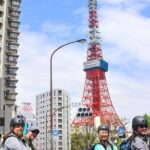
- Riding Shibuya Crossing: The City’s Most Famous Moment on Wheels
- Photos That Actually Help You Remember the Ride
- Day or Night: Choose the Version of Tokyo You Want
- Karts, Speed, and Feel: What It’s Like Behind the Wheel
- Price and Value: Is $103 Worth 75 Minutes?
- Permits and Paperwork: The Part You Must Get Right
- Small Group Energy: Why Max 5 Drivers Feels Better
- Alcohol Rules and Real-Life Expectations
- Who Should Book This Go-Kart Tour?
- Should You Book Monkey Adventure Kart in Shibuya?
- FAQ
- Do I need a driver’s license to ride the go-kart?
- How long is the tour?
- What areas will we drive through?
- Where is the meeting point?
- What’s included with the tour price?
- Can I take photos during the ride?
- Is the tour in English?
- Are there any restrictions for riding?
Key Points You’ll Actually Care About
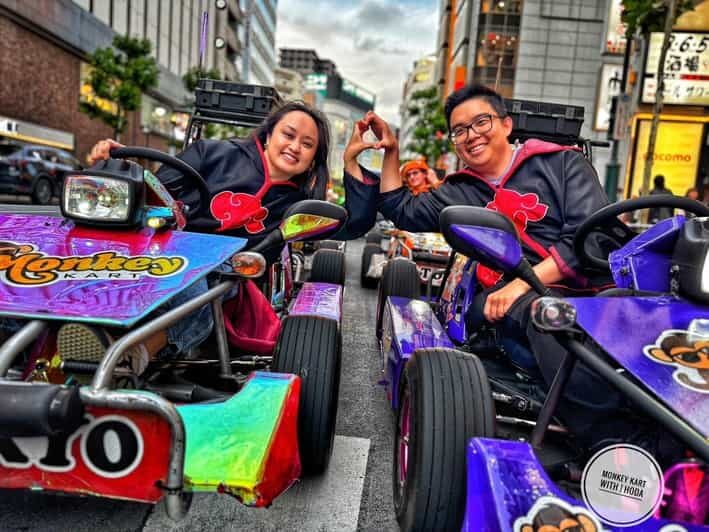
- Small group (max 5 drivers) means easier pacing and more attention from your English guide.
- Costumes are included, so you can show up as your favorite character instead of worrying about props.
- Shibuya Crossing is part of the ride, not just a photo stop from the sidewalk.
- Photos are captured during the tour and shared digitally (AirDrop or email), plus you get one printed hard copy.
- Your guide signals and stays engaged, and named guides like Lewis, Ayrton, Mirko, Rakesh, and Luna are repeatedly praised for keeping things fun and orderly.
From Shibuya Station to the Karts: Where the Tour Starts
The meeting point is easy to find if you can navigate Shibuya on foot. Go to the main big street and look for FamilyMart at 3-chome-17-3, Shibuya, Shibuya City, Tokyo. The closest landmark is Shibuya Station—use the central gate and walk about 2 minutes from Exit C2.
No hotel pickup is included, so I’d plan on arriving a little early on purpose. Shibuya is busy, and you’ll want a few minutes to check your paperwork and get into the right mindset before the briefing.
You can also read our reviews of more guided tours in Tokyo

Safety First, Then You Drive: How the Briefing Sets the Tone
Before you set off, you’ll get a thorough safety briefing and driving instructions from a professional guide. This matters in Tokyo because you’re not on a closed amusement track—you’re in a real urban environment where communication and simple rules keep everything smooth.
Here’s what you’ll feel in the first minutes:
- You’ll get basic guidance on how the kart works and how to follow instructions.
- You’ll learn what to do if the group needs to slow down or stop.
- The guide uses clear signals so you’re not guessing what’s coming next.
Even in the night reviews, the consistent theme is that people felt safe. Named guides like Gas, Lewis, Rakesh, and Chris are mentioned as upbeat but also firm on procedure—exactly the kind of mix you want when you’re learning to steer and brake while riding in a city.
Costumes Included: Why Dressing Up Changes the Experience
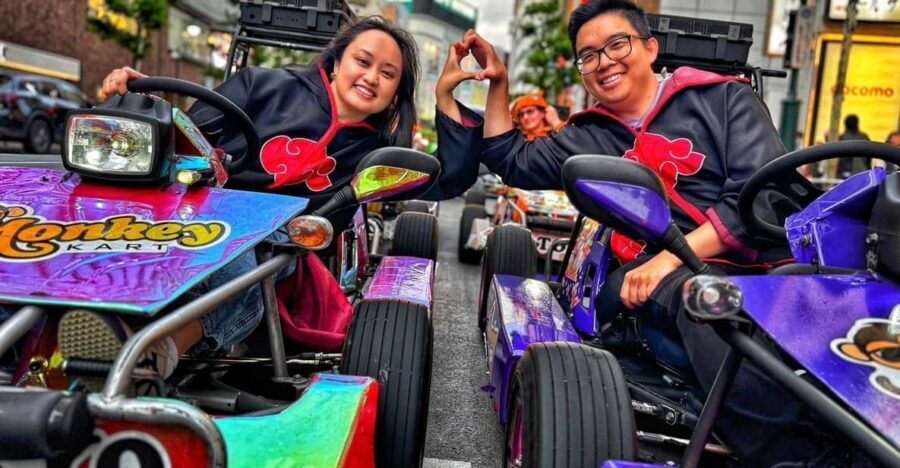
You can dress up in included costumes before you drive. This is more than silly fun. In Tokyo, costumes also help break the ice, and they make the photos look like part of an actual Tokyo story rather than generic group shots.
What I like about this setup is that it’s handled for you. The tour includes costumes and also provides an action camera or Insta360 mount, so you’re not stuck asking a stranger to capture your best moments.
Some travelers have specifically mentioned cool costume options and extra accessories like masks and fun eyewear. If you’re traveling with friends, this is the easiest way to turn a “standard activity” into an evening you’ll remember vividly.
The Route: Harajuku Streets, Then Shibuya and Shinjuku
Once you’re kitted up and confident, the ride follows a guided path through several of Tokyo’s most recognizable areas:
- Harajuku
- Shibuya Crossing
- Shinjuku and surrounding central neighborhoods
This is the big value point of the tour. You’re not just driving in a circle or stopping at scenic corners. Your guide leads you through the kind of street scenery that tourists normally only see while walking—or while staring at their phone.
Why that matters: Tokyo is visually dense. When you drive through it, you experience it at a closer speed. You notice the scale of buildings, the rhythm of crosswalk timing, and the way neighborhoods change block by block. The guide also points out landmarks as you go, which helps you connect the kart ride to what you’ll recognize later on foot.
Pacing is guided, not chaotic. In small groups, the route feels more like a guided street walk—just with steering wheels and a lot more adrenaline.
Riding Shibuya Crossing: The City’s Most Famous Moment on Wheels
Shibuya Crossing isn’t just a postcard. It’s a real intersection that feels like a choreographed system when you’re there. This tour’s headline is that you get to glide through the crossing by go-kart, guided and coordinated.
Even if you’ve seen Shibuya Crossing before, experiencing it from a driver’s perspective is different. From the kart, you get:
- a broader sense of movement across lanes (rather than only what you see between crowds),
- quick sightlines to landmark buildings,
- and that surreal feeling of being part of the scene rather than waiting for it.
People consistently mention how the ride feels like a fast, Mario Kart-style moment—without turning it into an unsafe free-for-all. The guide’s job is to keep everyone flowing and comfortable, and that’s where the best guides shine.





Photos That Actually Help You Remember the Ride
Good street activities live or die by photos. This one gives you help in that area.
During the tour, your guide captures high-quality photos at key locations. At the end, you’ll get the digital images shared via AirDrop or email, plus one hard copy photo included.
That combo is practical:
- Digital photos are fast for sharing with friends back home.
- A printed photo gives you a physical memory you can drop into an album.
Some guides are specifically praised for acting as part photographer, part guide—people mention taking lots of cool shots and making sure everyone got their moment without slowing the group into boredom.
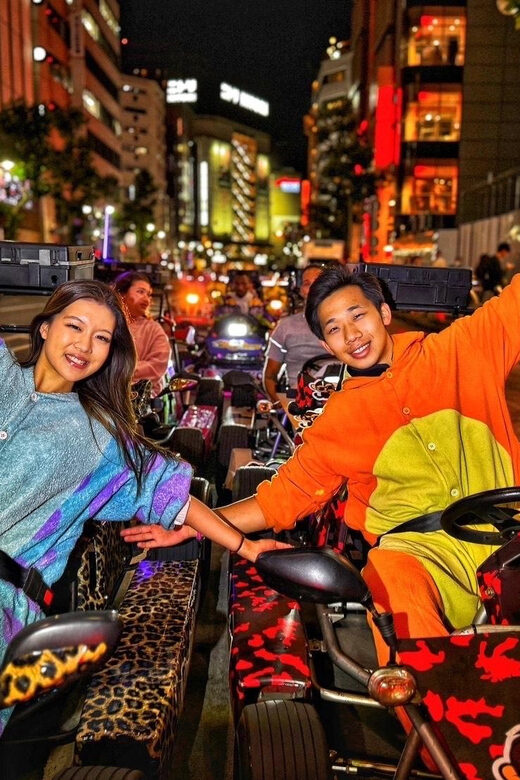
If you’re doing the night option, this gets even better. Tokyo’s lighting turns regular streets into neon backdrops, and a ride at night feels faster and more cinematic.
Day or Night: Choose the Version of Tokyo You Want
Your tour can run during day or at night, depending on your booking time. Both work, but the vibe is different.
Night driving tends to deliver:
- stronger city-light reflections,
- a more dramatic sense of motion,
- and photos that look more like Tokyo at its postcard best.
Daytime driving is great if you prefer:
- easier orientation,
- brighter visuals for landmark spotting,
- and cooler comfort in the lead-up to evening plans.
If you’re only doing one kart session, I’d pick the time that matches the rest of your Tokyo schedule. If your next activity is a nighttime neighborhood crawl, the night kart ride can act like the fun warm-up.
Karts, Speed, and Feel: What It’s Like Behind the Wheel
The karts are custom-built and described as street-legal, and your guide provides instructions so you can drive confidently. You should also expect that the ride is a mix of short acceleration moments and slower segments where the group stays together.
Speed can surprise first-timers—in a good way. People mention that the karts go faster than expected, and the experience feels like a real driving moment rather than just a slow parade.
One practical note: the tour duration is 75 minutes, but the amount of time actually spent driving can vary. One person noted getting around 57 minutes of driving time, even though the tour length was listed as 75 minutes. So I’d think of 75 minutes as including briefing, photo moments, and transition time—not a full 75 minutes with your foot on the gas.
Price and Value: Is $103 Worth 75 Minutes?
At about $103 per person for a 75-minute guided experience, this sits in the “splurge for fun” category. Is it worth it? In my view, it can be, because you’re paying for several things at once:
- a guide to lead you through central Tokyo areas,
- the karts and safety setup,
- the photoshoot and digital delivery,
- and added extras like costumes and water.
If you love high-energy activities and you want Tokyo from a totally different angle, it’s good value. If you’re mainly chasing classic sightseeing, you might find it pricey for the time behind the wheel.
My advice: treat it like a “one-time Tokyo highlight.” If you do it, do it with friends, plan your outfit, and show up ready to drive and have photos made.
Permits and Paperwork: The Part You Must Get Right
This is the make-or-break section for many visitors. You’ll need an International Driving Permit (IDP) in the 1949 Geneva Convention format, and it must be a physical hardcopy paper booklet issued by the official agency in your home country.
A few important points from the rules you need to follow:
- Online copies, Xerox copies, and card licenses are not valid.
- Some permit types aren’t recognized in Japan (for example, 1968 Vienna Convention, IDA, and IAA-issued permits).
- If your license is from certain countries (like France, Switzerland, Germany, Monaco, Belgium, or Taiwan), you’ll need a Japanese translation of your local license from JAF (Japan Automobile Federation).
- Permits from some countries are not permitted to drive in Japan, depending on whether they meet the 1949 Geneva requirement.
Also: you must be over 18 to drive. The tour isn’t suitable for pregnant women, and it also lists limits like people over 95 years.
If paperwork stresses you out, do it early. Japan’s driving rules can be strict, and this tour won’t work without the correct IDP.
Small Group Energy: Why Max 5 Drivers Feels Better
With a group limited to 5 participants, the experience stays personal. In practical terms, that usually means:
- easier communication when the guide signals,
- less waiting for your turn to go,
- and better attention during photo stops.
Several people mention that guides felt engaged, entertaining, and in control while also giving clear instructions. Named guides like Mirko, Rajesh, and Luna show up in the feedback as people who kept energy up while maintaining safety.
If you prefer more interaction (rather than being one face in a big crowd), this group size is a major plus.
Alcohol Rules and Real-Life Expectations
No alcoholic drinks in the vehicle are allowed. That’s a good rule, and it also helps keep the experience safe and orderly. You’ll want to arrive sober and comfortable because you’re driving for real.
Also, rain can affect things—this activity may be rescheduled if weather isn’t ideal. If you’re in Tokyo for a short window, I’d try to book a time that gives you flexibility in the day around it.
Who Should Book This Go-Kart Tour?
This is a great fit if you:
- want a fun, active Tokyo experience instead of another walking tour,
- like photo moments and want a guide to handle pictures,
- are comfortable with basic driving after a short briefing,
- and want to see Harajuku, Shibuya, and Shinjuku in one go.
It may not be for you if you:
- hate the idea of handling paperwork for an IDP,
- want a calm, low-adrenaline sightseeing day,
- or prefer guaranteed long driving time with zero waiting.
Should You Book Monkey Adventure Kart in Shibuya?
Yes, if you’re looking for a high-reward experience: a real-driving perspective on Tokyo, costumes included, and photos delivered digitally at the end. It’s also a smart first-day highlight because the route hits areas you’ll later want to revisit on foot.
I’d book it when:
- you have your 1949 Geneva IDP squared away,
- you’re okay with a short experience built around guidance and coordination,
- and you’d enjoy riding through Shibuya Crossing as more than a background shot.
If you’re unsure, here’s the easiest decision rule: if you want to feel like you’re part of Tokyo’s motion—not just watching it—this tour is worth the splurge.
FAQ
Do I need a driver’s license to ride the go-kart?
Yes. You must bring an international driver’s license. The tour requires a physical hardcopy IDP booklet issued under the 1949 Geneva Convention format.
How long is the tour?
The duration is 75 minutes.
What areas will we drive through?
The guided route includes Harajuku, Shibuya Crossing, and Shinjuku/central Tokyo neighborhoods.
Where is the meeting point?
Meet at the main big street near FamilyMart at 3-chome-17-3 Shibuya, Shibuya City, Tokyo. Shibuya Station Exit C2 is about a 2-minute walk.
What’s included with the tour price?
Included are the go-kart tour, guide, photoshoot, digital photos, one hard copy photo, water, costumes, and an action camera or Insta 360 mount.
Can I take photos during the ride?
Yes. Your guide captures photos at key locations, and you receive digital copies at the end via AirDrop or email, plus one printed photo.
Is the tour in English?
Yes. The live tour guide is available in English.
Are there any restrictions for riding?
You must be over 18. Alcoholic drinks aren’t allowed in the vehicle. The tour also lists it as not suitable for pregnant women and people over 95 years, and drivers must be at least 18.