REVIEW · TOKYO
Tokyo Guided Small-Group Biking Tour
Book on Viator →Operated by Bicycle Tours Tokyo · Bookable on Viator
Tokyo traffic can be intense, so the right route matters. This small-group bike tour threads through Shinjuku backstreets and major landmarks in one smooth day, with time to stop, walk, and look around at real Tokyo pace. You also end high above the city at the Tokyo Metropolitan Government Building for a 360-degree look.
Two things I really like: the maximum group size of 5 makes it feel personal and safer on busy roads, and the route pairs big sights (Meiji Jingu, Ginza, Imperial Palace) with quieter side streets locals actually use. Another strong point is the lunch setup: you’ll pick up a bento and then eat by the water with skyline views.
One consideration: you’ll ride about 20 miles / 32 km and you should be comfortable on busy roads (this is not an e-bike). If city riding makes you nervous, you might want a slower or more traffic-free option.
In This Review
- Key highlights that shape the whole day
- A Tokyo bike day that actually feels manageable
- Meeting point, bike fit, and what to bring before you roll
- Starting in Shinjuku: skyscrapers early, then quieter roads fast
- Meiji Jingu and Yoyogi Park: a walk that resets the day
- Omotesando and Roppongi Hills: shopping sophistication, then a step back in time
- Zōjō-ji Temple and Tokyo Tower: one view, then move on
- Lunch by the water: buy your own bento, then eat with skyline views
- Ginza riding and the Imperial Palace moat: classic Tokyo, no rushing
- The 48th-floor payoff: Tokyo Metropolitan Government Building in the final stretch
- How hard is it: 20 miles, busy roads, and a cross-city bike
- Price and value: what your $106.12 includes and what it doesn’t
- Who this tour is for (and who should think twice)
- Should you book this Tokyo small-group bike tour?
- FAQ
- How long is the Tokyo guided small-group biking tour?
- What is included in the price?
- Is lunch included?
- Where does the tour start and end?
- What group size is this tour limited to?
- What fitness level is required?
- What are the age limits?
- What should I know about bike fit?
- What happens if the weather is bad?
Key highlights that shape the whole day
- Max 5 riders for real attention from the guide, not a herd.
- Shinjuku to landmarks to skyline views in one long, well-paced loop.
- Meiji Jingu + Yoyogi Park includes time on foot in peaceful gardens.
- Bento lunch by Rainbow Bridge after a stop where you can spot Tokyo Tower.
- Ginza and the Imperial Palace moat add the classic Tokyo sightseeing frame.
- 48-floor finish gives you an easy, high-impact overview of where everything sits.
A Tokyo bike day that actually feels manageable
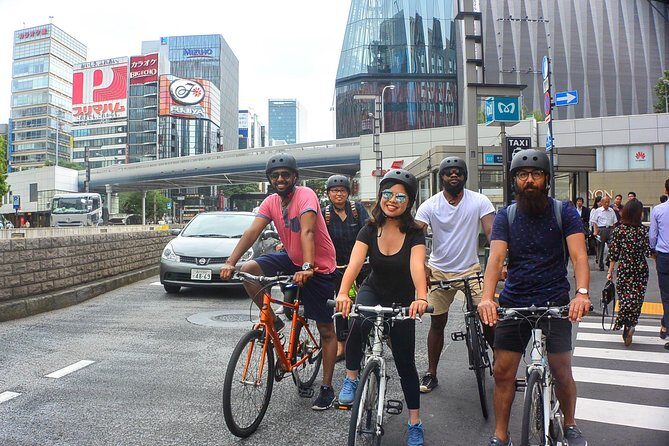
Tokyo is huge. On foot, you spend your time crisscrossing streets, waiting for crossings, and backtracking because you misjudged distance. On two wheels, the city suddenly makes sense. You get a fast survey of neighborhoods and landmarks in a way that feels like you’re moving with the rhythm of the city, not fighting it.
This is also a smart-sized tour. With a cap of 5 people, the guide can keep an eye on spacing, regroup quickly, and slow down when pedestrians and traffic get messy. That matters because the route includes stretches where you’re riding through active areas, not just smooth bike paths.
The best part is the balance. You don’t just tick off photos. You ride from tall Shinjuku streets into more residential areas, then shift into shrine and park calm, and later into shopping districts and palace grounds. It’s a day that shows the contrast Tokyo is famous for—right next to each other.
You can also read our reviews of more cycling tours in Tokyo
Meeting point, bike fit, and what to bring before you roll
You meet at 3-chōme-20-2 Nishishinjuku, Shinjuku City, Tokyo 163-1407. It’s near public transportation, so you can arrive without a stressful transfer plan. You’ll get a mobile ticket, which keeps things simple once you’re there.
Before riding, you’ll strap on a helmet and check your bike fit. This is not a “one-size-fits-all” setup. Your height has to fall between 125 cm and 190 cm (4 ft 1 in to 6 ft 3 in), or you won’t be able to ride the assigned bike properly. If your height is entered wrong during booking, the tour warns that you won’t be able to bike and you won’t get a refund—so double-check your details.
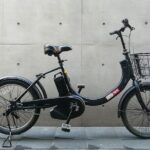
Your bike is a cross-city style with a flat handlebar, not a cruiser with a high riser. That means you’ll have a more upright, city-friendly posture, and you should be comfortable steering and navigating around pedestrians. It also helps if you know how to ride a multi-speed bike, since some parts of Tokyo move fast and you’ll want the right gear.
Bring comfortable clothes and a backpack or messenger bag. You’ll also want to stay weather-ready, since the tour depends on good cycling conditions.
Starting in Shinjuku: skyscrapers early, then quieter roads fast
You begin among the tall buildings of Shinjuku and ride at a relaxed pace. The goal at the start isn’t speed—it’s orientation. Tokyo can feel like a maze, even when you know where you’re going, so this is a chance to build your mental map while the guide manages the group.
Then the route pivots toward backstreets. You’ll move from major-area energy into a small shrine in a residential area, which is a classic Tokyo contrast. It’s one of those stops that makes you realize the city isn’t just about landmarks. It’s everyday blocks, small routines, and neighborhood spaces that don’t show up on most first-trip photo lists.
Traffic is part of the reality here. One reason this tour works well is the guide’s pace and planning. You’re told up front to expect a city ride on busy roads for stretches, about 32 km total. If you can handle that, you’ll enjoy the way the day keeps turning corners into new scenes.
Meiji Jingu and Yoyogi Park: a walk that resets the day
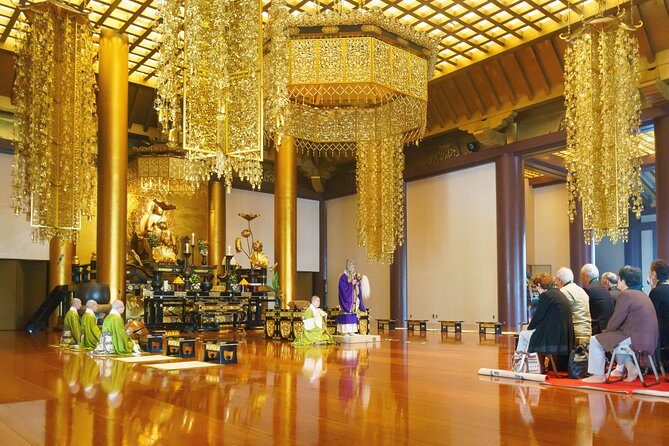
From the Shinjuku area you head toward Meiji-jingu, using Yoyogi Park along the way. In spring, this is where you can catch cherry blossoms in the park, but even outside blossom season, Yoyogi is a welcome break from the built-up feel of central Tokyo.
Meiji Jingu is one of the big reasons people come to Tokyo, but the value here isn’t just seeing it. It’s getting time to slow down. You won’t just bike past. You’ll walk around the gardens surrounding the shrine at a calmer pace, guided so you know where to look and what you’re seeing.
This part of the tour also helps you feel the geography. Tokyo’s shrines and parks are not tucked away on the edge of the city; they’re integrated into the flow. Watching that transition happen—high-rise streets into forested paths—turns a sightseeing stop into an understanding moment.
Omotesando and Roppongi Hills: shopping sophistication, then a step back in time
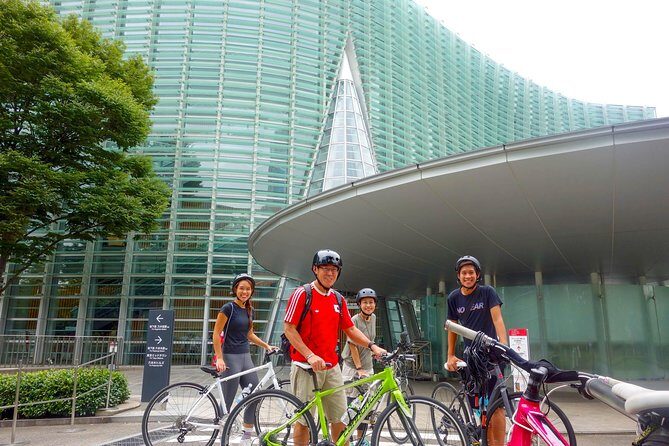
After Meiji Jingu and the park section, the ride continues through Omotesando, one of Japan’s more stylish shopping streets. You get to pedal through an area that feels designed for pedestrians and modern retail, where storefront rhythm is a kind of atmosphere of its own.
Then you head toward Roppongi Hills, the entertainment complex area. Here the vibe shifts again. You’re back near big Tokyo energy—modern buildings, busy streets, and a more global feeling.
But the route doesn’t get stuck there. You take a backstreet to Aoyama cemetery, described as looking and feeling like Tokyo from about a hundred years ago. Even if you’re not a cemetery person, the point is perspective. It’s Tokyo continuity: old cultural space sitting inside the city’s relentless growth.
If you’re the type who gets bored by “same-same” shopping districts, this portion helps by changing the mood several times within a short ride.
You can also read our reviews of more guided tours in Tokyo

Zōjō-ji Temple and Tokyo Tower: one view, then move on
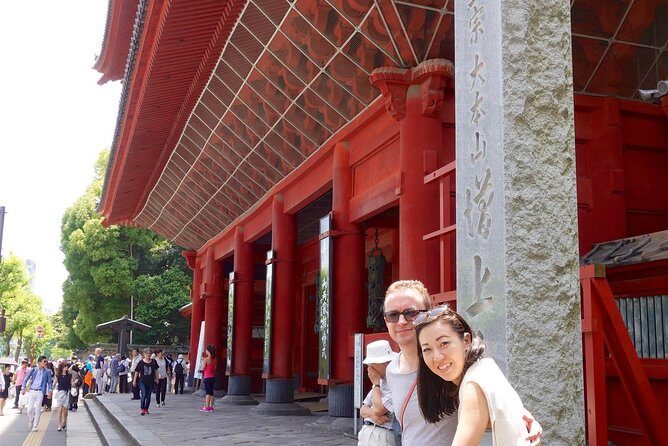
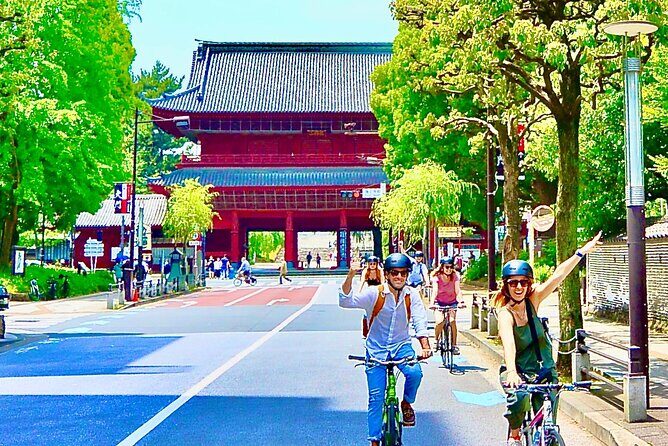
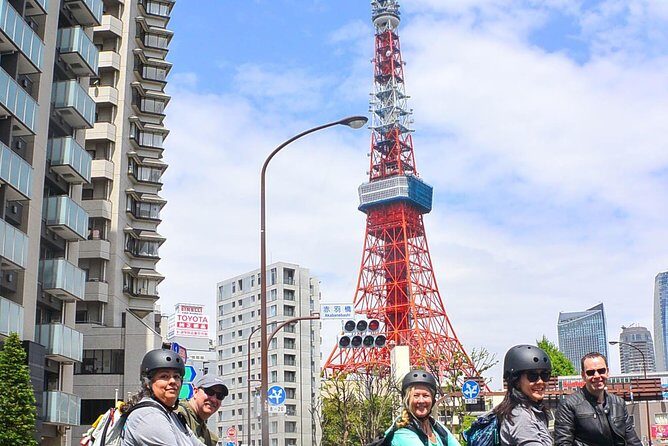
Next comes a stop at Zōjō-ji temple, with Tokyo Tower visible behind it. It’s a nice pairing because you get a temple setting and a modern landmark in the same frame. Instead of treating Tokyo Tower as a single attraction you have to hunt for, you see it as part of the skyline-to-spirituality mix that Tokyo does so well.
This part of the day also keeps momentum. It’s not a long museum-style wait. You’re there for the moment, then you keep cycling toward lunch and the waterfront.
A guide makes the difference here. In the feedback for this tour, Gaku is repeatedly mentioned for friendly, careful navigation and for choosing stops that feel special without turning the day into a stressful checklist.
Lunch by the water: buy your own bento, then eat with skyline views
Lunch is handled in a very Tokyo way. You’ll stop at a local supermarket to buy a bento box. Food isn’t included, so you’re shopping on-site and putting what you buy in your backpack.
Then you eat on the waterfront, roughly 25 minutes away from where you purchase the lunch. The setting is a major reason people rate this tour so highly: you get panoramic views of the skyline near Rainbow Bridge, with the Aqua City Odaiba complex in the scene.
This beats a generic “tour lunch.” You’re not just fed. You’re eating in a view that helps connect the map points you’re seeing later—especially the waterfront areas and how the city lines up around the bay.
Bring cash or a payment method you’re comfortable using, since you’ll need to buy lunch yourself. And if you’re picky about timing, don’t worry too much—the pacing here is built around these ride/walk blocks rather than rushing you through.
Ginza riding and the Imperial Palace moat: classic Tokyo, no rushing
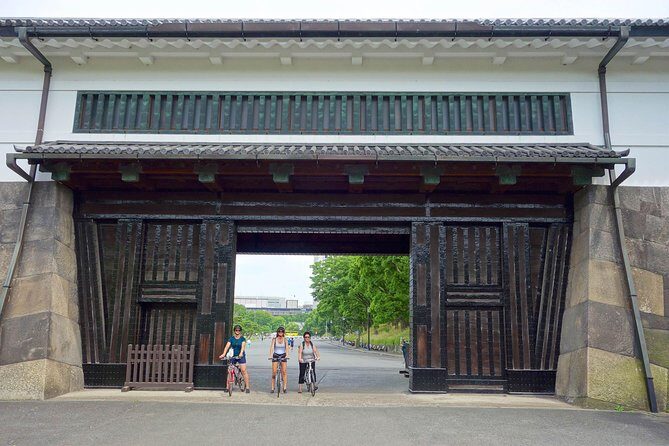
After lunch, you pedal through Ginza, including both main streets and back streets. Ginza can be intense on foot, but on a bike with a guide you can get a better sense of the district’s scale without getting trapped at every crossing.
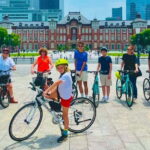
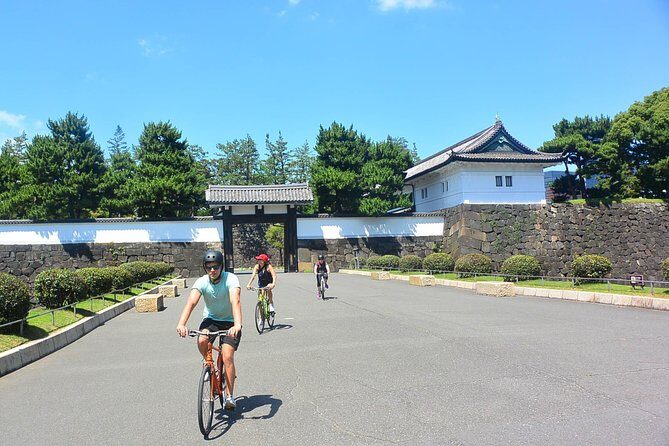
Then you cycle toward the Imperial Palace, with a focus on the grounds and surrounding defenses: you pass elements like the traditional garden, tea pavilion, stone walls, and the moat. You also ride through the outer gates and follow along portions of the moat so you see the palace as a connected space rather than a single point on a map.
One thing I’d keep in mind: palace grounds are about calm and walking, so the experience is a mix of cycling and time spent moving more slowly. This is the kind of stop where your energy level matters. If you pace yourself and drink water, it stays enjoyable instead of tiring.
The 48th-floor payoff: Tokyo Metropolitan Government Building in the final stretch
The day finishes back near Shinjuku, with the big wow factor coming first: the Tokyo Metropolitan Government Building. You’ll go up to the top level via a fast elevator—48 floors—and get a 360-degree view of Tokyo.
On a clear day, you might even see Mt. Fuji. Even when you don’t, the value is still there. From that height, Tokyo’s sprawl becomes easier to understand: where districts sit, how the bay angles in, and how Shinjuku connects to everything you’ve been riding.
After the view, it’s a short ride—about 5 minutes—back to the original meeting point, so you’re not stuck with a long commute at the end of a long day.
How hard is it: 20 miles, busy roads, and a cross-city bike
This tour asks for moderate physical fitness. You’re looking at roughly 20 miles / 32 km total distance, and the day runs around 6 hours 30 minutes.
Tokyo is fairly flat, and the ride is paced for most people who can ride a bicycle confidently. Many reviews highlight the low elevation challenge. Still, you should plan to stay focused, because the difficulty here is less about hills and more about traffic comfort.
You’ll ride on busy roads for some portions, and the tour notes you should feel comfortable cycling in the city. You’ll also need to be able to steer around pedestrians, especially in crowded areas near shopping and transit hubs.
If you’ve got the basics—balance, braking control, and the ability to work with a multi-speed bike—you’ll likely find this very doable. If you’re a brand-new cyclist, or you hate riding near cars, it may stress you out more than it should.
Price and value: what your $106.12 includes and what it doesn’t
At $106.12 per person for about 6.5 hours, the value is strong if you compare it to the cost of a guide plus bike rental in Tokyo. What you get included is key: a professional guide, plus bike and helmet rental.
What’s not included:
- Food and drinks
- Hotel pickup/drop-off
Lunch is where you’ll spend extra. You buy your bento box at a local grocery store, and you eat it on the waterfront. That cost depends on what you choose, but the structure is smart—you get to pick your food and eat in a view-worthy spot.
In plain terms, you’re paying for guided routing, safe navigation on busy roads, and a tight mix of major sights and neighborhood streets. And because the group is small, you’re not paying for empty seats on a large vehicle.
Who this tour is for (and who should think twice)
This tour is a great fit if you:
- Want a first-visit overview that still feels like you’re seeing real parts of Tokyo
- Like the idea of mixing big landmarks with smaller side streets
- Can ride confidently in a city with pedestrians and cars
- Are within the height range (125–190 cm) and you want proper bike fit
It may not be ideal if you:
- Prefer low-traffic cycling only
- Are uncomfortable with city-road riding for stretches
- Need a lot of stops for long breaks, since the day is built around continuous moving blocks
Age range is 12 to 69, and you may be asked for ID for age verification.
Should you book this Tokyo small-group bike tour?
If you want a single day that connects Tokyo’s major landmarks with the neighborhoods between them, this is a strong choice. The best reason to book is the structure: small group size, guided navigation, and a route that keeps changing scenery without feeling chaotic.
Book it if you’re comfortable riding on busy roads and you can handle a moderate effort day. Skip it if your cycling confidence is low or you’d rather avoid traffic entirely.
If you do book, give yourself a little mental flexibility. Tokyo can be busy. The guide’s role is to keep things moving and safe while still letting you enjoy the stops. That’s what turns a bike ride from stressful into memorable.
FAQ
How long is the Tokyo guided small-group biking tour?
The tour runs about 6 hours 30 minutes (approx.).
What is included in the price?
A professional guide is included, along with bike and helmet rental.
Is lunch included?
No. You buy your lunch bento box at a local grocery store for your own expense, then eat it on the waterfront.
Where does the tour start and end?
It starts at 3-chōme-20-2 Nishishinjuku, Shinjuku City, Tokyo 163-1407, Japan and ends back at the meeting point.
What group size is this tour limited to?
It has a maximum of 5 travelers per booking.
What fitness level is required?
You need moderate physical fitness and you should be comfortable cycling on busy roads.
What are the age limits?
The minimum age is 12 years and the maximum age is 69 years.
What should I know about bike fit?
Rider height must be between 125 cm and 190 cm. If the height is wrong, you may not be able to bike and there may be no refund. You may also need to provide ID for age verification.
What happens if the weather is bad?
If cycling is canceled due to poor weather (rain, heatwave, etc.), you’ll receive a full refund. You may also be offered a different date if the tour is canceled due to weather conditions.