REVIEW · TOKYO
Tokyo: Mount Fuji Must-see Attractions One Day Sightseeing Tour
Book on Viator →Operated by F Trip · Bookable on Viator
Fuji from Tokyo without planning sounds perfect. This full-day outing pairs round-trip coach transfers with live guide commentary, so you spend less time figuring things out and more time taking in the iconic mountain region. I especially like the way the route layers views (lake + parks + shrine angles) instead of rushing one single viewpoint.
Two things I really appreciate: the mixed lineup of scenic and cultural stops and the fact that part of the day includes entry you’d otherwise have to buy (like Saiko Iyashi no Sato Nemba). One caution: if clouds roll in, Mt. Fuji can be frustratingly hard to see, and a few stops can feel brief.
In This Review
- Key Points Worth Noticing Before You Go
- A One-Day Mount Fuji Escape From Tokyo With a Real Plan
- Price and Logistics: Why $60 Can Still Feel Like Good Value
- Your 10-Hour Route: Lakes, Pagoda Views, and the Oshino Springs
- Stop-by-Stop Breakdown: What Each Place Feels Like
- Saiko Iyashi no Sato Nemba (Traditional village with Fuji in the background)
- Lake Kawaguchiko (Quick lake viewpoints for Fuji framing)
- Oishi Park (Seasonal flowers that change the mood)
- Kawaguchiko Natural Living Center (That red torii + Fuji photo)
- Arakurayama Sengen Park + Chureito Pagoda (The famous viewpoint)
- Arakura Fuji Sengen Shrine (Old shrine views and family-prayer vibes)
- Oshino Hakkai (World Heritage springs fed by Fuji snowmelt)
- Guide Energy and Live Commentary: What Makes the Day Feel Worth It
- Photography and Timing Tips for the Fuji Viewpoints
- Weather Reality Check: When Clouds Show Up, Here’s What to Do
- Comfort, Crowd Levels, and the One-Day Pace
- Who This Tour Suits Best (and Who Might Want DIY)
- Should You Book This Tokyo-to-Fuji Day Tour?
- FAQ
- How long is the Mount Fuji one-day tour from Tokyo?
- How much does the tour cost?
- What’s included in the price?
- Is lunch included?
- What stops are included in the itinerary?
- Are entrance fees included for all stops?
- Do I need to use public transportation during the day?
- Is there live commentary during the tour?
- Will I definitely see Mount Fuji?
- What’s the maximum group size?
- Is free cancellation available?
Key Points Worth Noticing Before You Go
- Round-trip coach transfers remove most of the logistics headache from Tokyo
- Live commentary gives context as you move between Fuji viewpoints
- Time-tested stops include Lake Kawaguchi, Oishi Park, Arakura sights, and Oshino Hakkai
- A small-ish group size (max 45) helps the day feel organized
- Mt. Fuji visibility is never guaranteed, so keep expectations flexible
A One-Day Mount Fuji Escape From Tokyo With a Real Plan
Tokyo is loud, fast, and tightly packed. This tour gives you a long breather with a clear structure: meet, ride, stop, see, repeat—under one umbrella with a guide talking through what you’re seeing.
The best part for your day-to-day sanity is the round-trip transport. You’re not bouncing between train lines, figuring out station exits, or arriving at viewpoints already tired from transit. Add the air-conditioned vehicle and the trip feels like a planned excursion instead of a scramble.
A few more Tokyo tours and experiences worth a look



Price and Logistics: Why $60 Can Still Feel Like Good Value
At $60 per person, the price isn’t about buying fancy upgrades. It’s about buying time and certainty. You’re paying for:
- Coach transportation from Tokyo and back
- Air-conditioned comfort
- All fees and taxes (with at least one paid attraction included)
- A guided flow that hits the core Fuji-area hits in one day
Lunch is not included, so you’ll want a simple plan for food (convenience stores, quick meals near stops, or snacks you pack). Still, the overall setup is efficient for people who want Fuji without building an itinerary from scratch.
One more logistics detail that matters: this is a 10-hour day. That’s a full day, not a quick taste. If you’re the kind of traveler who hates being on a schedule, you might feel it in your legs by the end.
Your 10-Hour Route: Lakes, Pagoda Views, and the Oshino Springs
The day is built around classic Fuji angles and places that help you understand why people obsess over this mountain. You’re not just seeing pretty spots; you’re moving through a sequence: old village atmosphere → lake panorama → flower-season grounds → shrine-town framing → spring-fed water realm.
This itinerary also keeps variety in mind. You get water views at Lake Kawaguchiko and Oshino Hakkai, flower-season scenery at Oishi Park, and religious/cultural context at Arakura Fuji Sengen Shrine and Arakurayama Sengen Park.
And yes, it’s a guided tour—meaning you’re likely to spend more time within organized stop windows and less time wandering endlessly.
Stop-by-Stop Breakdown: What Each Place Feels Like

Times below are the ones built into the schedule. They’re short enough to fit everything in, but long enough for a real look if you move at a steady pace.
Saiko Iyashi no Sato Nemba (Traditional village with Fuji in the background)
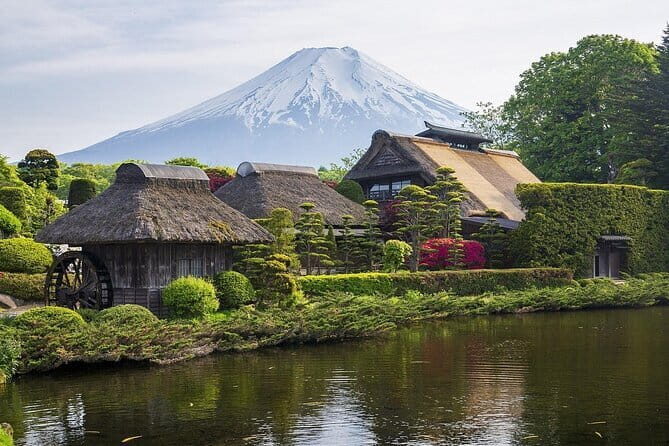
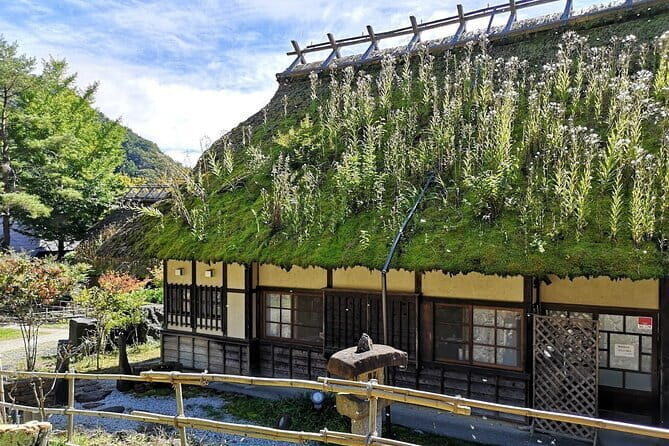
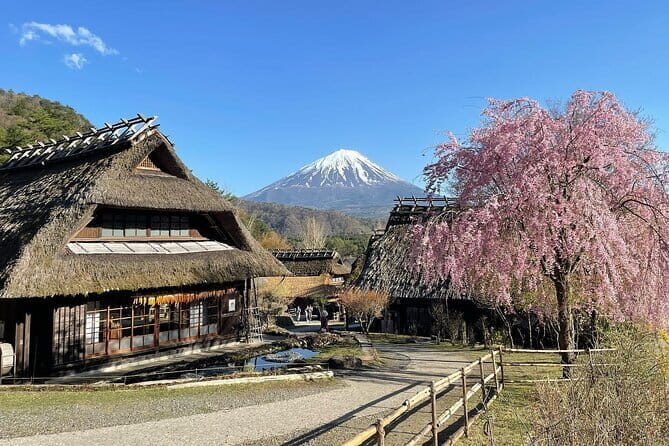
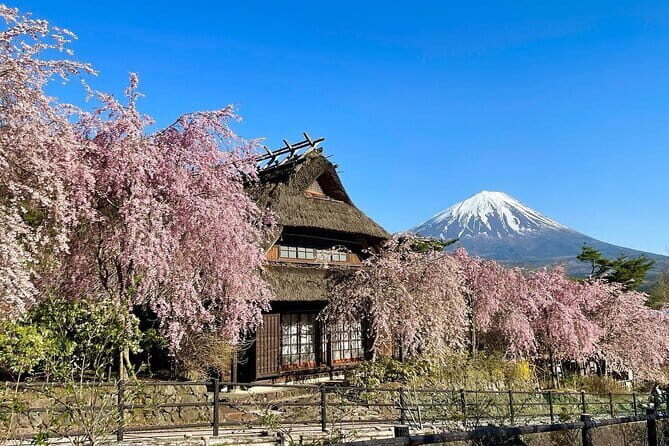
You start at a traditional Japanese village in Fujikawaguchiko Town, known for its postcard-style scenery with Mt. Fuji often framed behind it. It’s named as one of Japan’s most beautiful villages, and it carries a poignant note: the area was destroyed by a landslide during a typhoon in 1966.
What you can do with your time: slow-walk the village lanes, take photos with Fuji framing if visibility allows, and soak up the “old Japan” atmosphere. This stop is 1 hour and includes the admission ticket.
Potential drawback: if Fuji is hidden by clouds, you may feel like you’re visiting a beautiful village without the main backdrop. Still, the village itself is a destination.





Lake Kawaguchiko (Quick lake viewpoints for Fuji framing)
Lake Kawaguchiko is one of the famous Fuji Five Lakes, and the shoreline offers many vantage points for views of the mountain. Your scheduled stop is 20 minutes, with no admission charge.
What to expect: you’ll likely get just enough time to walk to a viewpoint, take photos, and enjoy the water-and-mountain contrast. If the weather cooperates, it’s a highlight.
My advice: at this stop, choose one good viewpoint quickly. Don’t try to “cover everything,” because the day moves on.
Oishi Park (Seasonal flowers that change the mood)
Oishi Park is described as a nature palette with seasonal displays—cherry blossoms, lavender, red leaves, kochia, and even snow-and-reed style scenery depending on the time of year. Your stop is 25 minutes, free to enter.
Why it’s worth it: even if Fuji is partly obscured, the park itself adds color and variety. When the mountain is visible, it becomes a two-layer scene: flowers in the foreground, Fuji behind.
Potential drawback: 25 minutes can feel rushed if you’re a slow wanderer or photography-first traveler. Go for the most dramatic angles and keep moving.
Kawaguchiko Natural Living Center (That red torii + Fuji photo)
This short stop is all about photography. On the second floor, you can capture a classic composition: a red torii blending with the view of Mt. Fuji. It’s a 10-minute window and free.
What you should do: commit to a photo plan. If your group is waiting, you don’t want to get stuck exploring hallways. Aim, shoot, check your shot, then move.
Potential drawback: since it’s brief, you may not get a second chance if the light shifts or the line moves.
Arakurayama Sengen Park + Chureito Pagoda (The famous viewpoint)
This is the big “photo-famous” stop. Arakurayama Sengen Park in Fujiyoshida City is known for one of the 21 places photographers around the world want to visit, and the star of the area is the Chureito Pagoda—a five-storied pagoda that often appears with Fuji in the background.
Your stop here is 1 hour, free.
How to use the hour: arrive ready for stairs. Even in good weather, you’ll want a few minutes to find a spot with the best sightline. If Fuji is clear, this becomes one of the strongest scenes of the day.
Possible drawback: because it’s famous, you may feel like you’re sharing the viewpoint with many other cameras and phone screens. If you hate crowds, keep your expectations realistic.
Arakura Fuji Sengen Shrine (Old shrine views and family-prayer vibes)
A short walk (and then a stop) brings you to Arakura Fuji Sengen Shrine. The shrine is described as having a history stretching back to 705, with more than 1,300 years of background. It’s a holy place associated with praying for well-being and family happiness.
There’s also a historical connection tied to Mount Fuji’s eruptions: in 807, society fell into panic after an eruption, and the shrine played a role in the response.
Your scheduled time is 15 minutes, free.
What you can do in 15 minutes: observe the shrine grounds, read what’s available on-site (if you can), and pause for a quiet moment away from the photo bustle.
Potential drawback: 15 minutes can feel like a fast touchdown. It’s best as a focused visit, not a long linger.
Oshino Hakkai (World Heritage springs fed by Fuji snowmelt)
You finish with Oshino Hakkai, a World Heritage Site famous for eight clear springs formed by snow melt from Mt. Fuji. It’s also labeled among the 100 Famous Waters of Japan, and the idea is simple: see, taste, and enjoy the calm water setting.
Your time here is 1 hour, free.
Why this end stop works: after parks and shrines, Oshino Hakkai feels different—cooler, quieter, and more “nature in action” than “nature as scenery.” The springs give you a sensory payoff, not just visuals.
My practical advice: slow down at this one. It’s the kind of place where you can spend extra time if your group lets you.
Guide Energy and Live Commentary: What Makes the Day Feel Worth It
The itinerary makes sense on paper, but what often turns it into a great day is the guide’s pacing and the way they explain what you’re seeing.
In the feedback tied to this tour, guides like Kevin, Andrew, Maddy, and Yulina are repeatedly called out for being organized and energetic. That matters because Fuji-area sightseeing can get repetitive fast if you only hear vague “look over there” directions.
With live commentary, you’re more likely to understand:
- why each viewpoint is chosen (lake angles vs. pagoda framing vs. shrine placement)
- what seasonal cues matter (flower timing at Oishi Park)
- the cultural and historical notes that turn a photo stop into a real story
You still walk, you still look, you still take photos—but you also leave with a clearer sense of what you saw.
Photography and Timing Tips for the Fuji Viewpoints

When you book a Fuji day trip, you’re basically buying a controlled chance at a clear mountain. Since visibility can be unpredictable, treat your plan like this:
- Identify the most “must-get” photo spots (Chureito Pagoda and the red torii view are prime)
- Use the first minutes at each viewpoint to decide where you’ll shoot
- Accept that clouds can change the whole scene, so keep moving rather than waiting forever
At the Kawaguchiko Natural Living Center, the payoff is tied to a specific composition (the red torii). At Arakurayama Sengen Park, the payoff is tied to sightlines and stairs. If you jump in with a plan, you get the photos even when conditions aren’t perfect.
Weather Reality Check: When Clouds Show Up, Here’s What to Do

This is the big truth about Mt. Fuji: it’s not guaranteed. Some days it appears sharply; other days it’s hiding behind cloud cover. That’s not a dealbreaker, but it changes the feel of the day.
If you get limited visibility, you’ll still enjoy:
- the village atmosphere at Saiko Iyashi no Sato Nemba
- flower colors at Oishi Park
- shrine calm at Arakura Fuji Sengen Shrine
- the water story and spring clarity at Oshino Hakkai
My best advice is to treat Mt. Fuji visibility as a bonus, not the sole goal. If you do that, you’ll enjoy the scenery even on less dramatic days.
Comfort, Crowd Levels, and the One-Day Pace
You’re in a coach all day, and the stop times are designed to fit everything in. That’s efficient, but it can also mean you feel a little “on the clock,” especially at busy photo hotspots like the pagoda area.
A couple of practical notes:
- The tour caps at 45 travelers, which helps with organization.
- Some feedback points to bus comfort being solid, though not every ride is perfect for everyone (one note mentioned a bus feeling older and lacking wifi).
So if you’re sensitive to long rides or you depend on onboard charging/wifi, come prepared with offline maps and a power bank.
Who This Tour Suits Best (and Who Might Want DIY)
This tour is a strong fit if you:
- want a structured one-day plan from Tokyo
- prefer round-trip transfers instead of train juggling
- like history and cultural context, not only photos
- want to hit multiple Fuji-area icons without spending your vacation in research mode
It may be less ideal if you:
- love slow travel and resent tight time windows
- want to focus on one single area for hours (this is built for variety)
- dislike the “popular stop” vibe, since major viewpoints are well-known and usually shared by many tour groups
Should You Book This Tokyo-to-Fuji Day Tour?
If your goal is to see the best of the Fuji region in one day without planning, this tour makes a lot of sense. For the money, you get transport, air-conditioned comfort, live guidance, and a route built around proven sights—including the spring-water finale at Oshino Hakkai.
I’d book it if you’re flexible about weather and you’re okay with a busy, efficient pace. I’d think twice only if you’re a super slow wanderer or you’re building your trip around one single photo outcome.
FAQ
How long is the Mount Fuji one-day tour from Tokyo?
The tour lasts about 10 hours.
How much does the tour cost?
It’s $60.00 per person.
What’s included in the price?
You get an air-conditioned vehicle and all fees and taxes.
Is lunch included?
No, lunch is not included.
What stops are included in the itinerary?
The day includes: Saiko Iyashi no Sato Nemba, Lake Kawaguchiko, Oishi Park, Kawaguchiko Natural Living Center, Arakurayama Sengen Park, Arakura Fuji Sengen Shrine, and Oshino Hakkai.
Are entrance fees included for all stops?
Not all stops charge. Saiko Iyashi no Sato Nemba includes admission, while Lake Kawaguchiko, Oishi Park, Kawaguchiko Natural Living Center, Arakurayama Sengen Park, Arakura Fuji Sengen Shrine, and Oshino Hakkai are listed as free.
Do I need to use public transportation during the day?
No. The tour includes round-trip coach transfers from the city, which helps you avoid planning transit.
Is there live commentary during the tour?
Yes, you’ll receive live commentary from your guide as you travel between stops.
Will I definitely see Mount Fuji?
Visibility can be unpredictable, so you may not always see Mt. Fuji clearly depending on the day’s weather.
What’s the maximum group size?
The tour has a maximum of 45 travelers.
Is free cancellation available?
Yes. You can cancel up to 24 hours in advance for a full refund.