REVIEW · KYOTO
Kyoto Flea Market Cultural Exchange with English Learners
Book on Viator →Operated by EB Tour · Bookable on Viator
Kyoto markets get a human filter. This Kyoto flea market cultural exchange leads you through To-ji Temple where you can browse Kobo-ichi and Kotto-ichi while an English-learning local chats with you about daily life and manners. You also get practical shopping help, including tips for friendly price talks.
I like two things most. First, the temple setting turns shopping into a cultural walk, not a random hunt. Second, the guide’s English practice creates real conversation, and that makes it easier to understand what you’re seeing, from antique ceramics to vintage clothing and old toys.
One consideration: the tour length is short (about 1.5–2 hours), and public transportation isn’t included, so you’ll want to plan your own ride to the meeting spot. Good weather also matters since the experience requires it.
In This Review
- Key Highlights You’ll Feel Immediately
- To-ji Temple Flea Markets: Kobo-ichi and Kotto-ichi in One Walk
- What can slow you down
- Your English-Learning Local Guide: Practice Japanese Customs the Real Way
- Why this matters for your Kyoto trip
- Haggling Tips That Actually Help You Shop Confidently
- A practical way to use the guide’s help
- Temple Grounds and Five-Story Pagoda Time: What Fits in the 1.5–2 Hours
- Timing note
- Price and Value: What $13.01 Buys You in Kyoto
- The real value equation
- Getting There: Meeting Point, End Point, and How to Plan Your Afternoon
- What to bring for a smoother market walk
- What You Can Buy (and What to Watch For)
- Who This Tour Fits Best in Your Kyoto Plans
- Weather and Timing: When the Tour Works Best
- Should You Book This Kyoto Flea Market Cultural Exchange?
- FAQ
- How long is the Kyoto flea market cultural exchange?
- Where does the tour start and end?
- Is this tour private or shared with other groups?
- Is public transportation included?
- What’s included in the price?
- Is there any admission fee involved?
- What happens if the weather is bad?
Key Highlights You’ll Feel Immediately
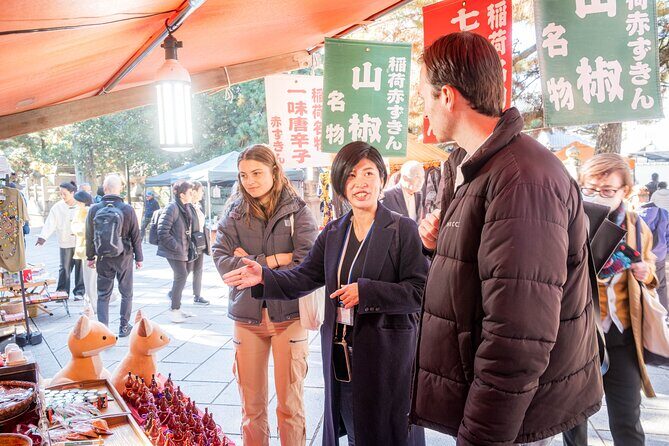
- Kobo-ichi and Kotto-ichi at To-ji Temple: flea-market browsing with a historical backdrop
- English exchange with a local learner: conversation that stays friendly and natural
- Haggling tips you can actually use: guidance for respectful price negotiation
- A mix of antiques and everyday nostalgia: ceramics, vintage clothes, toys, collectibles
- A short, focused route: about 1 hour 30 minutes to 2 hours with no long detours
To-ji Temple Flea Markets: Kobo-ichi and Kotto-ichi in One Walk
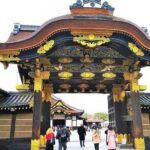
The heart of this experience is a market day at To-ji Temple, tied to flea markets known as Kobo-ichi and Kotto-ichi. That matters more than it sounds. If you’ve ever wandered a market and wondered what’s worth slowing down for, this tour gives you a structure: look around, ask questions, and then use your guide’s tips to decide what to pursue.
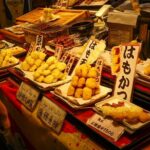
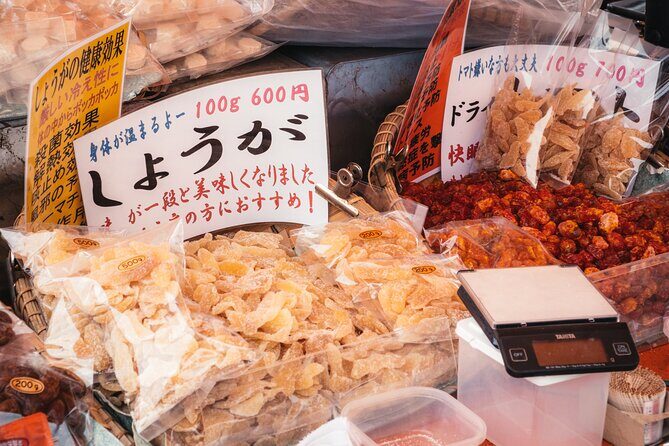
At the stalls, you’ll run into the kinds of items that make flea markets addictive. Think antique ceramics, vintage clothing, old toys, and rare collectibles. The point isn’t to buy everything. It’s to train your eyes to spot quality, age, and style—then learn how locals talk about those differences.
Also, To-ji’s location changes the vibe. You’re not just surrounded by sellers; you’re also moving through a famous temple area. That creates a calm contrast to the shopping energy. You’ll get a chance to walk around the temple grounds in the free area as part of the time built into the tour.
You can also read our reviews of more shopping tours in Kyoto
What can slow you down
If you’re the type who wants to sprint from stall to stall, this may feel a bit conversational. The tour is designed around talk and learning, not speed. Plan to enjoy the pace. The best finds often happen when you stop asking for the easy answer and start listening.
Your English-Learning Local Guide: Practice Japanese Customs the Real Way
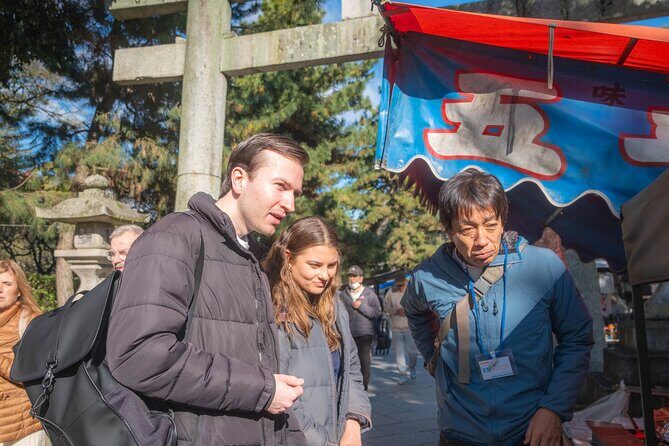
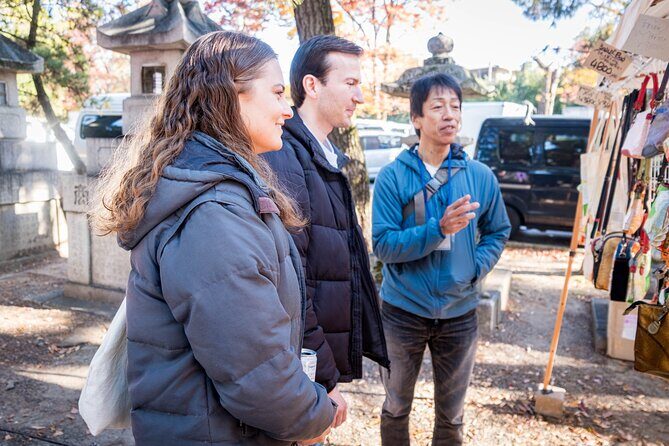
This is where the tour earns its reputation. You’re guided by a local Kyoto resident who is also an English learner, and the format is built for conversation. That means you’re not only hearing facts. You’re practicing how to connect—while your guide practices English at the same time.
From the feedback you’ll read, one theme pops again and again: the guides are kind, fun to talk to, and genuinely interested in Japan. One guide is described as a student from an English conversation school, and that background shows. The goal isn’t to deliver a lecture. It’s to chat with you in a way that feels human and easy.
What you’ll talk about tends to cluster around Japanese customs and how things work in daily life. For example, you can ask what something is used for, why certain items show up at these markets, or what a fair interaction looks like. Your guide helps translate not just language, but the social rhythm behind it.
Why this matters for your Kyoto trip
Kyoto can be heavy on rules—quiet manners, timing, and expectations. When you understand the why, the city feels less complicated. This tour gives you that practical context in small, manageable pieces, right where you’re walking and looking.
If you’re traveling with another person, the conversation style still works. You’ll feel like you’re sharing the walk, not performing it. If you’re traveling solo, it can be even better: you’re likely to get more back-and-forth with the guide as you move through stalls.
Haggling Tips That Actually Help You Shop Confidently
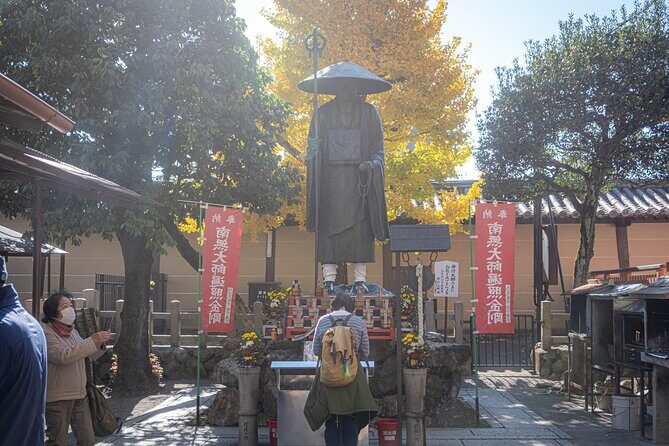
Let’s talk about the part many people worry about: price negotiation. In many markets, bargaining can feel awkward if you don’t know the rhythm. Here, you’re given guidance on how to do it in a friendly way.
The tour explicitly includes help with negotiating prices at tourist-facing places. In a flea market context, that guidance is gold. It lowers the stress of asking, and it helps you avoid the common mistake of making it too aggressive or too vague.
Even if you don’t plan to haggle, the tip value is still there. It teaches you how to ask questions and how to respond when you don’t know an item’s background. That’s a big part of shopping in Japan that many visitors skip.
A few more Kyoto tours and experiences worth a look



A practical way to use the guide’s help
When you see an item you like, don’t jump straight to the sticker price. Ask about the item first—what it is, how old it might be, what it’s typically used for. Then, if you’re interested, ask about price. This gives you room to understand the story before you negotiate.
And if you decide not to buy? That’s fine. The conversation and learning still happen, and you’ll leave with a better sense of value. You’ll also get sharper on what kind of pieces are worth the money versus what’s more decorative or novelty.
Temple Grounds and Five-Story Pagoda Time: What Fits in the 1.5–2 Hours
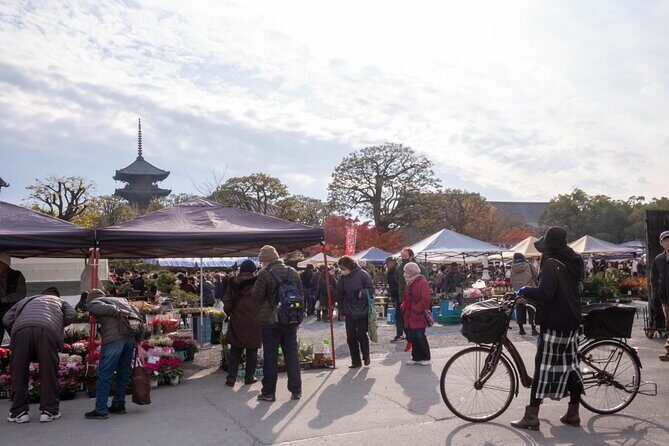
The tour includes a guided market stroll at To-ji Temple plus time in the temple grounds free area. You’ll also start at the To-ji Temple Five-Story Pagoda area, which gives you a strong sense of place right away.
This isn’t a full temple-only day, so don’t expect to cover every corner of To-ji. What you get is a helpful blend: you’ll browse the markets, then step into the calm of the grounds, where the guide can share local insights about the history and atmosphere.
That balance works well for real-world travelers. A pure temple day can feel like information overload. A pure market day can feel chaotic. This combo keeps you anchored. You learn about the site, then you see how the market culture fits into the same setting.
Timing note
The total time is about 1 hour 30 minutes to 2 hours. That’s perfect if you already have a schedule in Kyoto and you don’t want your day hijacked. It’s also long enough to feel you went somewhere specific, not just passed through.
If you’re coming from far away, give yourself a buffer. Markets and conversations both take time.
Price and Value: What $13.01 Buys You in Kyoto
At around $13.01 per person, this tour is priced in the territory where you can say yes without doing math gymnastics. The value isn’t just the market access. It’s the guided cultural translation, the conversation, and the practical shopping help.
Here’s what you’re getting for the cost:
- A guided walk through flea markets at a major temple site
- A local resident who is also an English learner, so interaction stays centered on communication
- Help with understanding what you’re seeing and negotiating prices
- A short route that doesn’t require you to rearrange your whole day
What’s not included is also important. Public transportation isn’t included, so you should budget for getting to the meeting point yourself. Also, gratuities are listed as included, which is unusual in wording. Practically, it means you don’t have to add a separate listed entry fee for the guide in the package. You can still tip if you want, because that’s your call.
The real value equation
You’ll get the best value if you:
- like interacting with locals instead of only watching
- plan to ask questions at stalls
- want help buying confidently, not just browsing
If your style is pure self-guided shopping and you don’t want to talk, the package won’t feel as useful. But if you want a guided, human experience at a reasonable price, it’s hard to beat.
Getting There: Meeting Point, End Point, and How to Plan Your Afternoon
The start time is 1:00 pm. You’ll meet at 544 Yamabushiyamachō, Nakagyo Ward, Kyoto, 604-8156. The tour ends at To-ji Temple at 1 Kujōchō, Minami Ward, Kyoto, 601-8473.
Two practical notes here:
- You’ll want to use your own method of getting to the meeting point since public transportation isn’t included.
- The tour is near public transportation, which is helpful for keeping your trip stress-free.
Because the tour is private, it’s just your group. That usually means you won’t get separated into random subgroups or forced into a pace that doesn’t fit you.
What to bring for a smoother market walk
Markets mean walking and handling items. Even when you’re not buying, bring:
- comfortable shoes
- a small bag you can keep closed
- water for the afternoon
- a plan for carrying anything you buy
If you’re buying fragile items like ceramics, you might want to think ahead about how you’ll transport them. This tour doesn’t list shipping or packing help, so plan accordingly.
What You Can Buy (and What to Watch For)
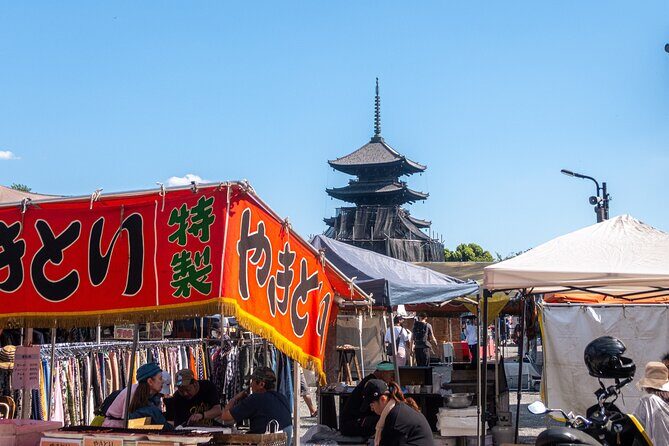
The market is where you’ll see the widest range of items, from antique ceramics and vintage clothing to old toys and collectible pieces. Since the tour is guided, you can ask questions that help you judge what you’re looking at.
A flea market is also where you should stay smart about value:
- Check condition closely before you commit.
- Ask what something is used for or how it’s meant to be cared for.
- Don’t rely only on the first price you hear—this is exactly where negotiation help becomes practical.
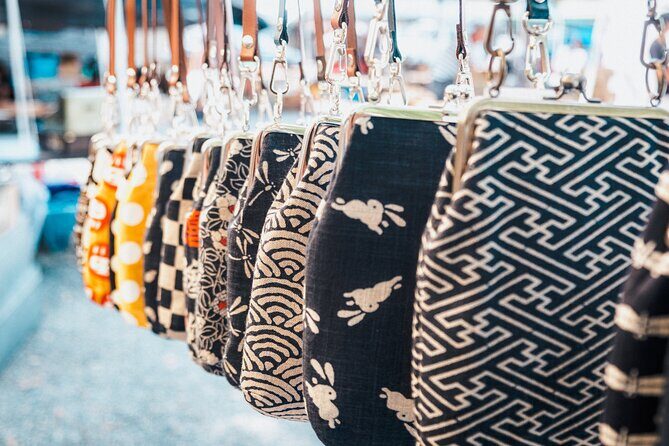
If you’re trying to buy a souvenir that feels meaningful, look for pieces that match Kyoto style. When you understand a little more about the item, it becomes more than a photo target.
Who This Tour Fits Best in Your Kyoto Plans
This is a strong match if you want:
- a cultural exchange with a local who is working on English
- a market experience with a clear, short route
- help shopping with confidence, including bargaining tips
- a blend of flea market energy and a major temple setting
It’s also a good choice if you’ve already seen the big-name sights and you want something more day-to-day and personal.
It might not be the best fit if you:
- hate talking to strangers, even politely
- want a long, multi-stop full-day market route
- prefer purely self-guided shopping with zero structure
Weather and Timing: When the Tour Works Best
This experience requires good weather. If it’s canceled due to poor weather, you’ll be offered a different date or a full refund. That’s a fair approach for an outdoor walking tour tied to market browsing.
Since it’s scheduled for 1:00 pm, you’ll likely be walking in daytime light. If Kyoto is running hot or humid during your visit, keep expectations realistic. You’re there to walk, chat, and browse, not sprint.
Should You Book This Kyoto Flea Market Cultural Exchange?
Yes—if you want Kyoto at human scale. The price is low enough to try without fear, and the format is built around interaction: a local English learner guiding you through To-ji Temple flea markets, with practical help for shopping and negotiation.
Book it if you:
- like conversation and cultural context
- want help understanding the stalls beyond the obvious
- appreciate a short, focused walk rather than a big itinerary
Consider skipping it if you want a solo shopping spree with zero talking, or if you’re traveling in a week where weather risk could ruin outdoor plans.
FAQ
How long is the Kyoto flea market cultural exchange?
It lasts about 1 hour 30 minutes to 2 hours.
Where does the tour start and end?
It starts at 544 Yamabushiyamachō, Nakagyo Ward, Kyoto and ends at To-ji Temple, 1 Kujōchō, Minami Ward, Kyoto.
Is this tour private or shared with other groups?
It is private. Only your group participates.
Is public transportation included?
No. Public transportation is not included.
What’s included in the price?
Gratuities are listed as included. You also receive a mobile ticket.
Is there any admission fee involved?
The itinerary notes admission ticket free.
What happens if the weather is bad?
This experience requires good weather. If it’s canceled due to poor weather, you’ll be offered a different date or a full refund.