REVIEW · KYOTO
Nijo Castle and Imperial Palace Visit with Guide
Book on Viator →Operated by WaRaiDo Guide Networks · Bookable on Viator
Nijo Castle and the Imperial Palace tell one story. You get guided context for Kyoto’s shift from shogunate rule to the later imperial era, plus the kind of on-the-spot explanations that are hard to match solo. I especially like that the tour is kept to a small group (and sometimes even just your party), so you’re not trapped listening while people drift off. One thing to plan around: you’ll walk, and comfortable shoes matter.
The second big win for me is the pace. In about 2.5 hours, you cover both sites with entrance fees and public transportation handled, which saves your time and avoids the awkward logistics shuffle. If you’re the type who wants to understand the why behind what you’re seeing—power, ceremony, symbolism—this format fits that goal.
In This Review
- Quick highlights that matter
- Two Palaces, One Guided Story of Shogun Power in Kyoto
- Price and Timing: What $79.18 Buys You (and What It Saves)
- Meeting at Nijō Castle Main Gate: Your First Hour Starts Strong
- Kyoto Imperial Palace After Nijo: Another Hour With a Different Lens
- The Public Transport Transfer: Efficient, Guided, and Low Stress
- Why the Guide Experience Makes or Breaks This Tour
- What You’ll Actually Learn (Beyond the Photos)
- Logistics You Should Plan For (So Your Day Stays Smooth)
- Who This Tour Fits Best
- Should You Book Nijo Castle and Kyoto Imperial Palace With a Guide?
- FAQ
- How long is the Nijo Castle and Imperial Palace guided tour?
- Where do we meet and where does the tour end?
- Is the cost $79.18 per person all-inclusive for entry and transport?
- Is it private or a small group?
- What time options are available?
- Is free cancellation available?
Quick highlights that matter
- Small group size with a maximum of 11 travelers, and a smaller feel (often under 8)
- Two focused 1-hour guided blocks: Nijo Castle first, then Kyoto Imperial Palace
- Tickets and public transport included, so you’re not juggling separate admissions
- English-speaking professional guide who adds historical and cultural context
- Choice of morning or afternoon departure to match your Kyoto rhythm
Two Palaces, One Guided Story of Shogun Power in Kyoto
This tour works because it connects the dots. Nijo Castle and Kyoto Imperial Palace aren’t just two “pretty buildings” stops. With a guide, you get the bigger storyline: how Kyoto’s political center operated under the shogunate system, and how the imperial era later gained a stronger role.
That’s why the best part here is interpretation. In the castle, you’re guided through the historic buildings with explanations tied to the Edo period and the shogunate. Later, at the Imperial Palace, you get context around the imperial family and the shift of power across eras—especially the period people associate with the move toward Emperor Meiji.
The guides also seem to hit the right balance between facts and clarity. Multiple guide styles are praised for being friendly and funny, but still respectful when discussing national treasures and the serious side of governance and ceremony. If you’ve ever walked through a complex site feeling like you only caught the visuals, this tour’s structure is built to prevent that.
You can also read our reviews of more guided tours in Kyoto

Price and Timing: What $79.18 Buys You (and What It Saves)
At $79.18 per person for roughly 2 hours 30 minutes, the value is mostly in what’s included. You’re not paying extra on arrival for admission, and you’re not spending your time figuring out transit between two major stops with a timeline to keep. The tour includes entrance fees at both locations and public transport during the transfer.
It also helps that the tour has a clear, limited timeline: one hour at each site with guide-led time blocks. That’s a sweet spot for people who want depth without burning half a day. Kyoto can swallow your schedule fast, and this keeps things efficient.
Timing is flexible too. You can choose a morning or afternoon tour slot, which matters if you plan to do other sightseeing that day (like temples earlier or later). Since the meeting is at Nijo Castle and the tour ends at the Imperial Palace area, it’s easy to plug into a Kyoto itinerary with minimal backtracking.
Meeting at Nijō Castle Main Gate: Your First Hour Starts Strong
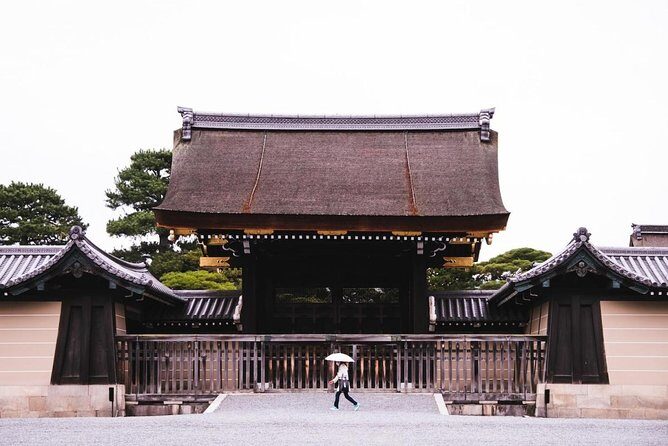
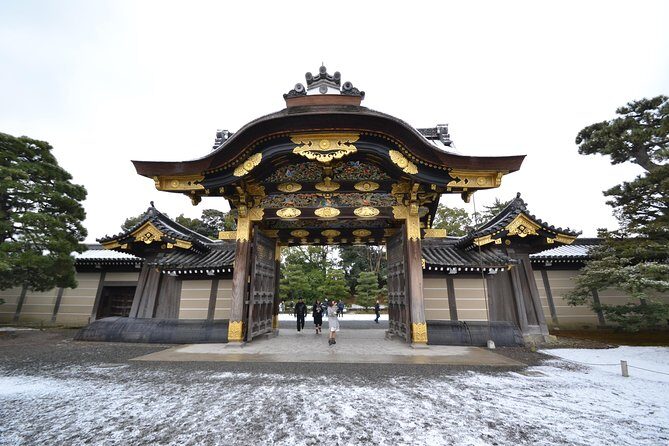
The meet-up is straightforward: you’ll gather in front of the huge white main gate of Nijo Castle at Nijō Castle (541 Nijōjōchō, Nakagyo Ward). There’s a lot to like about starting at a landmark like that. It reduces “where are we?” stress and helps you begin calmly instead of rushing.
Your first hour is guided and ticketed. The focus is on understanding Nijo Castle as a shogunate-era site, not just touring rooms at random. From the way guides are described, expect explanations that connect what you see to how the shogun’s world worked—how power was staged, and why details mattered.
One practical tip: bring questions. Many of the strongest comments center on guides answering specific questions well and giving just enough background to make the symbolism click. If you care about Edo politics, palace life, and the logic behind layouts and ceremonial choices, this first hour is where the tour really earns its keep.
Also, plan for walking. Even within a tight schedule, you’ll be moving through grounds and buildings, and comfortable shoes are a recurring “do this” item.
Kyoto Imperial Palace After Nijo: Another Hour With a Different Lens
After Nijo Castle, you head to Kyoto Imperial Palace using public transportation with your guide. This second stop is another 1-hour guided tour, and it also includes the admission fee.
Here’s what changes: the viewpoint shifts from shogunate symbolism to imperial context. The guide-led explanations focus on the imperial family and the historical line people associate with the later era, including the transition linked to Emperor Meiji. If you enjoy the human side of history—who held power, how authority changed, and what that meant for Kyoto—this is a smart pairing.
One more detail that’s worth noting for expectations: the Imperial Palace experience can be affected by events. In at least one case, access was limited due to an event closure. You should treat this as a possibility, not a guarantee, but it’s smart to keep flexibility in your day if you’re visiting on a tight schedule.
If you’re hoping for photo time, you’ll get some, but this is not a “wander and shoot” style tour. It’s guided, and the goal is for you to leave with context you can actually use when you look back at what you saw.
The Public Transport Transfer: Efficient, Guided, and Low Stress
The transfer is part of the deal. You’re not on your own figuring out how to get from the castle area to the Imperial Palace grounds; the guide handles the route using public transportation.
That matters for two reasons. First, it keeps the total day on track. Second, it reduces the friction of navigating Kyoto transit while trying to keep a group together. The tour is also described as near public transportation, so it’s set up to be practical rather than overly complicated.
What to expect emotionally: you’ll go from “wow, castle” to “now the imperial setting,” without a long pause that breaks momentum. Guides can also use travel time to explain what you’ll be seeing next, which helps the second hour feel connected instead of separate.




Why the Guide Experience Makes or Breaks This Tour
With tours like this, the guide is the product. Even the best buildings can feel flat if you don’t know what questions to ask. Here, the repeated theme is that the guides explain things clearly, keep the pace lively, and add the kind of cultural context that makes architecture and ceremony make sense.
English quality comes up often, with guides described as warm, humorous, and easy to spend time with. Names mentioned include Mia/Mie and Choko (and also Mike in at least one case). The common threads in their style are:
- they explain what you’re looking at
- they place it in the bigger Edo/shogunate-to-imperial story
- they answer questions without shutting you down
- they use helpful visual aids in some cases
I also like that the best comments don’t paint the guide as just a lecturer. People highlight humor and an approachable tone, with history delivered in a way that feels relevant rather than overly heavy.
If you’re someone who likes learning but gets bored by long monologues, pay attention to this: the tour is structured in two one-hour guided segments. That naturally limits time for any single “lecture mode” and keeps the experience moving.
What You’ll Actually Learn (Beyond the Photos)
The tour is built to teach you how to interpret the sites. The strongest focus points are:
- the Edo period and how the shogunate system shaped power in Kyoto
- how Kyoto functioned as an ancient capital tied to political authority
- the symbolism and practical “workings” behind the shogun’s world
- the later imperial era context, including the shift people connect to Emperor Meiji
These aren’t just trivia topics. They help you notice details you’d otherwise miss—like how authority is communicated through palace settings and the way history is staged through space.
It’s also a good fit for first-timers. If you’re new to Kyoto history and feel like you’re seeing the buildings but not the meaning, this tour helps you connect the dots fast.
Logistics You Should Plan For (So Your Day Stays Smooth)
Here are the practical things I’d plan around before you go:
- Start point matters: meet at the Nijo Castle main gate. Don’t assume you can wander in late and catch up easily with a guided group.
- Comfortable shoes: walking is part of both sites, and the schedule is tight enough that sore feet can ruin your attention span.
- Ask questions early: your guide’s explanations work best when you tell them what you’re curious about (shogun rule, imperial context, how power changed).
- Use the mobile ticket: the tour includes a mobile ticket feature, which helps with speed at entry points.
And if you like a little buffer, arriving a bit early helps. One strong comment notes that getting there early made it easy to find the guide and start smoothly.
Who This Tour Fits Best
This is a great choice if you:
- want a deeper historical lens than you’ll get from a quick self-paced visit
- like learning from an English-speaking guide with context and room for questions
- prefer a small group feel (maximum 11, often smaller)
- want to see both Nijo Castle and the Imperial Palace without turning your day into a transit puzzle
It may be less ideal if you:
- hate guided pacing and want long unscheduled wandering
- only want casual photo stops with minimal talking
- plan to skip history explanations entirely and just browse
If your goal is to leave with a coherent story about how shogun authority and imperial power are connected in Kyoto, this tour is very well matched.
Should You Book Nijo Castle and Kyoto Imperial Palace With a Guide?
Yes—if value to you means saving time while gaining real context. For $79.18, you’re paying for a licensed guide experience plus the admissions and transport you’d otherwise handle on your own. The two-hour structure also makes it easier to commit: you’re not gambling on a long guided day with uncertain interest.
I’d book it especially if you care about the Edo period and the power shift tied to Emperor Meiji. The guides are repeatedly praised for turning complex history into something you can actually hold in your head, with explanations that stay respectful and grounded.
Skip it only if you’re the type who needs total freedom and doesn’t care much about guided interpretation. Otherwise, this is one of the more efficient ways to see both sites in Kyoto while keeping the learning curve manageable.
FAQ
How long is the Nijo Castle and Imperial Palace guided tour?
The tour runs about 2 hours 30 minutes total.
Where do we meet and where does the tour end?
You meet in front of the huge white main gate of Nijō Castle at 541 Nijōjōchō, Nakagyo Ward. The tour ends in front of the Imperial Palace, with the provided end location listed near Kyoto Gyoen National Garden.
Is the cost $79.18 per person all-inclusive for entry and transport?
Yes. The price includes entrance fees and public transportation costs during the tour. Food and drinks are not included.
Is it private or a small group?
It’s described as a private-style experience for just your party, and it also lists a small group format (less than 8 guests) with a maximum of 11 travelers.
What time options are available?
You can choose either a morning or an afternoon tour to fit your schedule.
Is free cancellation available?
Yes. You can cancel up to 24 hours in advance of the experience start time for a full refund. If you cancel less than 24 hours before, the amount paid is not refunded.