REVIEW · KYOTO
Samurai School in Kyoto: Samurai for a Day
Book on Viator →Operated by Ginbu Co., LTD. (former name: Samurai Kenbu Co., LTD.) · Bookable on Viator
A katana class in Kyoto can feel unreal. You’ll learn samurai bowing and sword-draw basics and then step into kenbu-style performance training, plus a costume photo session. It’s hands-on history, not museum time.
I like that the lesson is structured and practical: a short film sets the stage, then you suit up and practice the exact moves—bow, draw, and resheath—under clear guidance. I also love the built-in souvenir side: a costume photo moment, a completion certificate, and a traditional towel. One thing to keep in mind: the earlier show/demo can run longer than you expect, so plan to stay for the full experience.
In This Review
- Key things I’d circle before you go
- Samurai for a Day in Kyoto: What the Class Really Delivers
- Finding Kembu Kyoto Dojo (GOZAN Building) Without Stress
- The 3-Minute Film and Samurai Warm-Up You’ll Appreciate Later
- Bow, Draw, Resheath: The Katana Basics You Actually Practice
- A practical note on physical demand
- Costume Upgrades the Fun (and Helps the Photos Land)
- Optional Longer Session: Walking, Folding Fan, and Kenbu Choreography
- The Mini Show Before or After: Why the Timing Can Change Your Feel
- Price and Value: Is $66.32 Worth It?
- Who This Samurai School Fits Best (and When to Skip It)
- Practical Tips That Make the Whole Day Go Smoother
- Wear the right clothes for costume changes
- Bring a calm mindset for safety and corrections
- Build a little extra buffer into your schedule
- If you care about photos, be ready when it’s your turn
- Should You Book Samurai for a Day? My Straight Answer
- FAQ
- How long is the Samurai School in Kyoto experience?
- What’s included in the price?
- Do I get dressed in a samurai costume?
- Is there an option for a longer practice session?
- Where do I meet the group?
- Is hotel pickup included?
- What should I wear?
Key things I’d circle before you go
- Sword etiquette first: you start with the bow, then learn how to draw and replace the sword in its scabbard
- Small-group format: maximum of 10 travelers, so your instructor can actually help
- Dress-up is part of the class: costume fitting plus a photo shoot, not just a quick change
- Optional upgrade for more choreography: walking, folding fan work, and more challenging kenbu sequences
- Safety and discipline matter: the class is built around doing moves correctly, not just posing
Samurai for a Day in Kyoto: What the Class Really Delivers
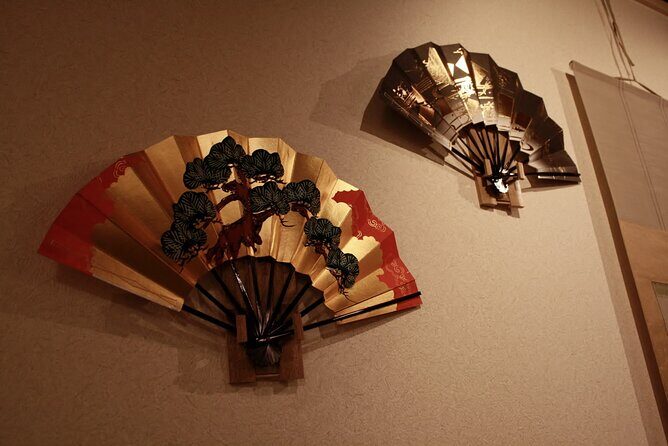
This is one of those Kyoto experiences that fits two moods at once: you want culture, but you also want to move. Samurai School in Kyoto is called Samurai for a Day, and the core idea is simple. You’ll learn stylized samurai techniques (including drawing a katana and basic strikes) from an instructor, then you’ll finish with a photo session in samurai costume. If you choose the longer option, you’ll keep going into additional choreography, including folding fan use and more advanced kenbu-style performance.
The big value here is that the class is not just viewing. You practice. You suit up. You get a completion certificate. And because it runs indoors at the dojo, it’s also a strong rain-day pick.
At $66.32 per person for about 90 minutes, it’s priced like an experience, not like a shopping spree. The best way to judge it is by what you get included: English-speaking instruction, a photo shoot, and souvenirs (a completion certificate and a tenugui towel). That makes the cost feel more reasonable, especially if you’d otherwise pay for a guided activity and photos separately.
You can also read our reviews of more tours and experiences in Kyoto.



Finding Kembu Kyoto Dojo (GOZAN Building) Without Stress
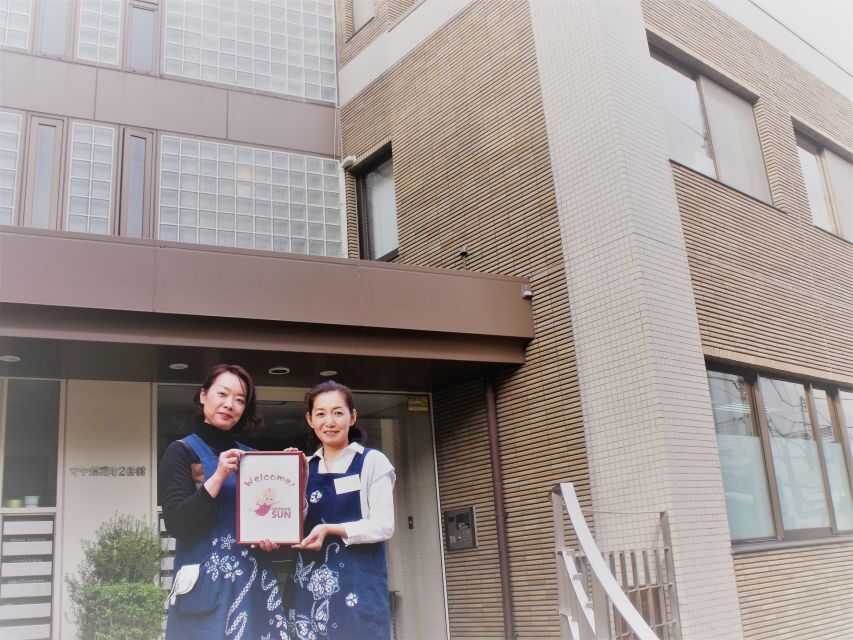
Your start point is in Higashiyama Ward, at Sanchōme 35, the GOZAN building area. On the day of the event, you go to the first basement floor—take the stairs on the right side of the GOZAN building—and arrive a bit early. The instructions say to arrive 10 to 3 minutes prior to your selected start time.
Why this matters: sword training runs on timing. If you’re late, you may feel rushed during costume changes, and you’ll miss the calm ramp-up that helps you learn safely.
Good news: it’s listed as near public transportation, and there’s no hotel pickup or drop-off. So if you’re already exploring Higashiyama, this is easy to slot into your day.
The 3-Minute Film and Samurai Warm-Up You’ll Appreciate Later
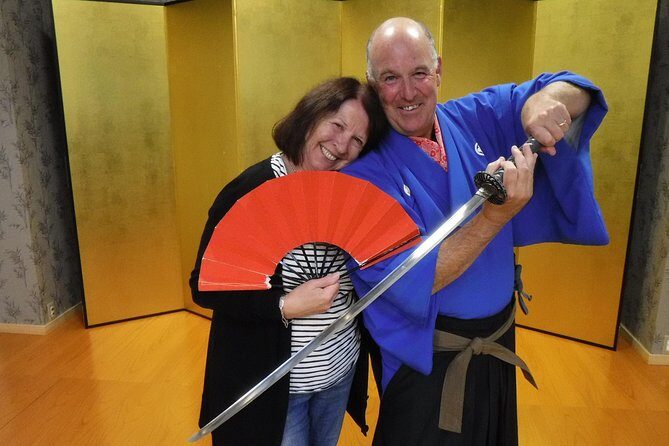
Before you touch the sword, the experience starts with a short 3-minute film about basic samurai practices. It’s quick on purpose: it gets the main idea across without turning the session into a lecture.
Then you meet your instructor and you watch your introduction to what you’ll do. You’ll learn the discipline behind the motions—how samurai training connects etiquette, movement, and form. That context is useful because once you’re holding the sword, you’ll understand why the instructor cares about steps that look simple (like how you bow or how you manage the scabbard).
Then comes the part that turns “cool history” into a real activity: you suit up in traditional uniform pieces, including a white belt, Japanese-style socks, and your sword.
Bow, Draw, Resheath: The Katana Basics You Actually Practice
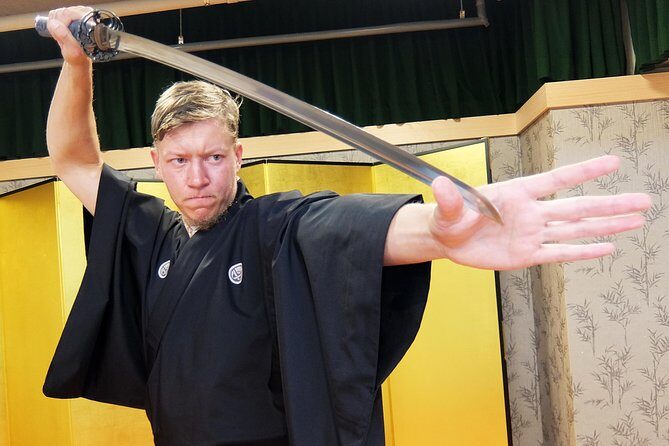
The heart of the shorter class is the sword technique foundation. You begin with proper bowing, then move into sword handling: an introduction to drawing the blade and returning it to the protective scabbard. You’ll also practice different methods of striking, so it’s not just a single motion you repeat mindlessly.
This is where the small-group cap helps. With a maximum of 10 travelers, you’re more likely to get corrections when your form needs adjustment. And because the class is safety-focused, you’ll be nudged to follow instructions closely rather than freestyle.
Even if you’re not a martial arts person, you can still enjoy this because the training style is structured. You’ll see the pattern: stand, bow, grip and draw, then replace properly. It’s a skill sequence, not a random set of moves.
A practical note on physical demand
The fitness requirement is listed as moderate. You don’t need to be an athlete, but you should expect standing, moving, and doing repeated choreography safely.






Costume Upgrades the Fun (and Helps the Photos Land)
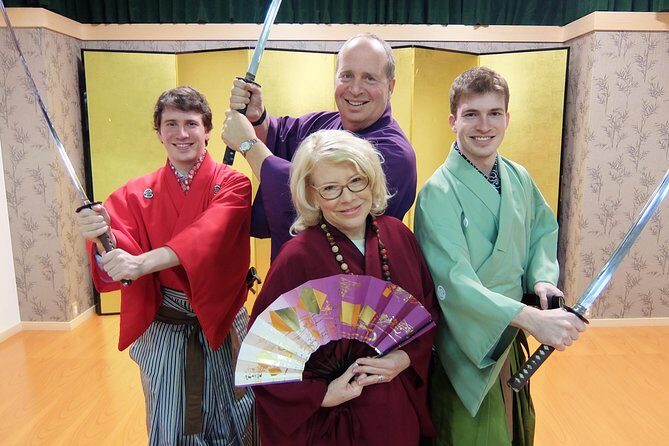
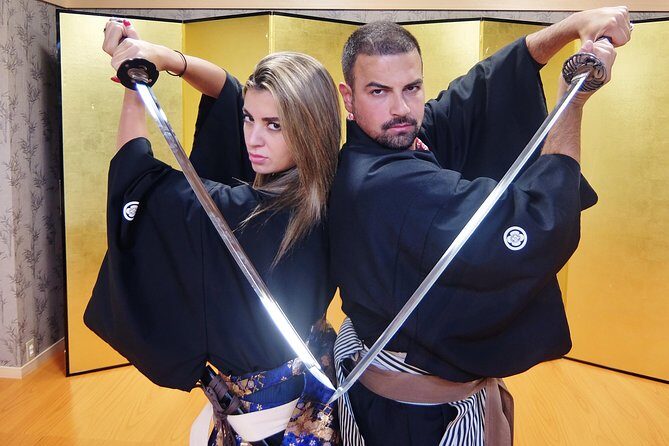
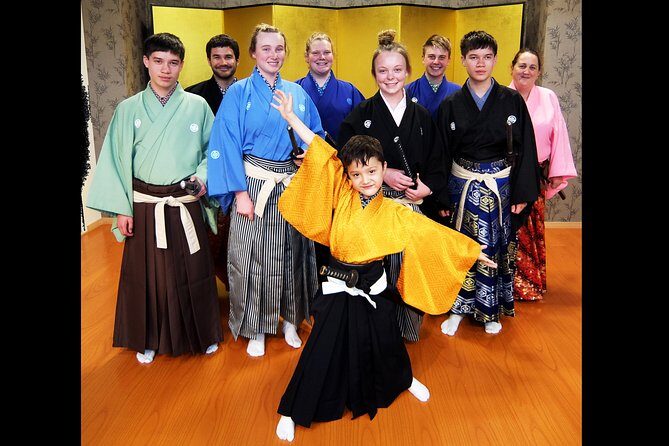
After sword basics, you pause during training to suit up in traditional samurai costume for a short photo session. You also get a completion certificate and a souvenir tenugui towel.
This costume-and-photos segment is a big part of the appeal. From the reviews, the costume experience is one of the most consistently praised elements: people love being dressed up and getting to hold a sword while looking the part. It turns your class into an easy-to-remember Kyoto moment.
One consideration: the photo session is time-bound. If you bring your own camera and expect long, posed shooting time, plan for it to be more “guided and efficient” than a professional studio session. A few past experiences have mentioned feeling rushed, so if photos are your top priority, come with a simple plan: be ready when you’re called, and don’t count on lots of take-and-try time.
Optional Longer Session: Walking, Folding Fan, and Kenbu Choreography
If you upgrade, you’re not just “staying longer.” You’re adding new movement layers and performance elements.
The longer lesson continues with stylized samurai actions such as how to walk and how to use a folding fan. Then you complete with more challenging kenbu choreography where you perform on stage. The performance is presented with poem and music accompaniment.
Why this matters for value: the short class gives you the basics. The longer option gives you a mini end-to-end arc: learn, practice, then show it as a performance. If you like the idea of training that feels like theater as well as martial arts, this is the option that turns your class into a story.
Also, this is where the experience feels most complete for history-and-performance lovers. You’re not only handling a sword—you’re learning how stylized sword-and-gesture movement becomes a form.
The Mini Show Before or After: Why the Timing Can Change Your Feel
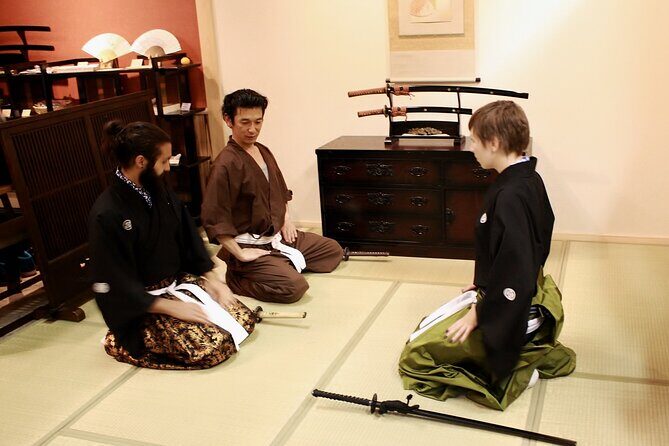
The experience includes a performance component where you’ll watch a show and see the performers’ skills. There’s also mention that a short demo or show may come early in the overall timeline, before the “interesting part” of hands-on sword practice.
So here’s the practical advice: treat the performance as part of the learning ecosystem. The show isn’t separate entertainment you must tolerate—it’s meant to help you understand what you’re practicing. But timing can be a factor. If you’re coming specifically for sword training and you dislike waiting, arrive with a patient mindset and be ready for the schedule to feel longer than the “hands-on only” part.
If you choose the longer training option, you may feel even more appreciative of the show because you’ve already practiced parts of the movement language.
Price and Value: Is $66.32 Worth It?
Let’s look at what you get for $66.32 and why it’s not just a random add-on.
Included:
- English-speaking instructor
- Photo shoot
- Tenugui towel
- Lesson completion certificate
Not included:
- Food and drinks
- Hotel pickup/drop-off
Duration is listed as about 1 hour 30 minutes (for the main option), and it’s a small group experience with a maximum of 10 travelers.
For value, you can think of this as three bundles:
1) Guided sword technique training (the main ticket item)
2) Costume and photos (a big part of the appeal, especially for families or couples)
3) Souvenirs and completion paperwork (easy to take home)
Compared to paying for a guided cultural activity and separately paying for costume/photo packages, the all-in structure is what makes the price feel fair—especially if you’re going with someone and you both want photos. If you’re a solo traveler who mainly wants “just practice,” you might feel the photo and certificate are optional add-ons rather than must-haves. But most people get a lot of mileage out of the whole experience package.
Who This Samurai School Fits Best (and When to Skip It)
This class is ideal for:
- Martial arts enthusiasts who want a focused, structured introduction to samurai-style movement
- History buffs who like context and discipline, not vague storytelling
- Families with teens (and older kids) who want hands-on learning over museum time
- Couples who want a fun Kyoto memory with photos
It may be less ideal if:
- You’re extremely impatient with schedule blocks and don’t want to wait for demos/show segments
- You expect a long, personalized photo session with lots of retakes and pose direction
- You’re looking for a deep, scholarly course. This is training and performance practice, not an academic seminar.
For kids: there’s guidance that if participants are ages 5 to 11, it’s preferable they attend some kind of class or martial arts school. The class has a disciplined tone, and the expectation is to follow instructions carefully.
Practical Tips That Make the Whole Day Go Smoother
Here’s what will help you enjoy the experience instead of fighting logistics.
Wear the right clothes for costume changes
You’re told to wear clothes suited for exercise and moving around. Clothes like a single hoodie or tights may not work well for costume changes. If you can, choose something you can get in and out of comfortably.
Bring a calm mindset for safety and corrections
The experience is explicit about following the instructor’s instructions for safety reasons. That means you’ll likely be corrected, and you should treat that as part of the value. This isn’t a casual gimmick—it’s training with boundaries.
Build a little extra buffer into your schedule
A few people noted the session can run a bit over. That’s normal for a small-group training class—people need time to suit up, practice, and take photos. So keep your next plan flexible.
If you care about photos, be ready when it’s your turn
The photo session is included, but time is limited. You’ll get your costume moment. For best results, show up ready, follow directions quickly, and you’ll get the most out of the time you’re given.
Should You Book Samurai for a Day? My Straight Answer
Book it if you want a hands-on Kyoto activity where you actually practice samurai technique, dress in costume, and walk away with photos and a certificate. The small group size and the structured teaching style make this feel like a real class rather than a scripted tourist show.
Consider skipping or choosing the shorter option if:
- You care mostly about quick sword practice and don’t want the longer performance-style training
- You’re very photo-focused and expect long, fully posed professional-style shots
My final take: this is a strong, fun “do something” Kyoto pick—especially on rainy days or when you want a memorable cultural activity that doesn’t require museum patience.
FAQ
How long is the Samurai School in Kyoto experience?
The main experience is listed at about 1 hour 30 minutes, and it may vary based on the selected option.
What’s included in the price?
Included are an English-speaking local instructor, a photo shoot, a tenugui towel, and a lesson completion certificate. Food and drinks are not included.
Do I get dressed in a samurai costume?
Yes. You’ll suit up first in samurai uniform elements during training, and then there’s a photo session where you’ll wear traditional samurai costume.
Is there an option for a longer practice session?
Yes. There’s an optional upgrade for a longer lesson, adding training like walking and folding fan skills, then more challenging kenbu choreography performed on stage with poem and music.
Where do I meet the group?
You start at Japan, 605-0005 Kyoto, Higashiyama Ward, Sanchōme, 35, and you’ll go to the first basement floor from the stairs on the right side of the GOZAN building.
Is hotel pickup included?
No, hotel pickup and drop-off are not included.
What should I wear?
Wear clothes suited for exercise and moving around. A single hoodie or tights isn’t suitable for costume changes.