REVIEW · TOKYO
Tokyo: 1.5-Hour Edo Kiriko Glass Cutting Workshop in Sumida
Book on GetYourGuide →Operated by Roomy's Inc · Bookable on GetYourGuide
Glass cutting sounds scary, until you try it. That’s the charm of this Edo Kiriko workshop in Sumida, where you get a guided, hands-on taste of Tokyo’s famous cut-glass craft with a small group of four. You’re not just watching; you’re learning the rhythm and getting your hands on the tools.
I especially like the practice session with test pieces first, which makes it much easier to understand why Edo Kiriko is so prized. I also appreciate the English-speaking support that keeps the steps clear, even when the craft gets technical.
One possible drawback: the atmosphere leans relaxed and hands-off, so true beginners may benefit from asking questions early rather than waiting for someone to step in. If you want very tight instruction, plan to be proactive.
In This Review
- Key points before you go
- Why Edo Kiriko Glass in Sumida Is Worth 90 Minutes
- Entering the Working Studio: What You’ll See First
- Practice With Tools Before Your Final Cut
- Choosing Your Glass: One-of-a-Kind Pieces for Beginners
- What You’ll Make: Drinking Glass vs. Lidded Container
- Cutting Your Own Pattern: The Skill You’re Really Learning
- English Support and How the Guide Helps It Click
- The Shop After: Turning Your Workshop Into a Souvenir You Understand
- Price and Value: Is $122 Fair for Edo Kiriko?
- Who Should Book This Workshop (and Who Might Skip It)
- Should You Book This Edo Kiriko Workshop?
- FAQ
- How long is the Edo Kiriko workshop in Sumida?
- Where does the workshop take place?
- What can I make during the workshop?
- Who is eligible to join?
- What’s included in the ticket price?
- Are hotel pickup and drop-off included?
- What languages are available during the workshop?
- Is photography allowed?
Key points before you go
- Real Edo Kiriko studio time: You see artisans engraving and cutting glass while the workshop is actually happening around you.
- Practice first: You try the tools on test pieces before cutting your final design.
- Pick your own glass: You choose from a daily changing set of unique pieces.
- Age-based making options: Adults and older kids cut drinking glasses; younger children make lidded containers.
- Small group format: Limited to 4 participants, which helps questions and attention.
- English support included: A live guide helps with translation and understanding the process.
Why Edo Kiriko Glass in Sumida Is Worth 90 Minutes
Edo Kiriko is one of those crafts that looks simple from far away and suddenly feels precise when you’re up close. The appeal of doing it in Sumida is that you’re working in the same kind of practical, working-studio environment where artisans actually make the glass—not in a staged showroom where everything is already finished.
This workshop is built for first-timers, but it doesn’t treat you like a kid who needs babysitting. You’ll watch craftsmen at work, learn basic safe technique, and then practice with tools before you cut your own design. That order matters. It turns the experience from I-watched-someone-do-stuff into I-understand-what-I’m-doing.
And yes, you take your finished piece home. That’s a big part of the value: this isn’t just a souvenir photo. It’s an object you made with your own hands, even if you’re a total beginner.
A few more Tokyo tours and experiences worth a look


Entering the Working Studio: What You’ll See First
When you arrive, you step into an active Edo Kiriko glass-cutting studio in Sumida. Artisans are engraving and cutting glass while the workshop gets underway. For me, that’s the difference between a craft class and a craft experience: you get to see the real workflow instead of a demo that’s over in two minutes.
You’ll begin by observing how the craftsmen handle the tools and manage the glass. You’ll also pick up the basic idea of how cut patterns are built—small controlled movements rather than brute force. You’re not expected to master it instantly, but you do get a sense of why these pieces are time-consuming and why the details matter.
Then your guide and staff explain what’s next. In your session, English support is available, so you’re not left guessing about safety or technique. That clarity is especially useful when glass cutting is involved, because the goal is confidence, not chaos.
Practice With Tools Before Your Final Cut
One of the most praised parts of this kind of workshop is also the most practical: you don’t start by cutting your final piece. You practice first.
You’ll get test glasses to work on so you can feel how the tools respond to pressure and angle. You’ll learn how to handle the setup, how to follow the guide’s instructions, and how to correct mistakes early—before they cost you your chosen glass. That “practice before the main event” structure is what makes Edo Kiriko feel doable.
I like this approach because it changes the mindset. Instead of worrying about getting it perfect, you focus on learning the motions. Even if your first attempts aren’t what you pictured, you’re training your hands for the real cut.
And because the workshop is small—limited to 4 participants—you’re more likely to get your questions answered quickly. Still, the general vibe is relaxed. If something isn’t clear, it’s smart to ask sooner rather than later.
Choosing Your Glass: One-of-a-Kind Pieces for Beginners
After the initial observation and practice, you choose your own glass. The selection changes daily, and the key thing is that each piece is one-of-a-kind. That means you’ll likely see different shapes, colors, and styles depending on the day.
This step feels more meaningful than it sounds. If you’re a beginner, having a design and glass you personally like makes it easier to stay motivated through the careful parts. It’s also why the finished piece feels like a keepsake, not a generic craft activity.
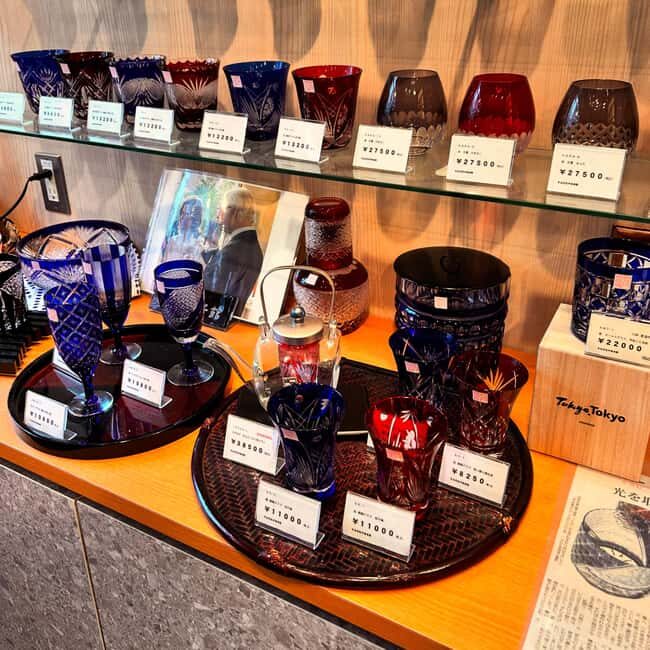
The workshop also includes a chance to visit the on-site shop afterward. That’s where Edo Kiriko shows its range: classic motifs, plus modern collaborations with well-known brands such as Starbucks. Seeing that variety right after you make something helps you understand Edo Kiriko as a living craft, not a museum-only tradition.
What You’ll Make: Drinking Glass vs. Lidded Container
This workshop is age-tailored, which actually helps you plan.
- Adults and middle school students cut drinking glasses.
- Elementary school children cut lidded containers, with supervision.
Participants must be at least 4th grade elementary school (with an adult companion). Also, it’s listed as not suitable for children under 9 years, which is useful to know if you’re traveling with younger kids.
Here’s the practical takeaway: if you’re bringing a family, think about the makers’ age as part of your expectations. A parent accompanying a child can observe without cutting, which lets everyone experience the studio even if only one person is working.
And because the workshop is indoors and designed for comfort, the hands-on portion feels contained. You’re working at a bench with guidance, not wandering between stations in a large room.





Cutting Your Own Pattern: The Skill You’re Really Learning
The main action is cutting your original pattern, guided by the staff. The exact tool technique isn’t spelled out in the basic description, but the workshop clearly follows a structured path:
- Watch how artisans work.
- Practice with test pieces.
- Choose your own glass.
- Cut your own pattern with staff guidance.
- Take the finished Edo Kiriko home.
What you’re really learning is control. Glass cutting in this style rewards patience and focus more than speed. The good news is the workshop atmosphere is relaxed. You’re not being scolded for mistakes, and the practice pieces help you get comfortable with the technique first.
That relaxed pace can be a two-sided thing:
- For beginners, it reduces stress and keeps you learning.
- For people who want constant step-by-step supervision, it can feel a little light.
So if you’re the type who likes very detailed coaching, go in ready to ask questions during your cutting time. The studio gives you freedom to experiment, and you’ll get more out of it if you guide that freedom with questions.
English Support and How the Guide Helps It Click
Edo Kiriko is a hands-on craft, but instruction matters—especially for safety. This workshop includes a live guide with Japanese and English support.
In plain terms, English support helps you do two crucial things:
- Understand what you’re supposed to do next (so you’re not guessing).
- Learn how to correct technique early (so you don’t feel stuck).
From the experience feedback, the guide’s translation is clear enough that you can follow the process rather than just watch silently. That also makes it easier to communicate with staff while you’re working.
If you’re traveling with family, this is even more valuable. Kids can focus on the cutting without falling behind on instructions, and adults can supervise with less language friction.
The Shop After: Turning Your Workshop Into a Souvenir You Understand
After the cutting portion, there’s time to browse the Edo Kiriko shop on site. This is one of those “small” extras that actually helps the whole experience make sense.
You’ll see:
- Traditional motifs alongside more modern styles
- Colorful Edo Kiriko items
- Brand collaborations, including a Starbucks connection
Then you look at those pieces with a different brain. Once you’ve tried cutting glass—at least on a test piece—you’re more likely to notice the work behind the patterns. You can see the craftsmanship in a way that’s hard to appreciate just by shopping.
And since you’ll be bringing something home that you made yourself, the shop time becomes a chance to compare styles and ideas. You might find a design you like for your next visit—or just enjoy recognizing the motifs you just learned about.
Price and Value: Is $122 Fair for Edo Kiriko?
At $122 per person for about 90 minutes, this workshop isn’t the cheapest thing you can do in Tokyo. But it’s also not overpriced if you look at what’s included.
You’re paying for:
- A guided workshop in a real working studio
- A practice session with test pieces
- Use of professional tools and guided safety technique
- Your own cut glass (or lidded container, based on age)
- English-speaking support
- A small group limited to 4 participants
The big value factor is the take-home piece. Craft workshops can feel pricey when the result is a paper craft you could do in an afternoon. Here, you get an actual glass item you made, and the materials and tool setup are real. That’s why it’s easier to justify the cost versus a class where nothing tangible is created.
If you’re someone who likes making one solid souvenir instead of collecting five mediocre ones, the value makes more sense. If you want a casual photo opportunity with no pressure to focus, you might find it expensive for what it is.
Who Should Book This Workshop (and Who Might Skip It)
This is a great match if you:
- Want a hands-on Tokyo activity that’s traditional but not overly formal
- Like crafts where patience and technique matter
- Prefer small-group settings with real studio access
- Are traveling with older kids who can follow safety-focused instructions
It’s also a good family option because companions can observe if they’re not cutting. That keeps the experience from turning into a stressful “everyone must participate” situation.
You might consider skipping it if:
- Your group has very young kids who are below the listed suitability age range
- You want tightly structured step-by-step teaching with constant intervention
- You’re hoping for a short, low-focus activity. This one rewards concentration
And one simple practical note: pets are not allowed.
Should You Book This Edo Kiriko Workshop?
If your goal is to experience Edo Kiriko in a way that goes beyond watching, I’d book it. The mix of real studio observation, practice with test glasses, and cutting your own design is the formula that makes the craft feel understandable. The small group size and English support also help you avoid the common problem with craft classes: feeling lost while everyone else moves on.
Book it especially if you want one meaningful Tokyo keepsake you can explain. You’ll have a story behind it, not just a label.
If you’re extremely sensitive to being guided lightly, just go in ready to ask questions during your cutting time. You’ll get more confidence faster, and you’ll enjoy the relaxed atmosphere without feeling abandoned.
FAQ
How long is the Edo Kiriko workshop in Sumida?
The workshop lasts about 90 minutes, with a guided experience designed around observation, tool practice, and cutting your own piece.
Where does the workshop take place?
It takes place in Sumida, Tokyo (Honshu, Japan) in an Edo Kiriko glass studio setting.
What can I make during the workshop?
Adults and middle school students cut drinking glasses. Elementary school children cut lidded containers.
Who is eligible to join?
Participants must be at least 4th grade elementary school, with an adult companion. The workshop is listed as not suitable for children under 9 years.
What’s included in the ticket price?
Included: the 1.5-hour guided workshop, a tool practice session, the glass-cutting experience (glass or lidded container), observation of artisans at work, and English-speaking support.
Are hotel pickup and drop-off included?
No. Hotel pickup and drop-off are not included.
What languages are available during the workshop?
The live guide provides Japanese and English support.
Is photography allowed?
Photography is allowed in designated areas.