REVIEW · TOKYO
Tokyo: Japanese Calligraphy Lesson with Skilled Instructor
Book on GetYourGuide →Operated by Experience Calligraphy Tokyo · Bookable on GetYourGuide
One word can turn into a keepsake. This Japanese calligraphy lesson in Asakusa walks you through picking a meaningful phrase, practicing it with lots of paper, and transferring it onto a real souvenir you can take home. Two things I really like: the English explanations that help you choose something that actually means something, and the calm small-group setup that makes it feel like focused tutoring instead of a hurried demo.
There’s one drawback to consider: you have just 1 hour, so you’ll be aiming for a finished piece, not a multi-session perfection project.
In practice, this is the kind of experience that works well in Tokyo when you want something hands-on, quiet, and distinctly Japanese—without needing to already know kanji strokes.
In This Review
- Key highlights
- Asakusa Setting: Tatami-Calm Rooms and a Small Group Pace
- Choose Your Word: English Meanings That Help You Pick Something Personal
- The Lesson Flow: From Practice Strokes to a Finished Piece
- Uchiwa, Shikishi, or Kakemono: Turn Your Calligraphy Into a Real Souvenir
- Shusuke’s Instruction Style: Calm Coaching You Can Follow in English
- What the Instructor Covers: Words, Meaning, and Stroke Accuracy
- Price and Value: Why $45 Works Here
- Logistics That Actually Matter: Timing, Meeting Point, and Room Type
- Who Should Book This Calligraphy Lesson in Tokyo
- Should You Book This Calligraphy Lesson in Asakusa?
- FAQ
- What will I make during the calligraphy lesson?
- How long is the lesson?
- How many people are in the group?
- What language will the instructor use?
- What materials are included?
- Is there free cancellation?
Key highlights
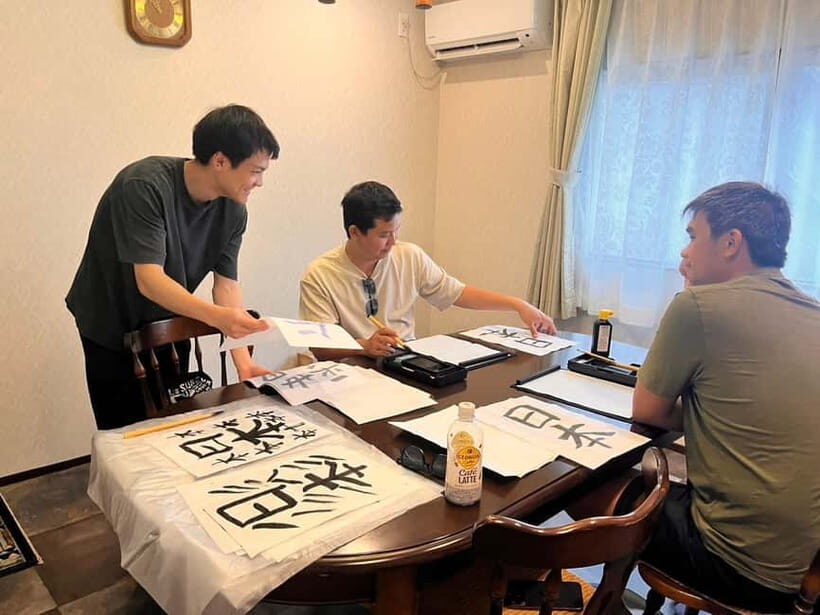
- Small group (up to 4) so you get real hands-on guidance
- English meanings explained clearly so you can pick your word or phrase confidently
- 20 sheets of hanshi gives you time to refine stroke by stroke
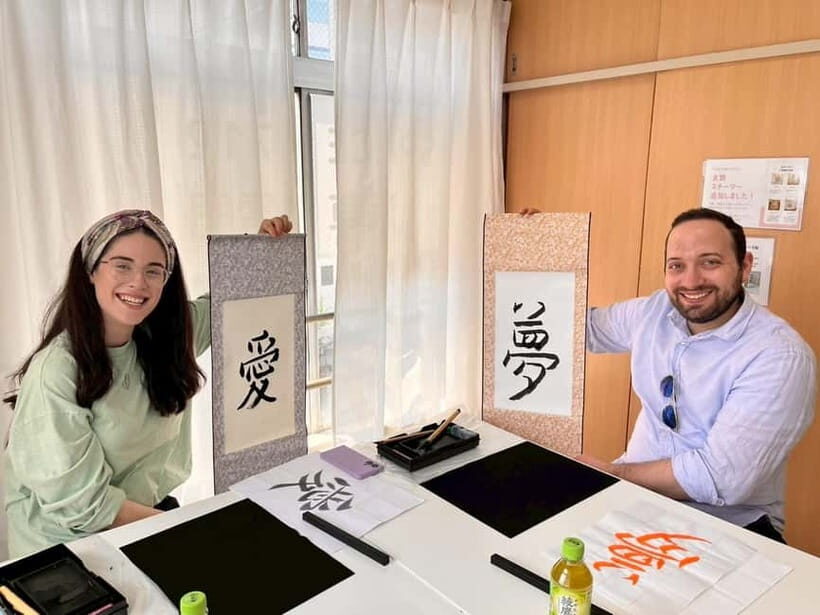
- Choose your final format: uchiwa fan, shikishi board, or kakemono scroll
- A commemorative photo to remember your finished piece
- Instructor Shusuke uses a steady, patient teaching style in a relaxed room
Asakusa Setting: Tatami-Calm Rooms and a Small Group Pace
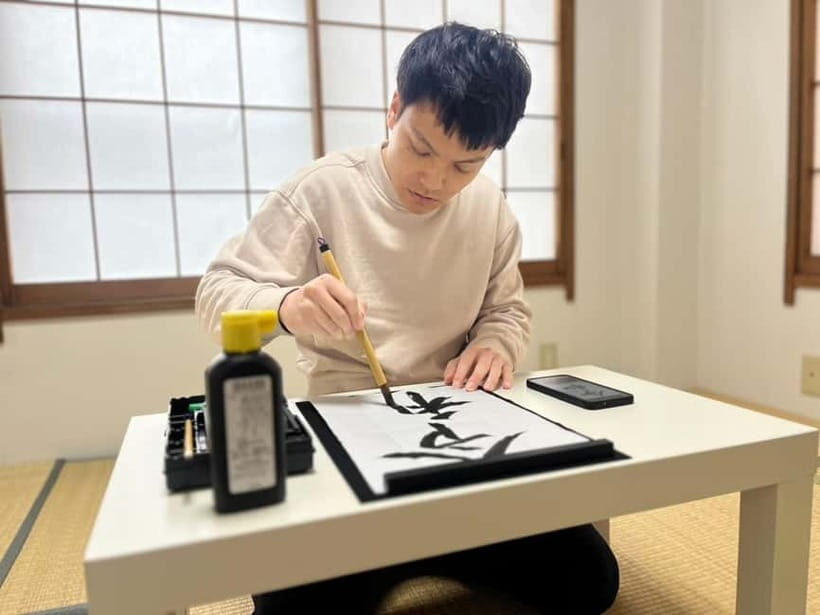
This class takes place in Asakusa, in a rented room. Depending on availability, you may be in a tatami-style Japanese room or a Western-style room with a table and chairs. Either way, the goal is the same: a calm place to write, watch, and practice without feeling like you’re in a loud workshop.
The group size is limited to 4 participants, and you can feel the difference. Instead of competing for attention, you get room to ask questions and slow down if your hand needs it. The experience also feels intimate—one of the biggest reasons this kind of lesson is worth doing in Tokyo rather than trying to rush through a museum-style activity.
A few more Tokyo tours and experiences worth a look


Choose Your Word: English Meanings That Help You Pick Something Personal
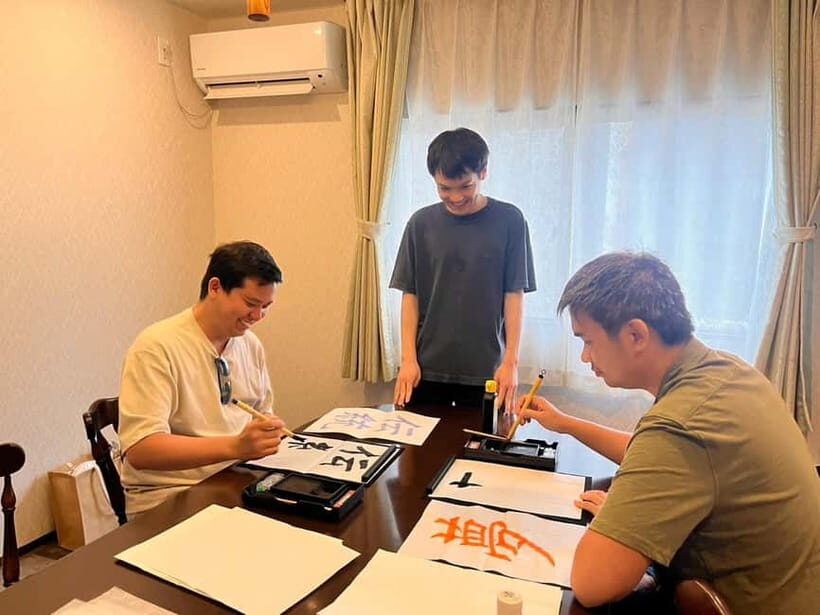
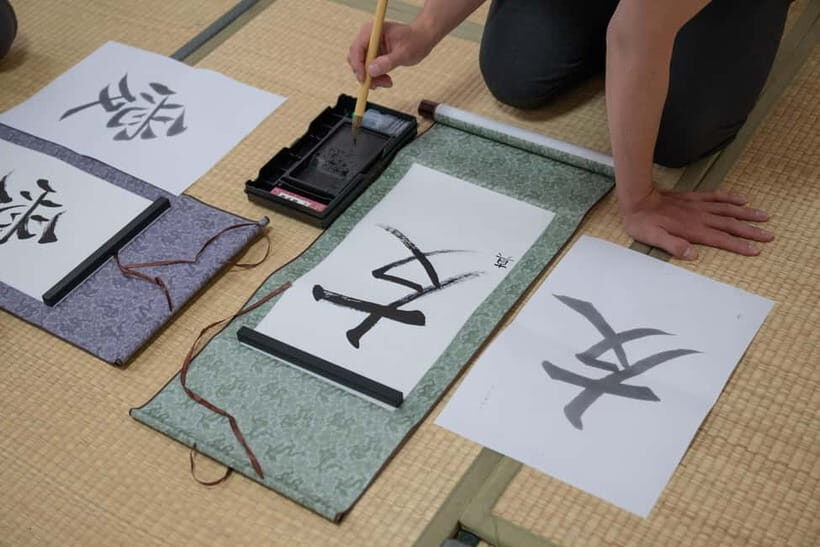
The first step is picking your favorite word or phrase from sample calligraphy works. You’ll see examples in different forms, each tied to a specific meaning and cultural significance, and the instructor explains the meaning in English so you’re not guessing what you’re writing.
This part matters more than you’d think. If you choose a character or phrase that feels relevant to you—something about your trip, your life, or a hope for the year—you end up with a souvenir you’ll actually want to keep. It’s not just decorative writing; it becomes a personal message.
If you’re worried about not knowing Japanese, you’ll probably find this stage reassuring. The instructor is there specifically to help you understand what the word is, not just how to copy it.
The Lesson Flow: From Practice Strokes to a Finished Piece
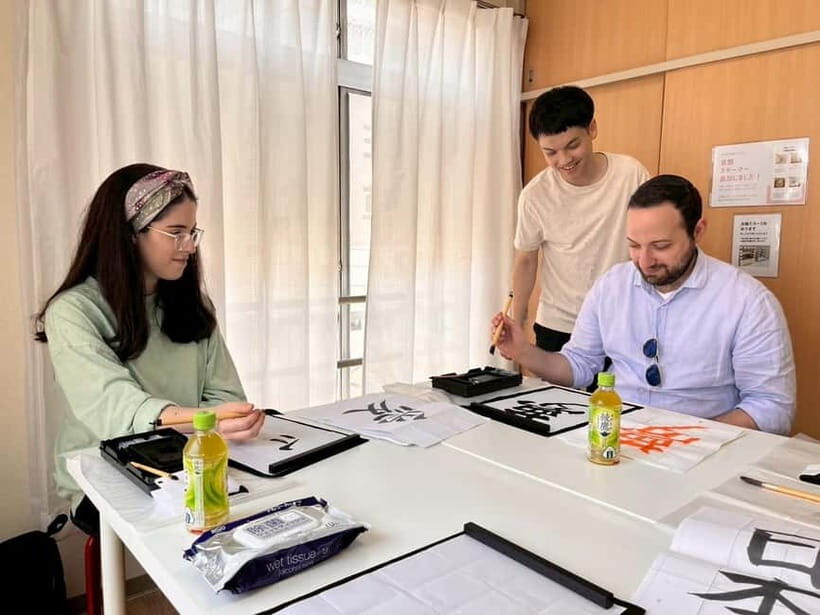
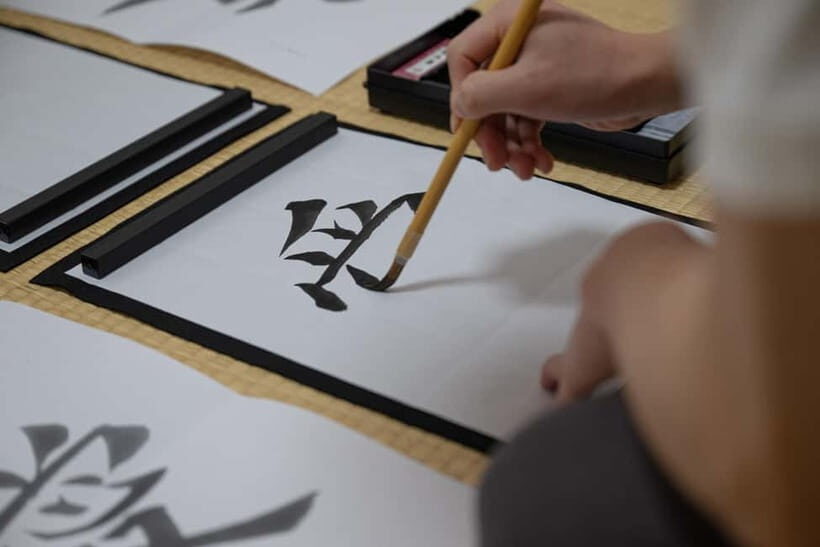
Once you select your word or phrase, you move into practice on special calligraphy paper. The class uses hanshi, and you get 20 sheets for working on your strokes. That gives you enough tries to get comfortable—especially if your first attempts look more like handwriting experiments than calligraphy.
About halfway through the class structure, your instruction becomes more specific. You’re shown how to shape strokes, how to control spacing, and how to adjust based on what you’ve written. Then you keep practicing long enough to tighten things up, with guidance available as you go.
A helpful detail in this kind of lesson is that you’re not expected to magically master everything from the start. With 20 sheets, you can do what real practice needs: repeat, check, correct, and repeat again.
Uchiwa, Shikishi, or Kakemono: Turn Your Calligraphy Into a Real Souvenir
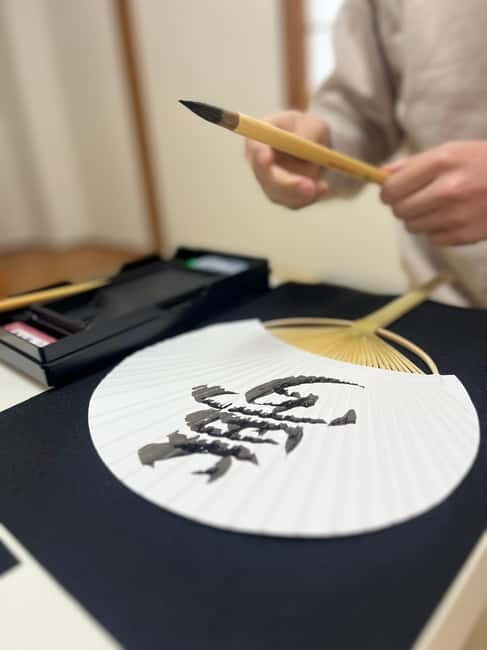
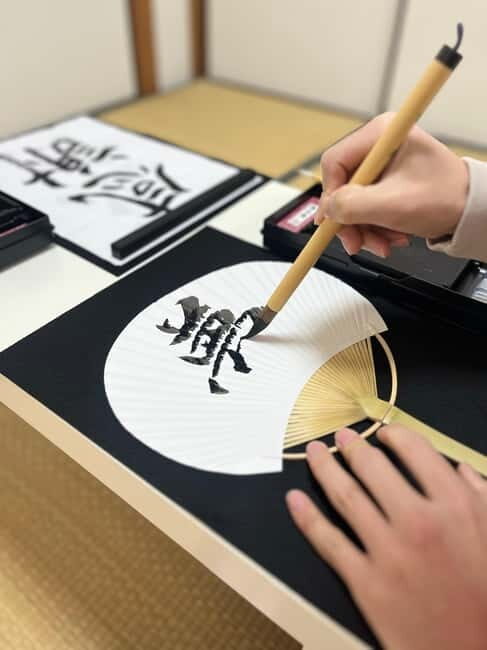
Here’s the fun part: you don’t just practice on paper and leave. You transfer your writing onto one of three take-home souvenir options: uchiwa (fan), shikishi (decorative board), or kakemono (hanging scroll).
This is where the experience becomes more than a class. You’re making a physical item that looks right in its intended format—flat and decorative for a fan or board, or more vertical and display-friendly for a scroll. Because the final item is your choice, you can pick what fits your life back home.
If you like the idea of a daily-use souvenir, the uchiwa fan is practical and fun. If you want something that frames easily or looks clean on a surface, shikishi is a strong option. And if you want that classic display feel, a kakemono is the move.
In one recent review, a participant described receiving a scroll-style souvenir with a kanji they wrote themselves. That’s exactly what you should aim for here: your own characters, not a copied example.
Shusuke’s Instruction Style: Calm Coaching You Can Follow in English
The instructor for this experience is Shusuke, and his background shows in how the lesson is delivered. He has 10+ years of calligraphy instruction and is certified in Japanese calligraphy (Rank: 3rd Dan, Japan Educational Calligraphy Federation). In plain terms: you’re not learning from someone who knows the basics—they’re teaching techniques.
Language support is also a big plus. Instruction is offered in English and Japanese, and Shusuke speaks Japanese natively with advanced English (and beginner Korean as well). That matters because calligraphy can get technical fast—things like stroke pressure and how to finish a line cleanly. When the key points are explained in English, you spend less time guessing and more time improving.
Multiple reviews point to a calm, relaxed vibe, with plenty of help during the session. One review specifically mentions that Shusuke took lots of photographs and was ready to answer questions, which can be reassuring if you’re unsure what to ask.
So yes, you’ll be making something yourself, but you’re not doing it alone.




What the Instructor Covers: Words, Meaning, and Stroke Accuracy
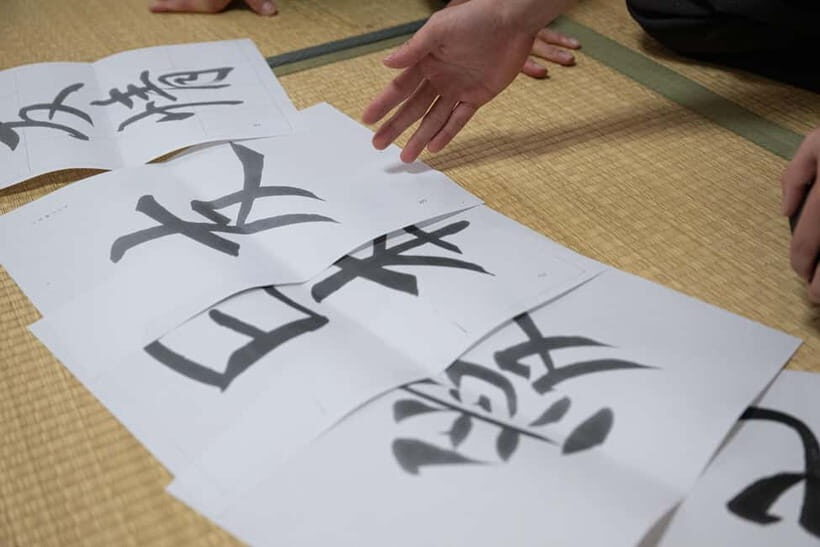
This class isn’t just copying characters. You learn about Japanese words and their meanings, with explanations in English that help you connect the written characters to the idea behind them. That is the difference between a souvenir that looks cool and one that feels meaningful.
You’ll also get instruction on writing techniques. With calligraphy, the final look depends on control: starting a stroke, guiding it, and finishing it with intention. The class structure supports that because you practice first, then transfer to your final item.
In a review in Spanish, a participant described exercises with kanji and learning about the different presentation formats, which lines up with what you do here: pick a word, practice it, then apply it to your chosen souvenir style.
If your Japanese knowledge is limited, that’s okay. You’re not being graded on vocabulary. You’re learning how to create a calligraphy piece that makes sense and looks right.
Price and Value: Why $45 Works Here
At $45 per person for a 1-hour lesson, this isn’t the cheapest thing you can do in Tokyo. But the value is strong for what you receive.
Here’s what the price is really covering:
- Guidance from an instructor with 10+ years of teaching experience
- Access to sample works and English explanations of meanings
- 20 sheets of hanshi for practice
- A take-home souvenir of your choice: uchiwa, shikishi, or kakemono
- A commemorative photo of your finished masterpiece
Many “craft” activities charge similar rates but leave you with something small or generic. In this case, the materials and the final souvenir are part of the deal. You’re also leaving with something you helped create, which makes it easier to justify the cost compared to buying a finished item at a shop.
In other words: you’re paying for skill transfer plus a finished, personal product.
Logistics That Actually Matter: Timing, Meeting Point, and Room Type
The class lasts 1 hour, which is plenty time to choose a word, practice, and produce a final piece—especially with an instructor guiding your strokes. The session is also small, with a maximum of 4 participants, so you’ll likely get started without feeling like you’re waiting around.
One practical point: the meeting point is in Asakusa, but the exact rental room location is shared by email after you reserve. The room could be tatami or Western-style depending on what’s available. That flexibility is normal, but it does mean you should read the email instructions carefully so you don’t waste time searching.
If you’re planning this on a travel day, it’s smart to schedule it with a little buffer. Japanese neighborhoods can be easy to get around, but small rooms and rental spaces are sometimes tucked away.
Who Should Book This Calligraphy Lesson in Tokyo
This is a great fit if you want a hands-on Tokyo activity that’s quiet, structured, and meaningful. It’s also a strong option if you want to understand Japanese words beyond a basic phrasebook level—because you’ll see examples, learn meanings in English, and then choose what speaks to you.
You’ll probably enjoy this most if:
- You like making souvenirs with your own hands
- You want a calmer activity with one-on-one attention in a small group
- You’re curious about Japanese writing and want clear guidance, not guesswork
- You’ll appreciate a finished item you can display at home
If you’re looking for something high-energy or sightseeing-heavy, this won’t be that. This is about writing, not rushing.
Should You Book This Calligraphy Lesson in Asakusa?
Yes, I think you should book it if you want a genuinely Japanese keepsake made in a small-group setting with English support and a teacher who can correct your strokes as you go. The biggest reason to choose this over a quick demo is that you practice on 20 sheets and take your work home in one of three souvenir formats.
Book it especially if you want your souvenir to have meaning, not just aesthetics. The word-selection stage is where you create that personal connection, and the instructor’s calm coaching helps you get to a satisfying final result within the 1-hour time frame.
If you’re short on time in Tokyo, this is one of those rare activities where the structure matches the time. You leave with a piece of art you made, and that’s hard to beat.
FAQ
What will I make during the calligraphy lesson?
You’ll choose a word or phrase, practice it, and then transfer it onto a take-home souvenir. You can choose between an uchiwa fan, a shikishi decorative board, or a kakemono hanging scroll.
How long is the lesson?
The calligraphy lesson lasts 1 hour.
How many people are in the group?
The group is limited to 4 participants, making it a small-group experience.
What language will the instructor use?
The lesson is offered in English and Japanese. The instructor also has advanced English ability.
What materials are included?
You receive 20 sheets of hanshi (calligraphy paper) for practice, plus step-by-step guidance from the instructor. You also get a commemorative photo with your completed masterpiece.
Is there free cancellation?
Yes. You can cancel up to 24 hours in advance for a full refund.
![[Narita Airport Terminals 1, 2] 40-60km Sawara Itako Historic Bike Tour - The Route: Tone River Cycling Road to Edo Sawara and Katori Jingu](https://images.thejapantraveler.com/wp-content/uploads/narita-airport-terminals-1-2-40-60km-sawara-itako-historic-bike-tour.jpg)