REVIEW · KYOTO
Authentic Maiko Experience&Kyoto Dinner (Free drink) at Noh Stage
Book on Viator →Operated by 舞妓さんと楽しむ京都の四季 · Bookable on Viator
A Noh stage makes it feel real. This intimate Maiko evening isn’t a mass “show.” You get live music, proper etiquette, and ozashiki-style conversation in a small room where the details matter.
Two things I really like are the kaiseki dinner paired with the performances, and the chance for real Q&A after the dance and kimono introductions. You’re not just watching from far away—you’re in the same atmosphere, with time to talk and play.
One consideration: the stage has clear rules. You’ll need socks or tabi for the Noh-stage photo time, and you can’t eat or drink while you’re up there.
In This Review
- Key Highlights You Should Know Before You Go
- A Maiko Dinner That Isn’t Built for Mass Audiences
- Finding the Okazaki Noh Stage: Location and Timing That Work
- 17:50–18:00: First Stop, Stage Rules, and Your Photo Window
- Dinner Starts With a Welcome Toast and the Real Soundtrack
- The Maiko Dance Moments: Close-Up, Live Music, and Etiquette
- Your Two-Shot Photo on the Noh Stage
- Conversation Time and Ozashiki Games: Where the Night Changes
- Unlimited Drinks for 2 Hours: A Practical Bonus
- How to Make the Most of Your Q&A (Without Overthinking It)
- Price and Value: Why $150 Can Make Sense Here
- Who This Fits Best (And Who Might Find It a Stretch)
- Should You Book This Maiko Dinner at the Noh Stage?
- FAQ
- What time does the experience start and end?
- Where exactly do I meet for the program?
- What do I need to wear for the Noh stage photo time?
- What’s included in the $150 price?
- Is there an interpreter or translation support?
- How big is the group?
- What is the cancellation window for a refund?
Key Highlights You Should Know Before You Go

- Maiko dance on a Noh stage with live shamisen (played by the jikata)
- Unlimited drinks for 2 hours, plus a welcome toast
- Two-shot photo on the Noh stage with the maiko
- Ozashiki games on stage, with live shamisen accompaniment
- Kimono and kanzashi intro followed by Q&A
- Small format with a maximum of 20 people, starting at 6:00 pm
A Maiko Dinner That Isn’t Built for Mass Audiences

Kyoto has plenty of “Maiko shows,” but many are designed like theatre—big stage, big crowd, big distance. This one is different because it leans into how a traditional ozashiki evening actually works: conversational, slower-paced, and very focused on manners and response.
What that means for you is simple. You’re not just there to watch pretty costumes. You’re there to learn the rhythm—when to listen, when to ask, and how the music and dance connect to what’s happening around you. The Noh stage setting also matters. It isn’t an afterthought; it’s the real performance space, which makes the experience feel more respectful and less staged for selfies.
A few more Kyoto tours and experiences worth a look
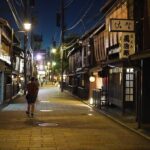
Finding the Okazaki Noh Stage: Location and Timing That Work

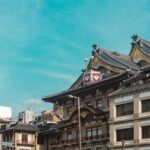
This experience meets in Okazaki, Kyoto (Sakyo Ward), at 岡崎庵, address listed as Kyoto, 606-8344, Sakyo Ward, Okazaki Enshōjichō, 9165. It ends back at the same meeting point, so you don’t have to figure out a second drop-off.
Timing is tight but friendly. Doors open at 17:50, and the official gathering happens at 18:00 on the second floor of the Noh stage. If you arrive early, you can relax in the first-floor café space—a nice buffer if you’re catching the train and want a calm start.
The evening runs until about 20:00. That’s long enough for dinner, music, conversation, photos, and games, without turning the night into a marathon.
17:50–18:00: First Stop, Stage Rules, and Your Photo Window
When the doors open at 17:50, you’re in “settle in” mode. You’ll wait in the café area on the first floor, then move up for the program when it’s time.
At 18:00, you gather on the second floor of the Noh stage area. This is where the rules show up—so read them before you wander into the photo moment.
During the free photo time on the Noh stage, you’ll need socks or tabi. Bare feet aren’t allowed. Also, you’re told no eating or drinking on the stage during that photo window. It’s easy to treat this as a quick snapshot, but do it properly: keep the moment tidy, then step back and let the evening continue.
Dinner Starts With a Welcome Toast and the Real Soundtrack

Once everyone gathers, the program moves to the welcome part. You’ll get a welcome toast, and then the dinner starts.
What I like about this pacing is that food isn’t an afterthought. Dinner begins right as the evening becomes formal. That helps you shift into the right mindset: this is a Kyoto evening, not a late dinner break between plans.
Then the live entertainment begins in earnest with the entrance of the maiko and the jikata—the jikata is the performer who plays the live shamisen. Unlike canned audio, live shamisen changes the feel of the room moment by moment. You can hear the energy in the instrument, and it gives the dance space a real heartbeat.
The Maiko Dance Moments: Close-Up, Live Music, and Etiquette

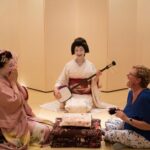
The highlight sequence is built around the maiko performance. The maiko dances on the Noh stage to the live shamisen, and the program also includes multiple dance performances, not just a single quick set.
Because the setting is the Noh stage, you’ll notice something important: it’s not just “look at me” dancing. The choreography and timing work with the room. When live shamisen leads the movement, it feels less like entertainment and more like practiced art.
After the dance, you’ll have greetings and self-introductions. Then there’s a structured kimono and kanzashi introduction with Q&A. This is one of the best parts for practical understanding. You’re not only seeing the visual—someone explains the choices, the styling, and what it means, then you get to ask questions.
A few more Kyoto tours and experiences worth a look
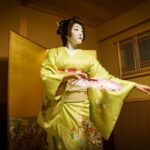
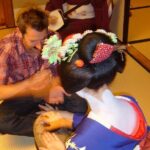

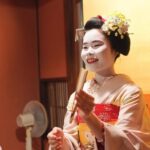
Your Two-Shot Photo on the Noh Stage

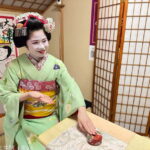
You’ll get a two-shot photo with the maiko on the Noh stage. This happens after the kimono/kanzashi introduction and the Q&A segment.
It’s worth knowing that this photo moment fits into etiquette. You’re not roaming around the stage. You’re there for a specific time, under stage rules, in the middle of a formal evening.
So if you’re booking with the photo goal in mind, I’d treat it like a respectful interaction—not a casual posing session. That approach will keep you in sync with what the staff and performers expect.
Conversation Time and Ozashiki Games: Where the Night Changes

The program doesn’t stop at dance and photos. After the introductions and Q&A, there’s dedicated conversation time with the maiko.
This is where you’ll feel the biggest difference versus a typical tourist performance. The setting is intentionally intimate, with time for playful back-and-forth and real questions. One of the standout themes from past participants is how they valued the chance to ask direct questions and learn the meaning behind what they were seeing—especially about life as a maiko and how the traditions work day to day.
Then you move into ozashiki games on the Noh stage, livened up by the live shamisen. These games add movement and personality to the evening. They also make the night feel less “lecture” and more like you’re joining the flow—still respectful, but warmer and more social.
Unlimited Drinks for 2 Hours: A Practical Bonus

For an evening that already runs a packed schedule, the unlimited drinks for 2 hours are genuinely useful. It gives you a social buffer during the parts that are more conversational—especially around greetings, Q&A, and the transition into games.
Just remember the stage rule: no eating or drinking during stage photo time. But for everything else, it helps you settle in and enjoy the evening without worrying about a drink cutoff halfway through.
How to Make the Most of Your Q&A (Without Overthinking It)
You’ll get Q&A during the kimono and kanzashi introduction, plus additional conversation time. You don’t need to prepare a speech, but having 2–3 clear questions can make you feel more confident.
Here are safe, high-value question types based on what the evening focuses on:
- Ask about the meaning of kimono and kanzashi choices.
- Ask how etiquette shapes daily behavior in a traditional setting.
- Ask about what aspects of training or performance surprise people.
Keep your questions short. Listen first, then ask. This kind of evening rewards people who stay present rather than trying to “win” the conversation.
Price and Value: Why $150 Can Make Sense Here
At $150 for about 2 hours, this is not a budget activity. But it’s also not priced like a basic show, because so much is included.
Here’s what you’re paying for:
- Kaiseki meal (not just snacks)
- Unlimited drinks for 2 hours
- Maiko dance with live shamisen
- Kimono/kanzashi introduction plus Q&A
- Two-shot photo
- Ozashiki games
- A Kyoto-certified interpreter guide (translation support)
In other words, you’re buying a full program—food, cultural instruction, live performance, interaction, and a photo moment—rather than just watching a dance set from a distance. If you value authenticity and conversation, that added value is real. If your priority is only a quick dance performance, you might find cheaper options elsewhere. But for people who want the “why,” not just the “what,” this format justifies the price.
Who This Fits Best (And Who Might Find It a Stretch)
This works best if you:
- Want a more intimate Kyoto experience with interaction, not just viewing.
- Like traditional etiquette and structured Q&A.
- Are comfortable in a small group setting and enjoy conversation.
- Want a guided cultural evening with translation support.
It may feel less ideal if:
- You hate rules around footwear and stage behavior (socks/tabi are required for the stage photo time).
- You’re traveling with very large luggage (oversize luggage isn’t included).
- You’re looking for a casual, flexible night out where you can wander.
The evening is small by design, with a maximum of 20 people, and it starts promptly at 18:00. If you’re late or flustered, you’ll feel it. Plan to arrive with a little breathing room.
Should You Book This Maiko Dinner at the Noh Stage?
If you’re choosing between a standard Maiko show and something that feels closer to how ozashiki gatherings operate, I’d book this. The combination of live shamisen, up-close dance on a real Noh stage, and real conversation time is the rare part. Add the kaiseki dinner, unlimited drinks, and a two-shot photo, and you’re getting more than a performance—you’re getting an organized cultural evening.
I’d especially recommend it if you want to ask questions and learn what you’re seeing, not only watch it. Bring socks or tabi for the stage, keep your timing tight for the 18:00 gather, and treat the stage rules like part of the experience.
FAQ
What time does the experience start and end?
The start time is 6:00 pm, and the event ends at 20:00 (about 2 hours total). Doors open at 5:50 pm.
Where exactly do I meet for the program?
You meet at 岡崎庵 (Okazaki Enshōjichō) in Sakyo Ward, Kyoto: Kyoto, 606-8344, Sakyo Ward, Okazaki Enshōjichō, 9165. The activity ends back at the meeting point.
What do I need to wear for the Noh stage photo time?
You’ll need socks or tabi for the Noh-stage photo time. Bare feet aren’t allowed, and there is no eating or drinking while on the stage.
What’s included in the $150 price?
Included are the meal (kaiseki style) and free drinks, the maiko’s dance with live shamisen, kimono/kanzashi intro and Q&A, time to talk with the maiko, ozashiki games, and a two-shot photo. A Kyoto-certified interpreter guide is also included.
Is there an interpreter or translation support?
Yes. The experience includes a Kyoto-certified interpreter guide, and translation support is part of how the evening runs.
How big is the group?
The program has a maximum of 20 people. There is also a minimum of two participants.
What is the cancellation window for a refund?
You can cancel for a full refund up to 24 hours before the experience start time. If you cancel less than 24 hours before, the amount paid isn’t refunded.