REVIEW · TOKYO
Experience Big soba knife Soba Making Class in Tokyo Kappabashi
Book on Viator →Operated by Sobagiri Rakujyo · Bookable on Viator
Making soba is easier than it looks. In Kappabashi, you’ll learn the real buckwheat noodle process with hands-on tools, then taste what you made. I love that it’s small-group (max 15), and you get clear, step-by-step guidance even if the instructor’s English is limited. The one thing to consider: if you have a buckwheat allergy, you can’t enter the restaurant.
This class runs about 50 minutes and keeps moving. You’ll follow a simple 4-step rhythm—adding water, kneading, stretching, and cutting—using a large soba knife made for the job. My only caution is practical: you’ll be working with floury dough and sharp-ish tools, so it helps to show up ready to get a little messy.
In This Review
- Key Things You’ll Notice in This Soba Class
- Why Kappabashi Is the Right Place for Soba
- Getting to Open Kitchen Studio and Starting Smoothly
- The 50-Minute Flow: From Dough to Real Noodles
- Using the Soba Knife: The Skill That Makes It Click
- No Hunger Pangs: Taste Your Soba (and Keep Some)
- Optional Add-Ons: Matcha Soba and Sake Choices
- Small-Group Size: Why It Feels Personal Without Being Awkward
- Price and Value: Is $51.33 a Good Deal?
- Who Should Book (and Who Should Skip)
- Should You Book Sobagiri Rakujyo’s Soba Class in Kappabashi?
- FAQ
- How long is the soba making class?
- Where does the class take place?
- Do they use wheat flour for the noodles?
- Is it a small-group experience?
- What equipment is provided?
- Is there food included?
- Are there extra fees for dietary options or special items?
- Can I cancel for a full refund?
Key Things You’ll Notice in This Soba Class
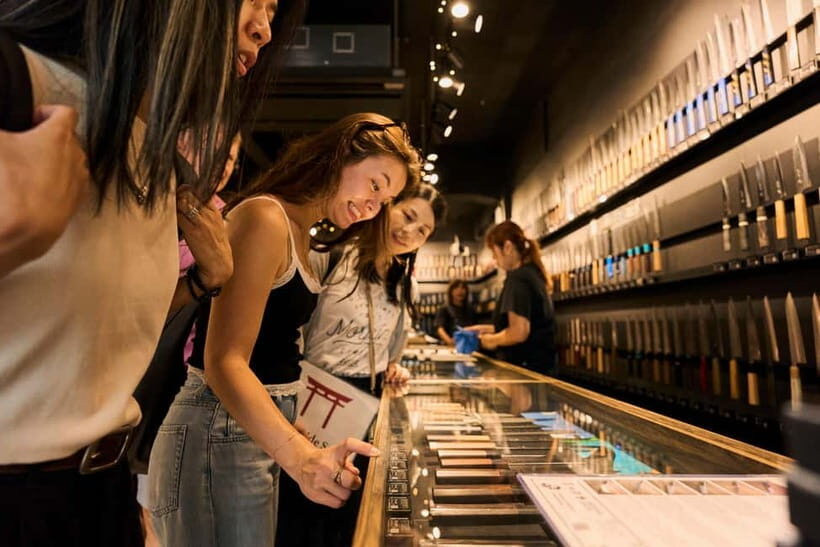
- Kappabashi kitchen town setting: You’re in Tokyo’s tool and chef-equipment lane, so the whole day feels food-first.
- Buckwheat-focused, no wheat flour approach: The class is built around soba noodles made from buckwheat flour.
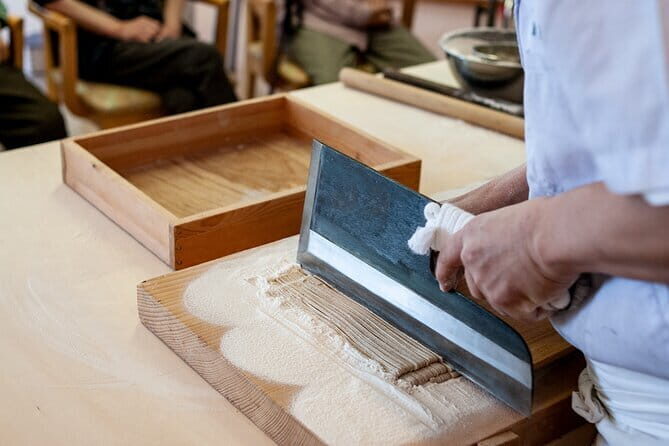
- Guided with real tools: You’ll use a soba knife specially designed for long, thin noodles.
- A meal that’s part of the lesson: You taste your noodles at the end, so you’re not stuck with just a demo.
- Aprons and gloves provided: They have sizes available so you can jump in without hunting for gear.
- Photos and sharing: The instructor takes photos and sends them to you, which is great if you want proof without hovering with your camera.
Why Kappabashi Is the Right Place for Soba
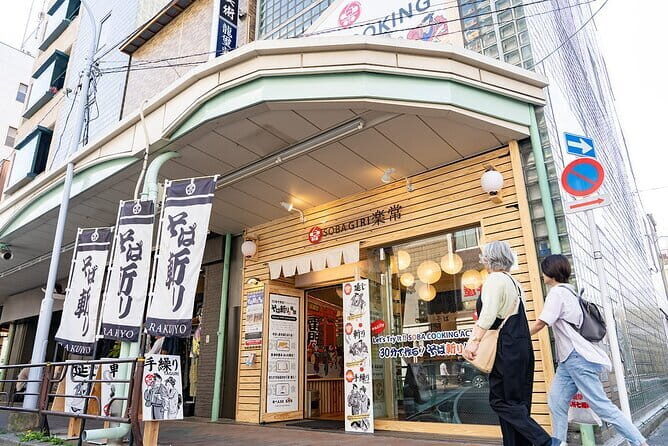
Kappabashi is Tokyo’s kitchen supply street area. If you like cooking, it’s one of the most fun neighborhoods to wander because everything feels built for real chefs: knives, pans, utensils, and that gear-nerd energy. Doing a soba-making class here feels more authentic than in a generic studio. You’re in the ecosystem that supports how Japanese food gets made.
The class is based in Asakusa/Kappabashi area, around 25 minutes from Sensoji Temple. That matters because Asakusa is a classic first-day Tokyo zone for many people, and this gives you a grounded, local-food activity without needing a long commute across town. It also keeps your morning or afternoon flexible. You can pair it with the broader Asakusa sights before or after, depending on your pace.
There’s also a “food crowd” vibe. The space is open and ground-floor, able to host up to 30 people, while your class is capped at 15. That balance keeps it comfortable—enough room to breathe, but not so big that you disappear into the background.
A few more Tokyo tours and experiences worth a look

Getting to Open Kitchen Studio and Starting Smoothly
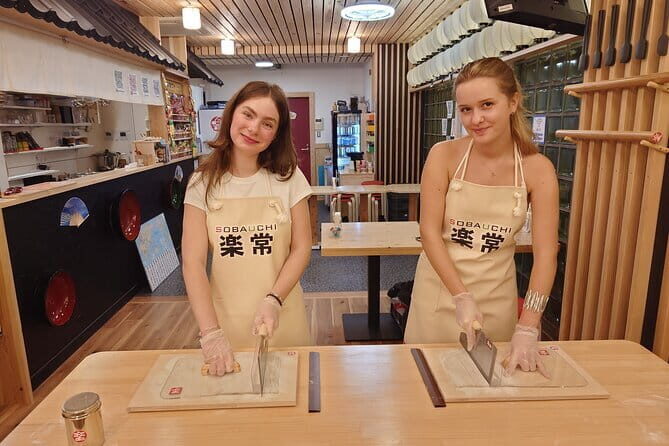
You’ll meet at the Matsugaya address (Taito City, Center Building area). The key practical point: it’s near public transportation, so you shouldn’t feel stuck planning around taxis or complex transfers.
Check-in is usually straightforward, especially since the ticket is mobile. When you’re on a Japan schedule—crowded trains, timed reservations, and walking blocks—mobile tickets save you from last-minute printing chaos.
Once you arrive, you get the gear: aprons and gloves in different sizes. I like this because it lowers the barrier to entry. If you’ve never handled dough before, you don’t need to be “the cooking type” to participate. You just show up, get suited up, and start doing.
One more important note: the restaurant does not allow people with buckwheat allergies. That’s not a “ask first” situation. If you’re affected, skip this and look for a different class that matches your needs.
The 50-Minute Flow: From Dough to Real Noodles
The class is designed to move fast and teach by doing. About 30 minutes is the core instruction, using a 4-step process: add water, knead, stretch, cut. Then there’s time for the result—cooked properly—so you can actually eat what you made.
I appreciate the structure because soba is one of those foods where the technique matters more than the ingredient list. If someone just hands you a recipe, you’ll miss the feel. Here, the rhythm is built into the lesson. You don’t just learn what to do; you practice the motions that give soba its shape and bite.
Also, the activity is framed as an electricity-free, eco-friendly style of cooking. That means it doesn’t feel like a gadget show. It’s handwork. The dough and the knife do the work, and you get to focus on fundamentals rather than electronics.
And yes, you also get to take your noodles out. That turns the class from a one-time thrill into something you can share later (or try again when you’re back home and can take your time).
Using the Soba Knife: The Skill That Makes It Click
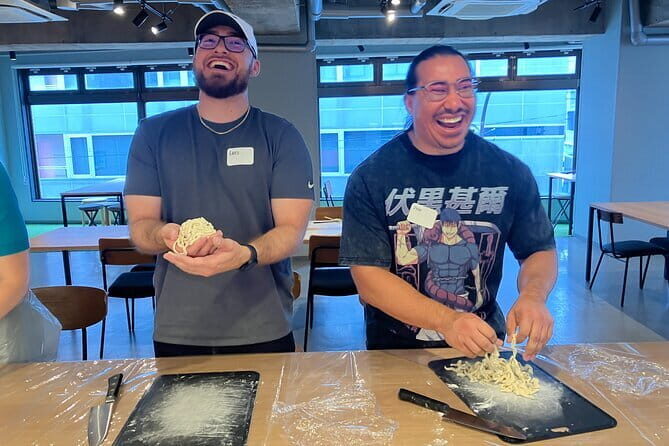
The headline for this class is the knife work. You’ll use a large knife designed for soba—built to help you cut long, thin noodles. That sounds simple until you’re actually holding it. This is where a guided class pays off.
The goal isn’t perfection. The goal is control:
- how much pressure to use,
- how you line up cuts,
- and how you keep the noodle strands consistent.
You’re also learning stretching. Stretching is where the dough changes from “lumpy” into “noodle-shaped,” and it’s often the part people expect to be hard. With instruction in the room, it feels less like magic and more like a repeatable motion.
Kneading is another core step. Soba dough needs attention to texture. If you rush it, cutting gets harder. If you nail the feel, the cutting step suddenly makes more sense. That’s why this class uses all four steps instead of teaching them as separate lessons.
A nice bonus from the way the class runs: it’s not only technical. The instructor is described as funny and approachable. Even when English isn’t perfect, the instruction comes through with timing and gestures. It’s the kind of teaching that works if you’re not fluent in Japanese food terms.
No Hunger Pangs: Taste Your Soba (and Keep Some)
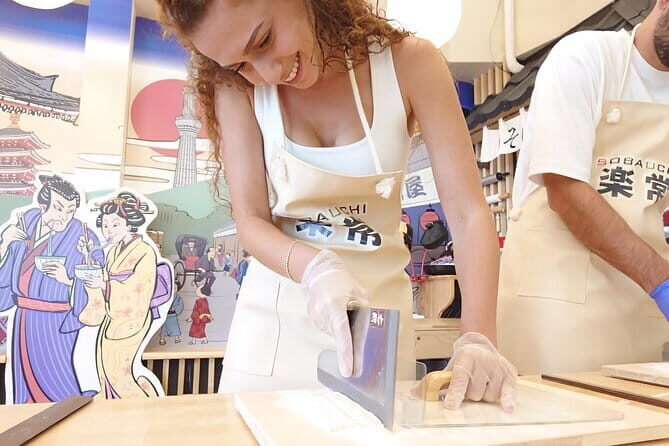
Here’s the practical win: you don’t finish the class starving. At the end, you taste the soba you cut yourself. That matters because soba is a dough-and-cooking result. You can’t fully judge noodle quality just by looks, and taste is what turns the lesson into memory.
You can eat the noodles as a meal or as a snack. The class also describes serving options in different flavors, so your meal isn’t always one-note. If you want a vegan or no-pork option, there’s an extra 500 yen fee linked to that flavor choice.
They also mention making matcha soba as an option and serving a few sake variations as an owner-selected add-on. Even if you skip alcohol, the matcha option is a fun way to try a flavor twist using the same core noodle technique.
And since you take out noodles you made, you’re leaving with a “second chance” experience. When you’re back in your hotel, you can reheat or serve them and remember exactly which step felt easy and which step took a redo.





Optional Add-Ons: Matcha Soba and Sake Choices
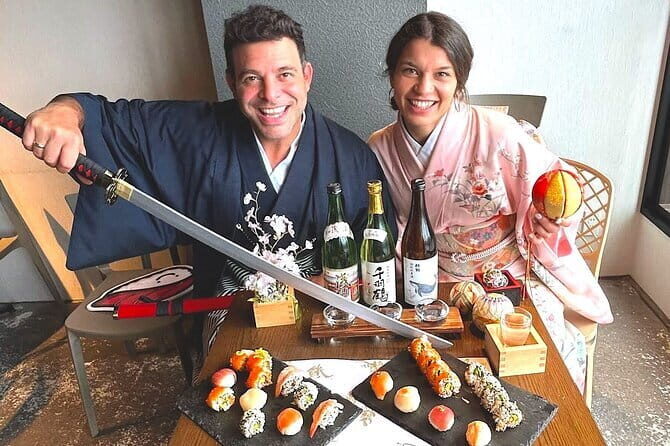
If you’re the type who likes to try variations, the class offers a matcha soba option. Matcha is mixed into the soba flour, so it’s not just a topping. That’s useful because it connects flavor to the process.
There’s also a sake menu: three types, selected and compared by the owner. That’s positioned as a paid add-on, and it’s really for people who want the full food-culture angle, not just the hands-on workshop.
Do you need either add-on? No. The main value is learning soba-making and tasting your own noodles. But if you’re in Asakusa/Kappabashi anyway and you want to make the day feel special, these extras can turn a class into a mini food event.
Small-Group Size: Why It Feels Personal Without Being Awkward
Max group size is 15 travelers. That’s a sweet spot. In a room that small, you can actually watch the instructor’s hands and reset your technique when needed. It also means the class doesn’t feel like a conveyor belt.
The business also talks about a usage pattern: couples come first, then families with children, then groups of friends. I read that as a sign that the class works across different comfort levels—people who want a romantic food activity, people who want something structured for kids, and people who want an interactive souvenir.
You’ll also be in a space that can hold more people than your class count, which helps if you want to breathe between steps. Some classes crowd you into a corner. This one aims for room to relax and enjoy after the hands-on work.
Price and Value: Is $51.33 a Good Deal?
At $51.33 per person for about 50 minutes, you’re not paying for a long fancy meal. You’re paying for three things at once:
1) instruction on a real technique,
2) use of proper tools and dough time,
3) and tasting your own noodles, plus noodles to take out.
Most food classes in Tokyo cost a lot more when you add the full experience—materials, cooking, and a sit-down or plated meal. Here, the value sits in “hands-on + eat what you made,” which is exactly where cooking classes can feel worth it.
There are also add-on costs you might choose—matcha soba (700 yen) and sake (1500 yen), plus the 500 yen fee if you select a vegan or no-pork flavor option. But those are optional. The base class already includes the tasting and the core noodle-making process.
If you’re a first-timer, you’ll likely find it’s a strong use of time. If you already cook a lot and want something deeply technical beyond the basics, you might want to compare it to longer classes elsewhere. But for learning the soba process in a focused, manageable window, it’s good value.
Who Should Book (and Who Should Skip)
This class is ideal if you:
- want a hands-on Tokyo food activity that doesn’t feel staged,
- like cooking basics with real tools,
- and you want a clear process you can repeat later at home.
It’s also a great “Japan starter” activity. Soba is common in Japan, but it’s still less known abroad for many people. Learning it from scratch helps you connect the dots on what Japanese cuisine is doing technically, not just flavor-wise.
Skip it if you’re dealing with buckwheat allergies, since entry isn’t allowed. Also, if you hate getting messy at all, you might find dough work stressful. It’s not extreme, but you’ll be handling ingredients and cutting noodles.
One more fit note: if you’re traveling with kids, the class seems designed to be friendly for families. It’s structured, short, and interactive—usually the magic combo for younger attention spans.
Should You Book Sobagiri Rakujyo’s Soba Class in Kappabashi?
My call: yes, if you want a legit, practical food experience and you like learning by doing. This is the kind of activity where the takeaway is not just photos. You leave understanding the steps, feeling the noodle dough, and you taste your results immediately.
It’s also one of the better “time-efficient” classes in Tokyo. You spend about 50 minutes total, but you get instruction, tasting, and take-home noodles. In a city where everything is booked and timed, that combo is rare.
If you’re only looking for a quick tourist snack, you could choose something easier. But if you want one memorable Tokyo skill—soba-making with a real soba knife—this is a strong bet.
FAQ
How long is the soba making class?
The class is about 50 minutes (approx.). The noodle-making instruction is described as taking about 30 minutes using a 4-step process.
Where does the class take place?
It takes place at Open Kitchen Studio in the Kappabashi area, near Asakusa. The meeting point is at Matsugaya in Taito City, and the activity ends back at the meeting point.
Do they use wheat flour for the noodles?
The class is described as soba noodle making without wheat flour. It focuses on buckwheat flour produced in Nagano Prefecture.
Is it a small-group experience?
Yes. The class is limited to a maximum of 15 travelers.
What equipment is provided?
You can use aprons and gloves, available in various sizes. A large soba knife specially designed for soba is part of the experience.
Is there food included?
Yes. Snacks are included, and you get to taste the soba noodles you cut at the end. The class also notes that you can take the noodles you made.
Are there extra fees for dietary options or special items?
There is an additional fee of 500 yen if you choose a vegan or no-pork flavor option. Optional add-ons include matcha soba (700 yen) and a sake set (1500 yen).
Can I cancel for a full refund?
Yes. You can cancel for a full refund if you cancel at least 24 hours before the experience starts. Cancellation within 24 hours of the start time is not refunded.