REVIEW · KYOTO
Kyoto: Tea Ceremony with Maiko
Book on GetYourGuide →Operated by B.B.Advisors Inc. AN KYOTO · Bookable on GetYourGuide
Matcha tastes better with backstage access. In this Kyoto tea ceremony, you get hands-on matcha with a Maiko, plus a real Q&A that feels far more personal than a museum demo.
I especially like the close-up photo time and the chance to learn how a Maiko lives inside the craft. My one heads-up: this isn’t a full traditional tea-house experience, and you’ll be dealing with stairs in a regular building.
The whole thing is fast, too. You’re basically in and out in about 45 minutes, and it’s close to Gojo Station, so it’s a smart move when Kyoto sightseeing time is short. One consideration: if the session includes a late-change situation, you might meet a Geiko instead of a Maiko depending on the date and circumstances.
In This Review
- Key Points Worth Knowing Before You Go
- Why a 45-Minute Maiko Matcha Session Works When You’re Short on Time
- Where to Meet Near Gojo Station (and How Not to Get Lost)
- The Maiko or Geiko Introduction: Close, Personal, Not Creepy
- Matcha Making Step by Step: What You’ll Learn and Actually Do
- The Ceremony Flow and Q&A: The Part That Turns a Show Into Understanding
- Photos Right Beside the Maiko (and the Senjafuda Charm)
- Price and Logistics: Is $28 Actually Fair?
- Venue Reality Check: It’s a Building, Stairs Are Part of the Deal
- Who This Is Perfect For (and Who Might Skip It)
- Should You Book This Kyoto Tea Ceremony With Maiko?
- FAQ
- How long is the Kyoto tea ceremony with Maiko?
- Where is the meeting point?
- Will I meet a Maiko or a Geiko?
- What will I drink and eat during the ceremony?
- Is English translation available?
- Is the venue accessible for people who need an elevator?
- Can I cancel for a refund?
Key Points Worth Knowing Before You Go
- Gojo Station is your shortcut: it’s about a 1-minute walk from Subway Karasuma Line Gojo Station, Exit 1.
- You make the matcha, not just watch: you’ll learn and then make your own cup.
- The Q&A is the real value: you can ask questions directly about Maiko life and training.
- You get close photos: you’ll take a commemorative photo right beside the performer.
- Senjafuda lucky charm included: you’ll receive this charm before you leave.
- No elevator: expect stairs to reach the venue(s).
Why a 45-Minute Maiko Matcha Session Works When You’re Short on Time
Kyoto can eat your day. Temple lines, neighborhood wandering, and train logistics all add up. This is built for people who want the feeling of Kyoto without giving up half their itinerary.
The timing is refreshingly tight: about 30–40 minutes of activity, plus a short start-and-finish rhythm. That means you can slot it between other plans instead of treating it like a whole day commitment. At $28 per person, the value comes from doing multiple things in one sitting: ceremony, sweets, a guided explanation, Q&A, and a photo moment.
Also, you’re not just learning “how to make tea.” You’re learning why matcha is treated like a serious ritual in Kyoto. The Maiko (or Geiko) frames the process as part of discipline, etiquette, and daily life. That angle is what makes it stick after the session ends.
You can also read our reviews of more tours and experiences in Kyoto.



Where to Meet Near Gojo Station (and How Not to Get Lost)
Your meeting point is close, but Kyoto walking can still trip you up—especially if you’re hunting for the right doorway. Start at Subway Karasuma Line Gojo Station, Exit 1. From there, it’s about a 1-minute walk to the location.
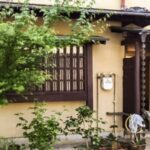
Look for the store entrance facing Gojo-dori (the main street). The entrance is on the street-facing side, so you shouldn’t have to play guessing games with side alleys.
Here’s a practical tip I’d follow if I were going: if you’re unsure, orient yourself by nearby landmarks and keep scanning for the correct building entrance, then go up the stairs when you’re directed inside. One guest specifically noted that the route can feel tricky until you find the place above a supermarket called Carnival, then follow signs up to the venue. If you reach the wrong street level, just stop and reset your bearings rather than rushing.
The Maiko or Geiko Introduction: Close, Personal, Not Creepy
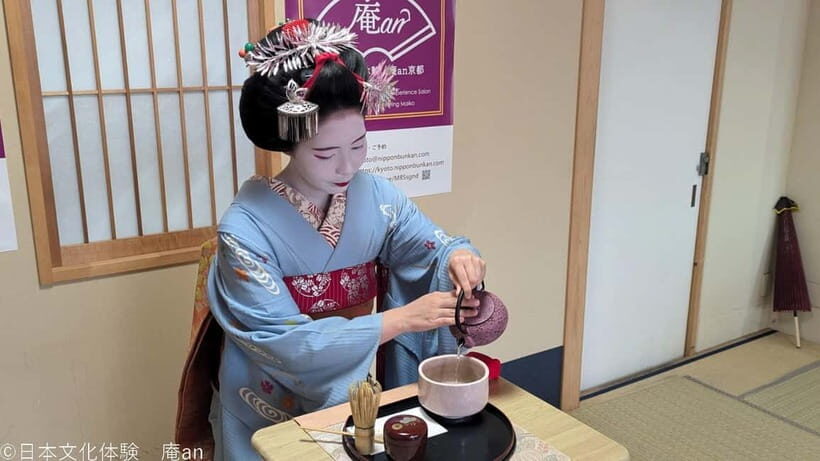
This program is built around meeting a Maiko up close. And unlike the “stand there and hope for a sighting” approach in Kyoto’s streets, you get an actual interaction window.
Depending on the date and circumstances, the experience may be hosted by either a Maiko or a Geiko. That’s important because it changes the vibe slightly. Still, the structure stays the same: greeting, tea ceremony, and a Q&A where you can ask questions directly.
If you get a Maiko, you’ll be learning in her presence—not just from a slide deck. The performer introduces the process, explains how to do it, and answers questions. One booking described a Maiko named Masaya San, who guided the matcha making and spoke confidently, with translation support available.
The tone matters here. Multiple write-ups highlighted that it feels respectful and friendly, not like you’re stalking someone for a photo. You’re participating, not hovering.
Matcha Making Step by Step: What You’ll Learn and Actually Do
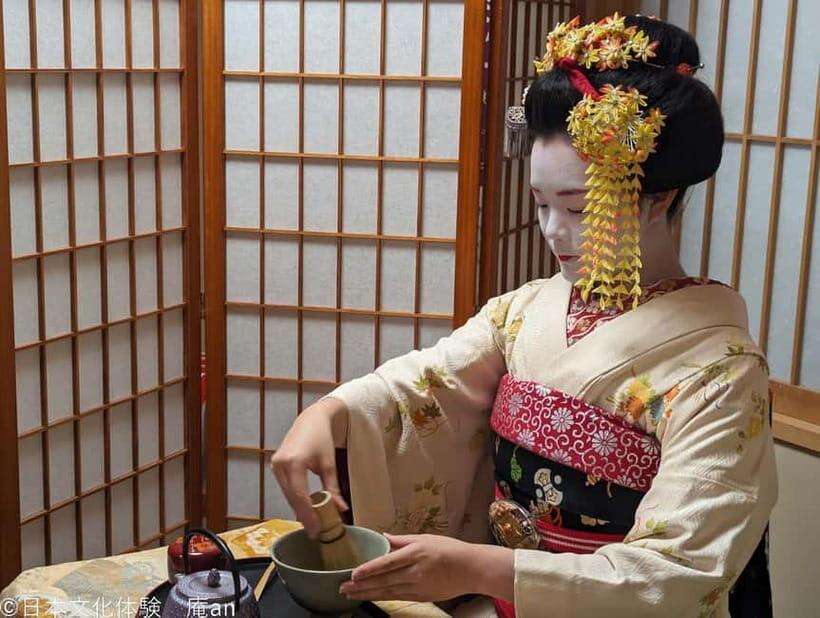
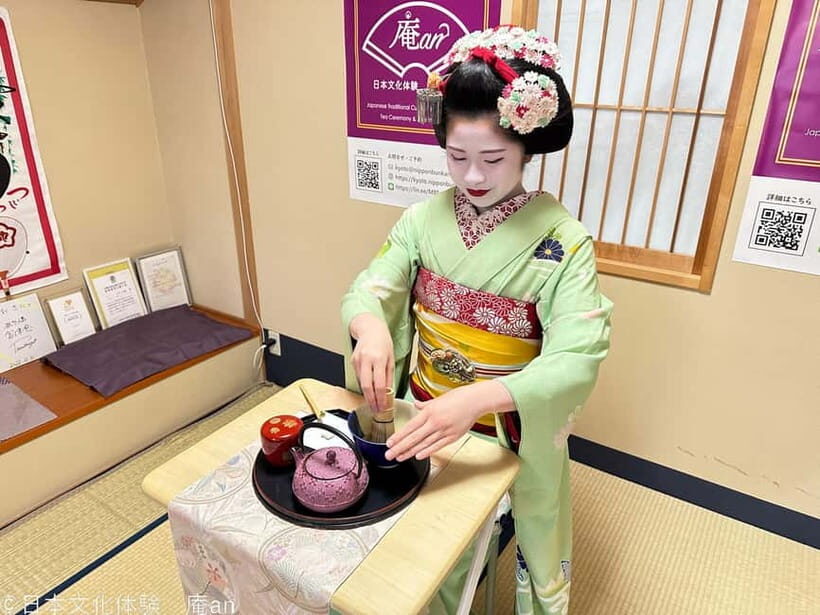
The main event is the tea ceremony with a hands-on matcha lesson. You’ll watch a demonstration first, then you’ll make your own matcha after the explanation.
Before you start mixing, you’ll be served two dried-type Japanese sweets alongside the matcha. These sweets are part of the tasting rhythm—your mouth gets ready for the tea, and the contrast (sweetness, then bitter-green matcha) becomes part of the experience.
Then you move into the practical part: the Maiko shows you how to make matcha the correct way, and you do it yourself. Expect a guided process rather than a sink-or-swim lesson. The staff also provides English translation as much as possible, and if you want to add translation you can contact in advance.
Here’s what I think makes this “value.” A lot of Kyoto experiences are either:
- performative (you watch), or
- hands-on but generic (you make a craft with no cultural framing).
This one tries to combine both: you participate in the technique and also get the cultural context from someone whose life revolves around these arts.
The Ceremony Flow and Q&A: The Part That Turns a Show Into Understanding
The schedule is simple and easy to follow, so you don’t spend your mental energy wondering what happens next.
Typical flow:
- Greeting from the performer
- Tea ceremony with matcha and the two dried sweets
- Q&A session
- Photo opportunity
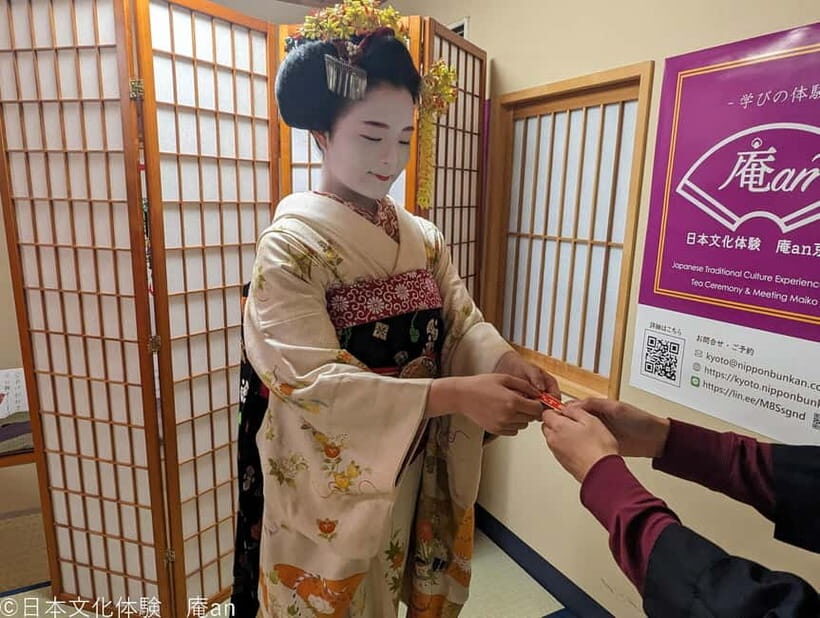
- Senjafuda lucky charm gift
- Room departure
The most powerful chunk is the Q&A session. This isn’t a rapid-fire “one question per group” setup. It’s a genuine chance to ask about daily life, training, etiquette, and what it means to work toward becoming a Geiko. People who enjoy culture also tend to love this portion because it’s where facts replace assumptions.
In plain terms: you go in expecting to see elegance. You leave knowing the discipline behind it.




Photos Right Beside the Maiko (and the Senjafuda Charm)
The photo moment is included, and that’s a big deal here. You take a commemorative photo right beside the performer, not from across the room. This is the kind of close photo you usually only get if you’re either lucky or standing in exactly the right place at exactly the right time.
Then comes the gift: the Maiko gives you a Senjafuda lucky charm. This is the kind of small Kyoto souvenir that feels connected to the experience rather than stuck on at checkout time. It’s also the right “final button” to remember the ceremony after you’ve left the building.
One more detail: the venue isn’t an ochaya (traditional tea house) or a classic private house. It’s located in a building, but the atmosphere is described as relaxed, with friendly staff. So you still get the personal feeling, without the intimidation factor of a super-formal setup.
Price and Logistics: Is $28 Actually Fair?
Let’s talk money in a practical way. At $28 per person for roughly 45 minutes, you’re paying for more than matcha.
You’re also paying for:
- a performer-led tea ceremony (not just a tutorial)
- sweets and matcha included
- a structured Q&A you can’t easily replicate on your own
- included photos close-up
- the Senjafuda charm
If you’ve tried to “DIY” a Kyoto tea moment, you know how quickly it becomes either expensive (private lessons) or disappointing (tourist-style tastings with minimal interaction). This program aims at the middle: a contained format with real access and a guided pace.
The main “hidden cost” isn’t money—it’s your schedule discipline. The experience won’t accommodate delays, and latecomers won’t be entitled to a refund. If your Kyoto day runs late (and it often does), build in a buffer so you don’t gamble with the timing.
Venue Reality Check: It’s a Building, Stairs Are Part of the Deal
This matters because Kyoto can trick you. You might picture a perfect traditional tea-house interior, but this event takes place in a building. The staff still creates a calm, relaxed setting, but it isn’t a historic house.
Also plan for stairs. There’s no elevator, and you’ll need to take stairs to reach the venue. If you’re someone who struggles with steps, this could be a deal breaker. If you’re okay with stairs, you’ll likely find it manageable since the session is short.
Language is another logistics point. The main language is Japanese, but English translation is provided as much as possible. If you’d like extra translation support, you can contact ahead of time.
Who This Is Perfect For (and Who Might Skip It)
This is a great fit if you:
- want a Kyoto cultural experience that fits into a tight schedule
- like interactive learning (you’ll make matcha yourself)
- enjoy asking questions and getting direct answers
- care about respectful close interaction and good photo chances
It might be less ideal if you:
- need an accessibility-friendly setup (stairs are required)
- want a fully traditional ochaya-style setting rather than a building venue
- tend to run late and hate clock pressure (latecomers aren’t refunded)
For most people, this sits in the sweet spot. It’s not trying to be an all-day Kyoto immersion. It’s aiming to give you a strong Kyoto taste in under an hour.
Should You Book This Kyoto Tea Ceremony With Maiko?
I’d book it if your Kyoto plan has gaps you want to fill with something elegant and interactive. The combination of hands-on matcha, a serious Q&A, close photo time, and the Senjafuda charm makes it feel like more than a quick stop.
Skip it only if the idea of stairs is a problem or if you’re looking for a full traditional house setting with no building feel. Otherwise, this is one of the more efficient ways to get the Maiko/Geiko world into your day without turning your itinerary upside down.
If you’re choosing between “watching from a distance” and “participating up close,” pick participation.
FAQ
How long is the Kyoto tea ceremony with Maiko?
The experience runs about 45 minutes, with the program itself taking roughly 30 to 40 minutes. You’ll start at around the scheduled time and leave at the end of the session.
Where is the meeting point?
Meet near Subway Karasuma Line Gojo Station, Exit 1. It’s about a 1-minute walk, and the store entrance faces the main street (Gojo-dori).
Will I meet a Maiko or a Geiko?
It depends on the date and the situation. The experience may be hosted by either a Maiko or a Geiko.
What will I drink and eat during the ceremony?
You’ll drink matcha and try two dried-type Japanese sweets (ohigashi) served with the tea.
Is English translation available?
English translation is provided as much as possible. The program language is Japanese, but you can request support by contacting in advance if needed.
Is the venue accessible for people who need an elevator?
No. There is no elevator in the building, and you will need to use stairs to reach the venue.
Can I cancel for a refund?
Yes. Free cancellation is available up to 8 days in advance for a full refund. After that, a cancellation fee may apply.