REVIEW · TOKYO
Tokyo: Asakusa Walking Tour with Japanese Comedian
Book on Viator →Operated by Karate Comic Ryo · Bookable on Viator
Comedy meets temple time. This is a 90-minute Asakusa walk led by stand-up comedian Karate Comic Ryo, mixing Buddhist and Shinto sights with humor so the area feels easier to understand and easier to enjoy.
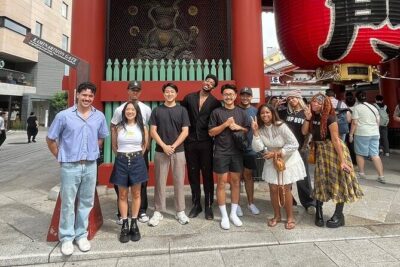
I like the small-group format capped at six people (with an overall stated maximum of eight). I also love how the route guides you through key points inside the Senso-ji grounds, from the famous gates down to quieter statues like the 17th-century Nisombutsu.
One consideration: the pacing is busy and picture-friendly, so if you want long, quiet time at each spot to pray or sit, you may want to do a second pass on your own after the tour ends at Senso-ji.
In This Review
- Key things to know before you go
- Karate Comic Ryo Leads: Why This Feels Less Like a Museum Tour
- Meeting at Asakusa Pier and Getting Your Bearings Fast
- From Kaminarimon to Nakamise Street: Icon Entry and Real Street Atmosphere
- Bentendo, the Bell of Time, and Nisombutsu: Seeing the Temple Complex Details
- Nitenmon Gate to Asakusa Shrine: Power, Portability, and Local Connections
- Yogodo, Awashimado, and Hozomon: The Walk Through Gates and Guardian Energy
- Nishisando Sweets and the Final Approach to Senso-ji
- Price, Time, and Value: Why $37.99 Can Make Sense Here
- When to Go: Crowds, Heat, and a Smarter Morning Plan
- Who Should Book This Asakusa Walk (and Who Might Skip It)
- Should You Book? My Practical Take
- FAQ
- How long is the Asakusa walking tour?
- How much does the tour cost?
- Where do I meet the guide, and where does the tour end?
- Is there a small-group limit?
- Do I need to pay for entry at the stops?
- What ticket do I use?
- What is the cancellation window?
- One Last Decision Helper
Key things to know before you go
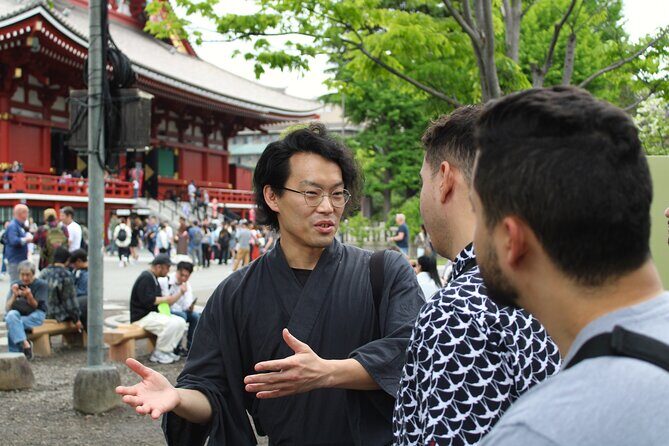
- A comedian guide, not a lecture: You’ll get stories with laughs, and plenty of time for questions.
- Senso-ji from the outside in: The walk works inward from the Kaminarimon entry, then through multiple gates and temple structures.
- Landmarks plus detail stops: You’ll see structures like Nitenmon Gate and also smaller features such as the Bell of Time.
- Everything is free to enter: The planned stops are admission free, so your money goes mainly to guiding and context.
- Snack moment built in: You get a practical chance to try local sweets on the Nishisando side.
Karate Comic Ryo Leads: Why This Feels Less Like a Museum Tour
Asakusa can look overwhelming fast. You’re staring at gates, incense smoke, crowds, and a lot of “what am I looking at?” moments. This tour solves that with a guide who can explain why each place matters, then keep things light with stand-up-style humor.
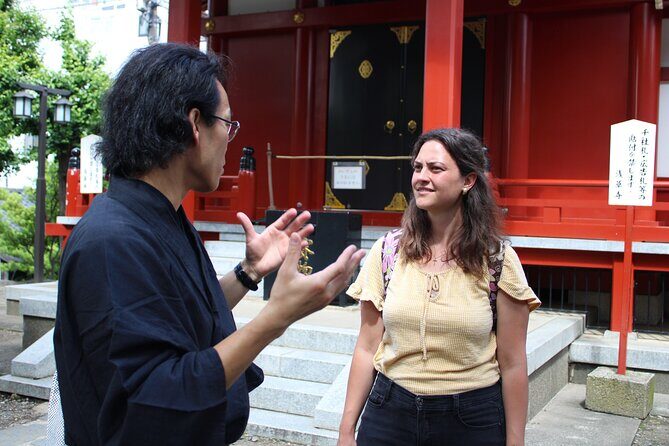
What makes it work is the guide’s communication style. The experience is designed for foot travel, quick stops, and constant orientation: where you are, what you’re seeing, and what to notice next. You’ll also get real back-and-forth conversation energy, so you’re not stuck listening while people file past.
You can also read our reviews of more walking tours in Tokyo
Meeting at Asakusa Pier and Getting Your Bearings Fast
The tour meets at Tokyo Cruise Asakusa Pier (1-chōme-1-1 Hanakawado, Taito City) and ends in front of the main hall of Senso-ji. Starting near the pier is useful if you’re mixing activities around Asakusa, since the area connects to public transport and walking routes.
Right away, you’ll get an orientation boost at the Asakusa Culture Tourist Information Center. You’ll head up to the 8th floor for a view that helps you place the larger Senso-ji area in your mind. Even if you don’t catch every detail from above, it makes the street-level walk feel less random and more like a route you understand.
Tip: if you’re sensitive to heat or crowds, aim for an early start when you can. One of the best practical bits from real experiences here is that starting earlier can help you beat the push of people around the main temple approach.
From Kaminarimon to Nakamise Street: Icon Entry and Real Street Atmosphere
Next comes the approach through Kaminarimon—the iconic main gate into Senso-ji’s area. You’re not just walking past a landmark; you’re learning how the gate functions as the symbolic entry into the temple district. That matters because the next street you hit, Nakamise Shopping Street, is basically the transition zone between the modern shopping street and the religious complex.
Nakamise is famous for a reason: it’s the classic Asakusa corridor where visitors expect snacks, souvenirs, and old-school storefront vibes. The difference here is you go in with context, so the street feels like part of the pilgrimage experience rather than a separate shopping detour.
A small practical thought: Nakamise can get crowded, especially later in the morning. If your priority is photos with fewer people, the timing of your tour start becomes part of the experience, not just a logistics note.
Bentendo, the Bell of Time, and Nisombutsu: Seeing the Temple Complex Details
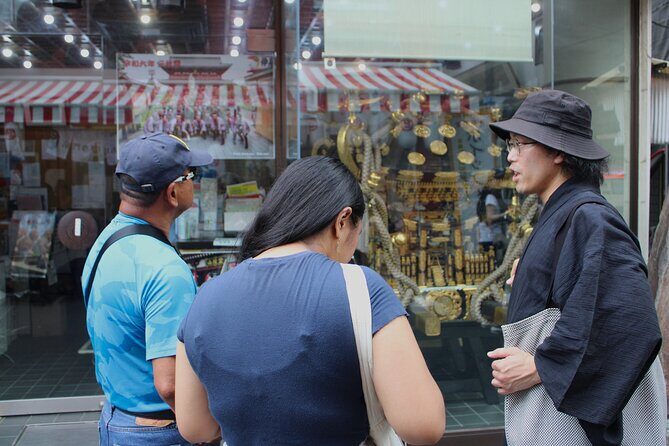
As you move into the central temple area, you’ll hit Bentendo, a smaller but meaningful stop associated with a deity connected to art and prosperity. It’s one of those places where a quick explanation changes your entire viewpoint. Instead of seeing a pretty hall, you understand what visitors have long come to ask for.
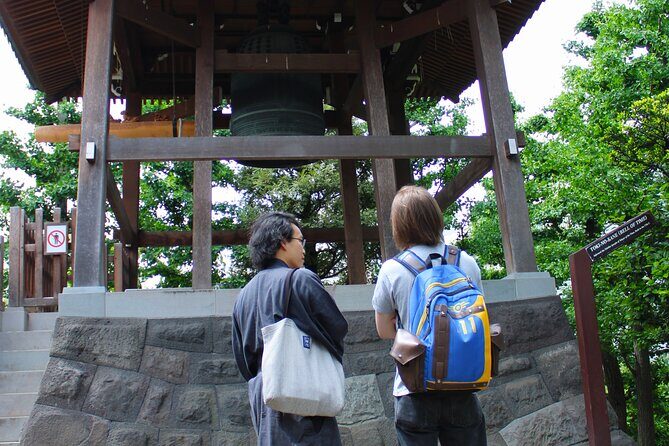
Right next to Bentendo is the Bell of Time. This one is especially interesting because it links temple practice to how people used to measure time during the Edo period (16th to 18th century). When a bell is described in that historical rhythm, you start noticing the temple grounds as more than “static architecture.” It’s community life, layered through centuries.
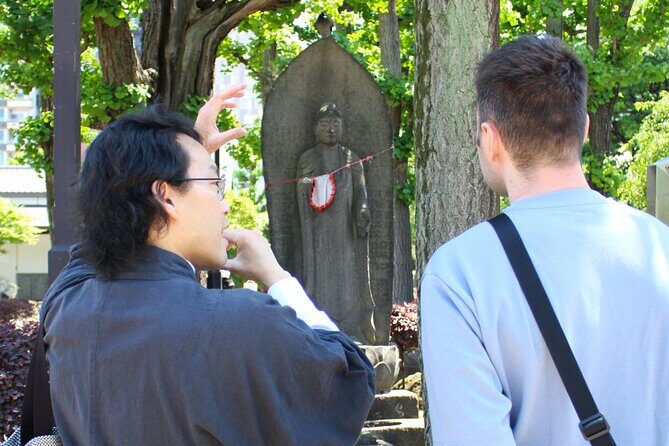
Then you’ll reach Senso-ji Temple Nisombutsu, a calmer spot with bronze statues and stone statues of Buddhist deities constructed in the 17th century. The benefit of stopping here is simple: you learn what’s worth looking at even if you only have a short time in Asakusa. A guide points out the statues and explains why they’re here, so you don’t leave with only a vague sense of “some figures.” You leave with a reason to remember them.
Nitenmon Gate to Asakusa Shrine: Power, Portability, and Local Connections
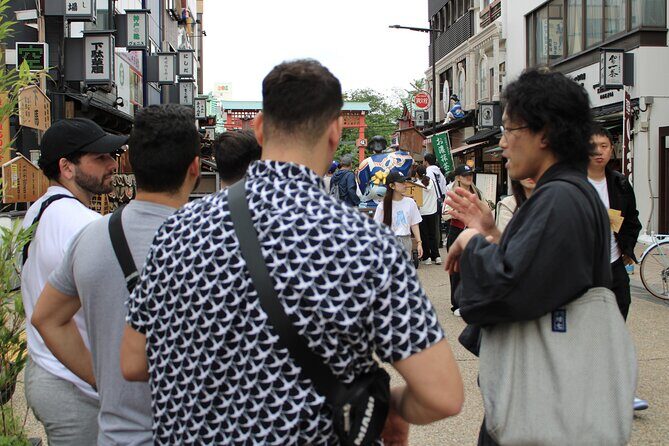
One of the bigger highlight moments is Nitenmon Gate on the right of the main hall area. It’s noted as one of Japan’s National Cultural Properties, and it’s tied to shogunal access rules: the gate was used as the shogun’s gate, meaning only high-ranking figures (generals) were allowed to pass.
That story changes how you read the gate. It stops being a photo backdrop and becomes a clue about authority, movement, and who could enter sacred spaces. It’s also a great stop for questions, because it naturally leads into topics like how religion and governance interacted over time.
After that, the route continues to Asakusa Shrine, which includes three deities closely related to the origins of Senso-ji. There’s also a storage area for three big portable shrines used in local festivities. If you’ve ever wondered how shrines connect to community events (not just static buildings), this is where you see the “portable” side of worship.






Yogodo, Awashimado, and Hozomon: The Walk Through Gates and Guardian Energy
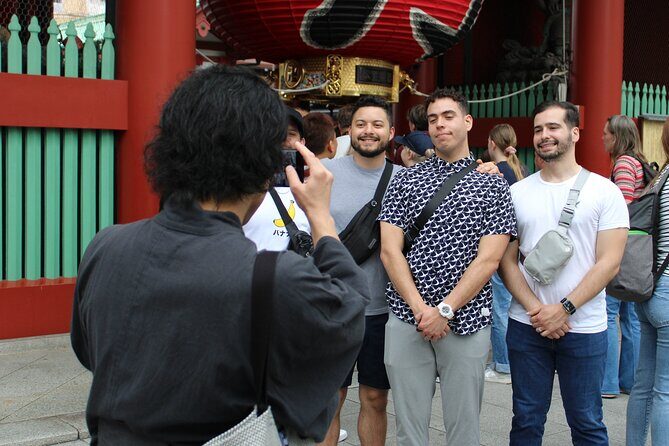
From here, the tour keeps moving through the temple grounds with short stops designed to reset your attention. Yogodo and Awashimado are both part of this “inside the complex” rhythm. Even though the stops are brief, they help you understand that Senso-ji is a collection of related spaces, not one single building.
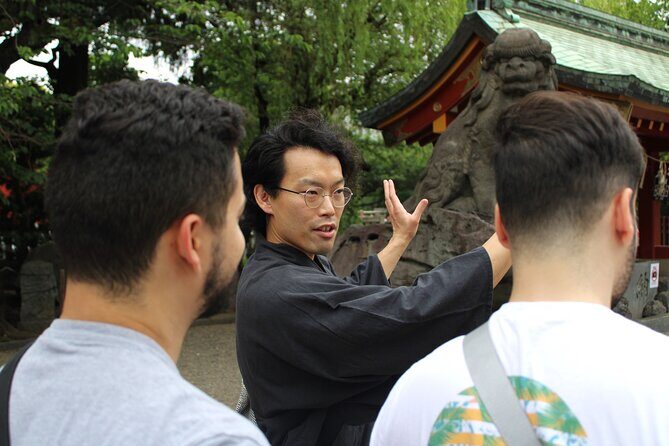
Then comes Hozomon—a gate with a pair of guardian statues in front. Guardian statues are common across Japan, but what helps here is learning to recognize what they’re signaling: protection at the threshold and the idea that you’re entering a sacred zone. When someone tells you exactly what to look for, you notice posture, symmetry, and placement instead of treating the scene like generic temple scenery.
If you’re taking photos, this section is also where you’ll likely slow down naturally. Gates and statues create good composition lines, and a guide keeps you from missing key angles while the crowd stream moves.
Nishisando Sweets and the Final Approach to Senso-ji
Between the temple stops, there’s time for the “Asakusa side quest” that many people actually remember most: food. The tour includes Asakusa Nishisando, with a chance to stop at 花月堂 (Kagetsu-do) for Japanese sweets, specifically melon-bread. One of the practical tips echoed by experiences here is to try the melon pan-style snack recommended during the walk. It’s sweet, portable, and a good energy boost if you’re walking in the morning.
Finally, you arrive at Senso-ji Temple, described as Tokyo’s oldest temple with 1,400 years of history. You’ll hear about the Buddhist deity Kannon Bodhisattva and why this temple became so beloved over the centuries. The payoff is that you reach the main hall with a mental map, not just a camera and a crowd.
Ending in front of the main hall is also convenient because it leaves you flexibility. If you want to stay longer for incense, prayer, or photos, you can. If you’d rather continue exploring Asakusa, you can pivot immediately without feeling like you missed the “real” part.
Price, Time, and Value: Why $37.99 Can Make Sense Here
At $37.99 per person for about 1 hour 30 minutes, this tour is priced like a value-focused guided walk. The big reason it can feel like a good deal is that the main stops are admission free, meaning the cost is mostly paying for direction, context, and a guide who can connect the dots across multiple temple and shrine areas.
Also, the small group size changes how you experience it. With fewer people around, you have more chances to ask questions, and the guide can adjust pace when someone needs a clearer explanation. That matters in a complex place like Senso-ji, where details matter and “just follow the group” can feel unsatisfying.
One more value angle: you don’t have to plan a route or decide which side streets and structures are worth your time. You’re given a built-in path that hits the iconic entry point (Kaminarimon) and then moves through specific named features like the Bell of Time and Nitenmon Gate.
When to Go: Crowds, Heat, and a Smarter Morning Plan
Timing can make or break your temple-photo experience. If you can start earlier, do it. One practical tip that keeps coming up is that starting around 8:00am helps you avoid the later surge and the worst heat, with Senso-ji and the approach area feeling more manageable.
There’s also a food-market rhythm to keep in mind. A useful note from real-world experience: markets often open around 10:00, so if your goal is calmer temple scenery, morning-first works. If your goal is maximum “street energy” and shopping buzz, later might be better.
Either way, the tour format helps because it doesn’t require long waits. You’re moving from stop to stop, and the guide keeps you oriented while the neighborhood wakes up around you.
Who Should Book This Asakusa Walk (and Who Might Skip It)
You’ll like this tour if:
- You want Senso-ji context without turning your day into a study session.
- You enjoy history explained in human terms, with humor that keeps attention from drifting.
- You prefer walking over riding, especially in older neighborhoods where details appear in side angles.
- You’re traveling as a family or with friends and want a guide who handles questions patiently.
You might skip it if:
- You want long, silent worship time at each stop.
- You dislike structured group walking and prefer unplanned wandering the entire day.
- You’re only interested in one building and nothing else. This walk is designed to connect multiple shrine and temple features, including gates and smaller sacred spots.
If you’re doing Asakusa as a first-timer, this tour is a strong “starter guide” because it teaches you what you’re looking at. If you’re returning later, it’s still useful because the details you miss the first time (like Nisombutsu or Bell of Time) become obvious once someone points them out.
Should You Book? My Practical Take
Book it if you want an efficient, funny way to understand Asakusa rather than just photograph it. For the price, the value is in the guided route through meaningful named stops—starting with that 8th-floor overview, then flowing through Kaminarimon, Nakamise, Bentendo, the Bell of Time, Nisombutsu, Nitenmon Gate, Asakusa Shrine, Hozomon, and finally the main hall of Senso-ji.
Skip it only if you truly don’t want a structured walking plan. Otherwise, this is exactly the kind of small-group, question-friendly tour that helps you leave Asakusa with more than souvenirs—more of the “why” behind what you saw.
FAQ
How long is the Asakusa walking tour?
It runs for about 1 hour 30 minutes.
How much does the tour cost?
The price is $37.99 per person.
Where do I meet the guide, and where does the tour end?
You meet at Tokyo Cruise Asakusa Pier (1-chōme-1-1 Hanakawado, Taito City) and the tour finishes in front of the main hall of Sensō-ji Temple.
Is there a small-group limit?
Yes. It’s described as a small-group experience capped at six people, with a maximum of eight travelers stated.
Do I need to pay for entry at the stops?
The planned stops are listed as free admission.
What ticket do I use?
You receive a mobile ticket.
What is the cancellation window?
Free cancellation is available up to 24 hours before the experience start time for a full refund.
One Last Decision Helper
If you’re excited to walk Asakusa and want the place explained in plain language (with jokes), this tour is a solid choice. If you prefer total freedom with no stop-by-stop guidance, you can still enjoy Asakusa on your own—but you’ll have to do more guessing about what each gate, statue, and shrine is telling you.