REVIEW · TOKYO
Half-Day Local Tokyo Tour in Adachi Market and Shibamata
Book on Viator →Operated by Trip Designer Inc. · Bookable on Viator
Skip the usual Tokyo crowds.
This half-day local loop pairs Adachi Fish Market (quiet, seafood-focused) with Shibamata’s old-town feel and Taishakuten’s famous temple grounds. You start with a visit to Central Market Adachi Shijo, then you ride one-way rail to Shibamata and walk through a classic shopping street toward the temple complex. It’s a smart change of pace if you’ve already seen the headline sights.
I particularly like two things: the chance to spend focused time at a specialized marine market, and the way the day mixes food culture with standout temple art. The market visit is a full 1 hour, and the Shibamata side is paced with multiple short stops (like the Taishakuten-Sando approach and the Taishakuten main area), so you get texture instead of rushing through a checklist.
One possible drawback: there’s no food included, so if you’re hungry on the market and street, you’ll want to budget for snacks or drinks on your own. Also, it’s a walking tour over several blocks, so comfortable shoes help.
In This Review
- Key highlights you’ll actually feel
- A half-day that feels local, not squeezed
- Price and what you’re really paying for ($91.96)
- Meeting at 千住大橋駅 and staying on time
- Stop 1: Central Market Adachi Shijo (1 hour)
- The Shibamata switch: a one-way train included
- Stop 2: Shibamata’s old-town river mood (30 minutes)
- Stop 3: The Statue of Futen No Tora (5 minutes)
- Stop 4: Taishakuten-Sando approach (20 minutes)
- Stop 5: Shibamata Taishakuten / Taishakuten Daikyoji Temple (40 minutes)
- Stop 6: Yamamototei (30 minutes) and the Japan–West mix
- Why the guides (like Kaori, Mutsuko, and Meg) matter
- What I think this tour is best for
- Practical things to pack and decide before you go
- Should you book the Adachi Market and Shibamata half-day tour?
Key highlights you’ll actually feel
- Max 8 people means you’re not lost in a sea of elbows at the market
- Adachi Fish Market is specifically a specialized marine-products stop, not a general tourist bazaar
- Shibamata Taishakuten brings wood-carved temple sculptures and an ikebana garden into the same circuit
- Taishakuten-Sando is about a 200-meter old-style shopping stretch between station and temple
- One-way train fare included takes the stress out of getting from Senju Ohashi to Shibamata
- Yamamototei adds a Japan-and-West mix in temple architecture for a change of visual pace
A half-day that feels local, not squeezed
This tour is built for people who want Tokyo, minus the constant lines and selfie stops. Instead of chasing the best-known fish markets or the most famous neighborhoods, you go to Adachi for seafood shopping energy, then you head to Shibamata for a riverside town vibe and temple scenery.
The timing also helps. With about 4 hours 30 minutes total, you get two major experiences without burning a full day. It’s a solid choice if you want to keep your schedule flexible for other parts of Tokyo, like neighborhoods closer to where you’re staying.
And yes, the small group matters. With a maximum of 8 travelers, you can actually ask questions at the market and then move at a human pace through Shibamata’s lanes.
You can also read our reviews of more shopping tours in Tokyo


Price and what you’re really paying for ($91.96)
At $91.96 per person, this isn’t a bargain tour, but it also isn’t a splurge. In the value math, you’re paying for three things: a professional guide, admission-related access on the Shibamata side, and the included one-way train fare.
The tour includes local taxes, a professional guide, and a small-group walking tour. It also includes one-way rail fare from Senjuohashi Station to Shibamata Station—that’s time you don’t have to spend figuring out transit and fares during your day. Entrance fees are covered too, and Yamamototei is explicitly marked as included.
What’s not included is where you’ll likely spend extra: food and drinks. Since the market and the street around Taishakuten-sando are exactly where you’ll see tasty temptations, budget a little so you’re not making decisions while hungry.
Meeting at 千住大橋駅 and staying on time
The meet-up is straightforward: Senjuhashidocho, Adachi City, Tokyo 120-0038, at 千住大橋駅 (Senjuhashidocho/ Senjuohashi area), starting at 8:00 am. The tour ends at Shibamata Station (4 Chome-8 Shibamata, Katsushika City, Tokyo 125-0052).
That early start is part of what makes the day work. You’ll be well positioned to enjoy Adachi’s market atmosphere and still have energy for the Shibamata walking portion.
One practical point: this is a group tour with a set schedule, so treat the start time like a real commitment. If you miss the launch, you’ll likely miss the coordinated flow between the market segment and the Shibamata train transfer.
Stop 1: Central Market Adachi Shijo (1 hour)
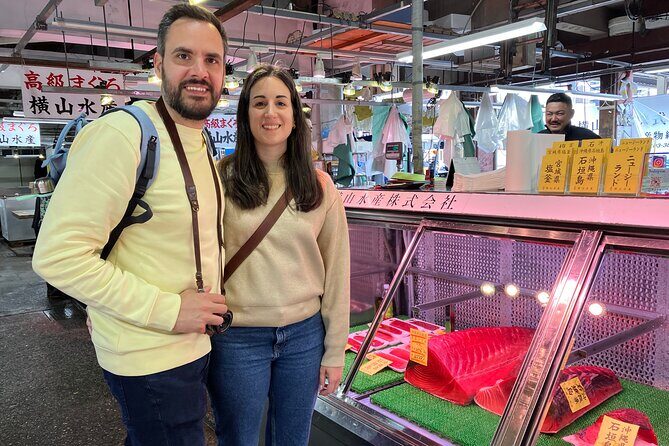
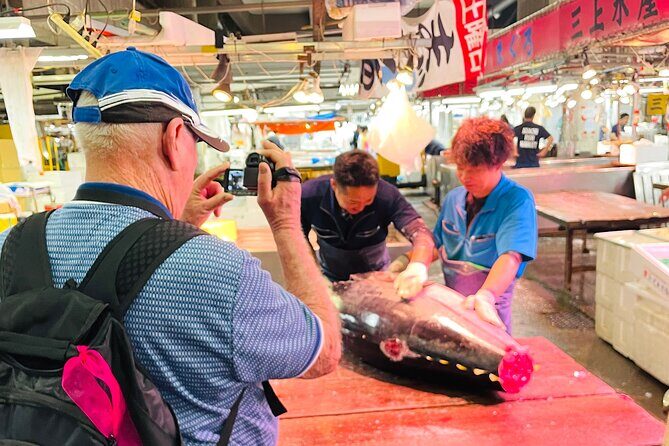
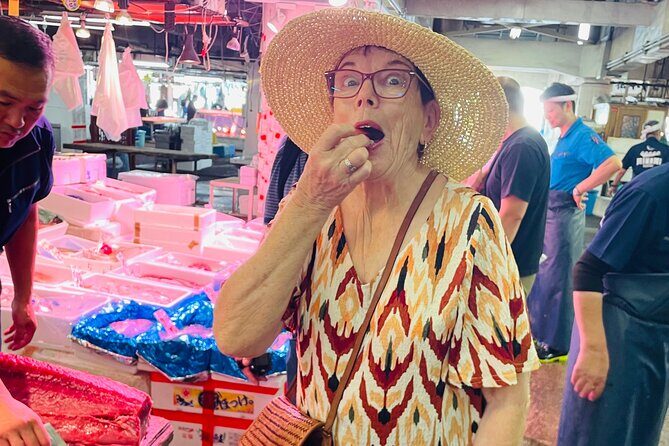
This is the heart of why the tour feels different. Adachi Fish Market is described as the only specialized marine-products market in Tokyo, and the big advantage is that it’s not crowded with tourists the way some headline markets are. In plain terms: you can look, learn, and move without constant shoulder-to-shoulder pressure.
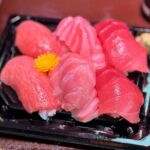
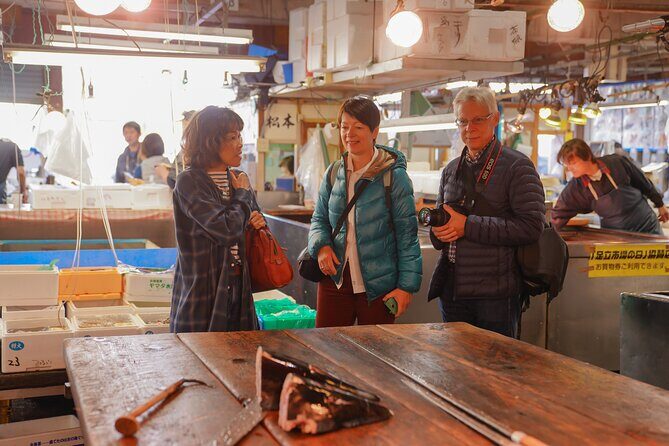
During the 1 hour here, you browse stalls selling fresh seafood suitable for sashimi and sushi. The vibe is local commerce first, education second—and that’s exactly why it’s fun. You’re not just staring at displays; you’re seeing how seafood is offered and chosen in a place that caters to the real market rhythm.
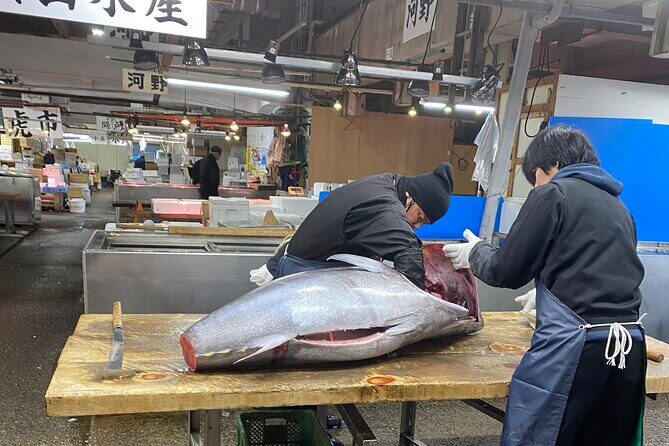
A highlight from guide experiences in the reviews is how much there is to talk about. One review notes the group saw enormous tuna and a variety of seafood, which is a reminder that this isn’t just a quick peek. You get enough time to notice differences between fish, cuts, and stall selections.
Tips for getting more out of this stop:
- Go in with curiosity rather than a strict shopping list. The market is more interesting when you compare what stalls prioritize.
- Be ready for a more active browsing pace, since you’ll be moving stall to stall as a group.
The Shibamata switch: a one-way train included
Once the Adachi market time is done, you’re taken care of for the hardest logistics part: the one-way train fare from Senjuohashi Station to Shibamata Station is included. That matters because it keeps the day from turning into a transit puzzle.
Think of this as the tour’s reset button. In about a half-hour-ish window of movement and orientation, you go from a seafood market atmosphere to an Edo-style, neighborhood walking mood.
Also, Shibamata is a town you’ll appreciate more once you’re physically there. The slower travel approach helps you feel the shift instead of just skipping between far-apart points.
A few more Tokyo tours and experiences worth a look



Stop 2: Shibamata’s old-town river mood (30 minutes)
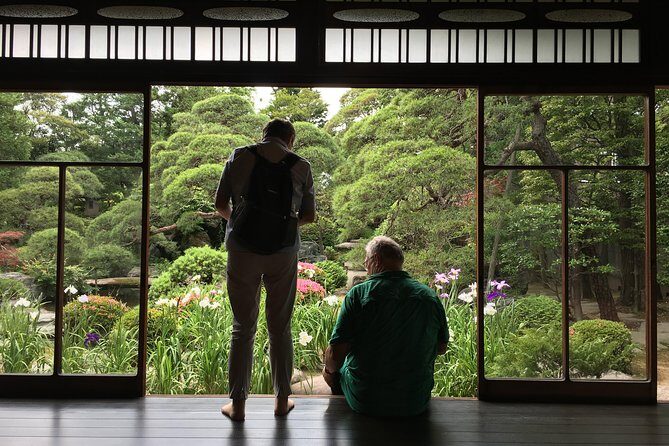
After you arrive, you get a 30-minute window to soak up Shibamata as a riverside old-style town. The emphasis here is not modern shopping malls—it’s the calmer, traditional texture of the area.
This is a good segment for two types of travelers:
- People who like wandering without being rushed.
- People who want context before they hit the temple stops.
Shibamata also has a strong cultural angle. In Japan, it’s connected to the fictional home of Mr. Tora from the Otoko wa Tsuraiyo movie series, which leads directly into the next quick stop.
Stop 3: The Statue of Futen No Tora (5 minutes)
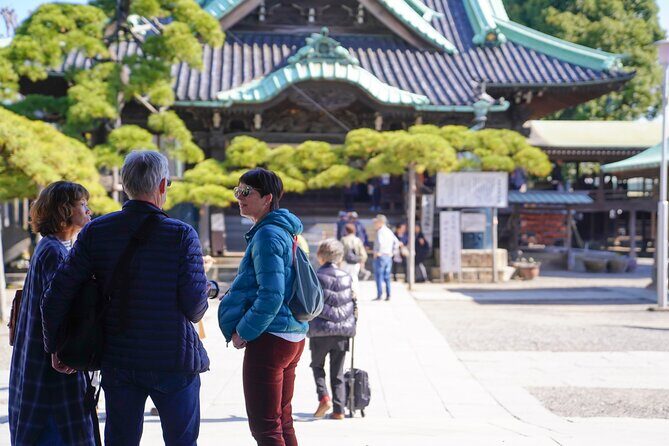
This one is short on purpose. Outside Shibamata Station, you’ll walk by the bronze statue of Futen No Tora, connected to Mr. Tora from the Otoko wa Tsuraiyo series.
Even if you’re not a movie-series fan, it’s a useful way to learn that Shibamata isn’t only historic architecture. It’s also a place tied to popular culture, which is a big part of why Japanese towns feel alive.
In a group tour, micro-stops like this are valuable because they add variety without stealing time from the main sights.
Stop 4: Taishakuten-Sando approach (20 minutes)
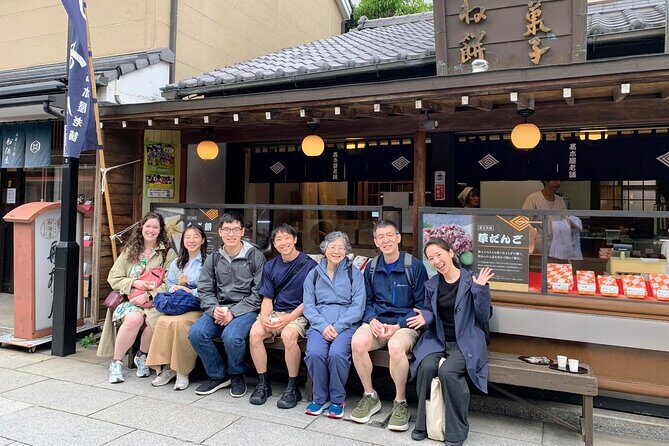
Now you walk the Taishakuten-Sando, described as about 200 meters from Shibamata Station to Shibamata Taishakuten. This is the classic old-street approach: small shops, snack possibilities, and that sense of stepping into a different era.
The street is mentioned as having Japanese sweets shops and buckwheat noodle shops. That’s important because even if you don’t buy anything, you’re surrounded by the kinds of food that make temple streets in Japan feel like more than just an access corridor.
A key drawback to plan around: this stop can be the moment you realize you didn’t budget for snacks. Since food and drinks are not included, treat this as your cue to decide how you want to handle eating—either bring your own small items (if you already travel that way) or plan to buy something here.
Stop 5: Shibamata Taishakuten / Taishakuten Daikyoji Temple (40 minutes)
This is where the tour earns its keep. You get 40 minutes at Taishakuten Daikyoji Temple, and the descriptions focus on visual detail.
What you’re looking at:
- Wood-carved sculptures installed around the main hall, covering stories from the Lotus Sutra
- A garden of ikebana, the Japanese art of flower arranging
This combo is a nice balance. The carvings give you narrative and craftsmanship, while the ikebana garden slows everything down. It’s not just sightseeing; it’s a chance to stand and actually notice.
In the reviews, the temple side is praised as beautiful and authentic, and it’s repeatedly paired with the fish market as a reason people felt they saw a different Tokyo. That pairing makes sense here: the market is about daily life and consumption, while the temple carvings and garden are about meaning and art.
One more practical note: because the main hall and carvings are detail-heavy, this stop rewards slower attention. If you rush, you’ll miss why this place is worth the time.
Stop 6: Yamamototei (30 minutes) and the Japan–West mix
Your final major stop is Yamamototei, about 30 minutes, included in the tour. It’s described as a two-story building using a combined style of Japanese and Western architecture.
The point of this stop isn’t that it’s a random extra. It’s that it changes the visual rhythm right after Taishakuten. Instead of more of the same temple vibe, you get a structural contrast—Western architectural elements integrated into a shrine-style setting.
The review write-ups also reinforce that the tour is good at explaining what you’re seeing. One review praises how the guide was attentive and explained local culture and customs, and another highlights guides who were personable and easy to understand by the end. A stop like Yamamototei is exactly where that kind of explanation helps, because mixed-style buildings are easier to appreciate when someone frames what you’re noticing.
Why the guides (like Kaori, Mutsuko, and Meg) matter
This tour’s strongest repeat theme is the guides. Multiple reviewers highlight the guide as friendly, professional, attentive, and clearly communicative.
Names that come up in the reviews include:
- Kaori, praised for clear language and making the experience feel personal
- Mutsuko, praised for local charm and enjoyable pacing
- Megumi, noted for answering questions and keeping the group engaged
- Masayo, praised as attentive and focused on culture and customs
- Yumi, praised for helping people see parts of Tokyo they wouldn’t find alone
- Mana and Fumiko, also praised for strong guidance and making the day memorable
Even if you don’t care about biographies of your guide (fair), these are useful signals. A guided fish market visit isn’t the same as wandering alone. With a good guide, you know what to ask, what to look for, and how to connect the market and temple pieces into one story of local Tokyo.
What I think this tour is best for
This is a great fit if:
- You want an off-the-radar Tokyo neighborhood without feeling like you need perfect Japanese
- You like food culture but don’t want your day limited to one restaurant
- You prefer smaller groups (max 8) and more conversation time
- You want a temple stop that includes art and garden space, not just a quick photo
It’s also a good pairing tour. If your trip already includes major Tokyo sights, this adds contrast with Adachi and Shibamata.
If you hate walking, though, take note. This is a walking-oriented half-day with multiple segments: market browsing, sando walking, and temple grounds. It’s not an exhausting hike, but it is movement.
Practical things to pack and decide before you go
Because it’s a small-group walking tour, I’d treat it like a morning-to-midday stroll with one bigger hub (the market) and one temple complex (Taishakuten).
A few common-sense decisions that match what’s included and excluded:
- Wear comfortable shoes for market aisles and temple grounds
- Bring a bit of spending money for food and drinks, especially along Taishakuten-Sando
- Plan to stay with the group at the designated meeting point at 8:00 am
- Use the mobile ticket feature as provided by your confirmation, so check-in is smooth
Should you book the Adachi Market and Shibamata half-day tour?
Book it if you want Tokyo that feels lived-in: seafood market energy in Adachi, then a calmer, historic street-and-temple day in Shibamata. The included train fare from Senjuohashi to Shibamata and the temple entrance coverage make the half-day efficient, and the max 8 group size is a real quality marker.
Skip it only if you already have a strong plan for Shibamata and you’re specifically chasing the most famous fish-market brands. This tour is designed for a different goal: local Tokyo, with less crowds and more context.
If your ideal day is part market, part art, and part old street wandering, this is a smart use of half a day.