REVIEW · TOKYO
Tokyo Imperial Palace:Guided Walking Tour of East Gardens
Book on Viator →Operated by YURAGI · Bookable on Viator
Tokyo’s palace grounds have a quiet pull. This small-group walking tour through the Imperial Palace East Gardens and Edo Castle remains turns photos into context, guided in English with time to ask questions. I liked how the pace stays relaxed while the guide explains what you’re looking at and why it mattered.
I especially enjoyed the stop at Sakurada Tatsumi Yagura—an Edo-period watchtower site that’s still one of the few left standing—because the guide connects the structure to samurai-era power. One possible drawback: on an unexpectedly hot day, you’ll be outside for stretches, so plan for sun, water, and breaks when your guide suggests them.
You’ll finish right back where you started, and you won’t need to wrestle with separate tickets for the main sights during the tour. It’s an easy win if you want something more meaningful than a quick look from the outside.
In This Review
- Key things I’d circle before you go
- Why the Imperial Palace East Gardens are better with a guide
- Meeting point near Kokyo Gaien: start in a place you can actually find
- Stop 1: Sakurada Tatsumi Yagura watchtower and the Edo Castle logic
- Stop 2: The Imperial Palace as a living symbol you can interpret
- Stop 3: East Gardens on former Edo Castle ruins
- What the 2-hour, max-8 format gets you (and what it doesn’t)
- Price and value: how $0.39 makes sense here
- Mobile tickets and timing: easy, but plan for outdoor time
- Who should book this Imperial Palace East Gardens walk
- Should you book Tokyo Imperial Palace: Guided Walking Tour of East Gardens?
- FAQ
- Where is the meeting point for the tour?
- How long does the Tokyo Imperial Palace East Gardens walking tour take?
- Is admission included for the stops?
- How large is the group?
- Is the guide English-speaking?
- What if the Imperial Palace is closed when I go?
Key things I’d circle before you go

- Sakurada Tatsumi Yagura in the middle of palace history: an Edo-era watchtower that helps you understand how this place was watched and controlled.
- Clear explanations, even in tough weather: one guide, Taro, was praised for keeping it interesting and educational when it was extremely hot.
- All the main stops are free to enter during your tour: the walk focuses on places where you can actually go in and see key details.
- Small group size (max 8): you get more attention than you would on a big bus tour.
- A guided workaround when access is limited: at least one tour run adapted smoothly when the Imperial Palace area was closed, with alternative spots and stories.
Why the Imperial Palace East Gardens are better with a guide

The Imperial Palace can feel a bit abstract if you only look at it from the outside. The grounds are beautiful, sure, but what makes them worth your time is the layering: Edo Castle roots, later political shifts, and the slow transformation into today’s imperial residence. A guide helps you read the site like a living map instead of a random collection of walls, gates, and watchpoints.
What I like about this tour is that it stays grounded in what you can see right there—stonework, ruins, and landmark points—then links those details to the big themes: emperors, samurai warriors, and political power through the ages. That turns the walk into more than sightseeing. You start to understand why certain areas were built the way they were, and how control and ceremony shaped daily life here.
It also helps that the tour is designed for a small group. When there aren’t many people, your guide can slow down for questions and point out the stuff most visitors miss—like why a watchtower matters in a defensive layout, or what ruins imply about the original castle footprint.
You can also read our reviews of more walking tours in Tokyo


Meeting point near Kokyo Gaien: start in a place you can actually find
You’ll meet at Starbucks Coffee in Kokyo Gaien Wadakura Fountain Park: 3-1 Kōkyogaien, Chiyoda City, Tokyo 100-0002, Japan. That’s a smart anchor in a city where directions can get confusing fast. You also end back at the same spot, which makes planning your next move simpler.
The tour is scheduled for about 2 hours, and the stops are split into three roughly equal segments. In practice, that means you get enough time to enjoy the walk without feeling rushed through the key areas. And because it’s near public transportation, you can usually plug it into a normal Tokyo day without a major detour.
If you’re building an itinerary, I’d treat this as a “morning or early afternoon” activity. The Imperial Palace grounds are open-air for big parts of the experience, and you’ll feel it on sunny days. Go earlier if you can, and bring what you’d bring for walking Tokyo: comfortable shoes and a water plan.
Stop 1: Sakurada Tatsumi Yagura watchtower and the Edo Castle logic

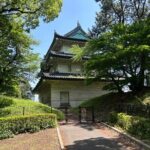
The tour’s first landmark is Sakurada Tatsumi Yagura, also called the Sakurada Nijū Yagura. This is a historic watchtower within the Imperial Palace grounds, built during the Edo period. It’s one of the few remaining structures from that era, which is a big deal: Edo-era defensive buildings rarely survive in full.
Standing near a watchtower changes how you read the surrounding area. From a distance, it’s easy to think of it as just a pretty structure. With a guide, you understand it as part of a system—someone had to watch, report, and respond. The guide’s stories about samurai-era power give the stone and tower placement meaning, instead of leaving you with a vague “cool, historic building” reaction.
The time at this stop is about 30 minutes. That’s enough for you to:
- see the tower as a landmark, not just a blur in a photo,
- notice the details that make it recognizable as Edo-period architecture,
- and get the historical context before you move on.
Practical tip: at this first stop, take a moment to orient yourself. Get your bearings on where the tower sits in relation to the nearby grounds, then the rest of the walk starts to click.
Stop 2: The Imperial Palace as a living symbol you can interpret

Next comes the Imperial Palace, described as the primary residence of the Emperor of Japan. It’s also one of Tokyo’s most iconic landmarks, and that means you’ll likely see other visitors trying to figure out what they’re allowed to view.
This is where an English-speaking guide really matters. You’re not just looking at a famous building; you’re learning how the palace fits into Japan’s political and cultural story. The tour focuses on the significance of the Imperial Palace in Tokyo’s history and frames it through themes like governance and power shifts over time.
That said, it’s smart to expect that access can vary. One of the tour experiences shared that the palace was closed at the time, yet the guide still kept things engaging with other nearby viewing areas and explanations. In other words: even if you can’t go exactly where you planned, the tour isn’t designed to leave you staring at nothing.
This stop is also about 30 minutes. I’d use that time to slow down and look beyond the most obvious photo angles. The moats, stone walls, and garden edges are part of what makes the palace feel like a world within the city. A guide helps you understand which features are functional (defense, separation, control) and which are ceremonial.
Stop 3: East Gardens on former Edo Castle ruins

The final stop is the Imperial Palace East Gardens, which are part of the inner palace area and are open to the public. This area sits on the former site of Edo Castle, so you’re walking through a landscape shaped by the castle’s footprint—plus the later redesigns that followed major changes in Japan’s political life.
Here, the tour leans into “you can see it” history. You’ll encounter stone ruins, gates, and historic wall sections, along with landscaped paths that help connect those elements. The goal isn’t to overwhelm you with dates. It’s to help you connect physical remnants to the stories you heard earlier—especially the idea that power isn’t only about leaders. It’s also about buildings, access points, and how space forces order.
Why this stop is especially valuable is simple: ruins can feel meaningless until someone helps you read them. With a guide, you start to notice patterns—what’s likely original structure versus later restoration, where the castle likely had its boundaries, and how the grounds’ layout communicates separation from the outside world.
This segment is about 30 minutes. The best way to enjoy it is to keep your eyes moving in a slow loop: path → stonework → gate or ruin → garden edge. You’ll get more from short attention shifts than from trying to absorb everything at once.
You can also read our reviews of more guided tours in Tokyo



What the 2-hour, max-8 format gets you (and what it doesn’t)

The tour runs about 2 hours and has a maximum of 8 travelers. For a Tokyo landmark experience, that small cap matters. You get a more conversational pace. When questions come up—like how certain areas were used or why a watchtower survived—your guide can respond without turning into a lecture interrupted by traffic.
It also affects how you feel while walking. Large groups can feel like a rush through checkpoints. With this format, the walk stays human. You can take a slower step, stop for a better view, and actually listen instead of trying to keep up.
What it doesn’t do is promise a huge variety of stops beyond the East Gardens focus. This is a focused experience. That can be a drawback if you’re hoping for a broader “palace area highlights” route that covers everything in one go. But if your goal is to understand the Imperial Palace grounds that are accessible and make sense of Edo Castle remnants, the focus is a strength.
Price and value: how $0.39 makes sense here

The listed price is $0.39 per person, which is nearly symbolic. Even if you treat it as a promotional or test-level listing, it points to the real value driver: the guided interpretation and the fact that the main sites in the walking route are free to enter.
You’re getting:
- a professional English-speaking guide,
- a planned route with three high-impact stops,
- free admission ticket entry at each segment,
- and a small-group experience that can be harder to find for landmarks like this.
In a city where guided tours can easily cost much more, the bargain part here is obvious. But the smarter way to think about it is this: the guide’s job is to help you understand what you’re seeing. If you’re the type who enjoys context—why a watchtower exists, why walls and gates matter—this price becomes an excellent deal, not a gimmick.
The only reason I’d hesitate is if you’re the type who prefers a do-it-yourself stroll with zero structure. If that’s you, you might find it more relaxing to wander on your own. But if you want quick clarity and fewer guesswork moments, the guide value is real.
Mobile tickets and timing: easy, but plan for outdoor time

The tour uses a mobile ticket, and the main stops are marked as free admissions. That simplifies the practical side—you’re not scrambling for extra payment steps right before you want to see something.
Timing is also clean: the experience is listed at about 2 hours, with 30 minutes at each of the three stops. In a busy Tokyo day, that makes it easy to schedule. You can also pair it with nearby areas around the Imperial Palace area without feeling like your day will fall apart if the walk runs slightly long.
The main timing consideration isn’t the schedule; it’s the weather. One review specifically called out extreme heat and praised the guide, Taro, for keeping things engaging. That’s a strong hint that your comfort depends on how prepared you are. Bring water, wear breathable clothing, and take shade breaks when the guide suggests pausing.
Who should book this Imperial Palace East Gardens walk
I think this tour fits best if you:
- want a guided explanation of major palace grounds without a day-long commitment,
- enjoy historical context tied to visible details like walls, gates, and watchtowers,
- prefer small groups (up to 8) where questions are possible,
- and like walking at a comfortable pace through central Tokyo.
It’s also a good choice if you’re visiting Tokyo for the first time and want one experience that helps you interpret the city’s power story, not just its food and shopping.
On the other hand, if you’re expecting a wide range of separate attractions outside the Imperial Palace grounds, you may find the route too focused. This is intentionally about the East Gardens and key nearby landmarks within the palace setting.
Should you book Tokyo Imperial Palace: Guided Walking Tour of East Gardens?
I’d say yes if your goal is meaning, not just a photo. The standout strength is the guide experience—friendly, engaging, and capable of keeping the tour educational even when conditions are tough. The smaller group size helps a lot, and the free-entry nature of the main stops makes the overall value feel unusually strong for Tokyo.
You should also book if you don’t want to spend time figuring things out on your own. The route gives you a clear flow: watchtower first, then the Imperial Palace focus, and finally the East Gardens with Edo Castle ruin remnants. By the time you finish, the grounds usually feel less like a landmark and more like a readable story.
Skip it only if you want a self-directed wandering experience with no scheduled structure. Otherwise, this is a practical, low-stress way to see the Imperial Palace grounds with context you’ll actually remember.
FAQ
Where is the meeting point for the tour?
You meet at Starbucks Coffee – Kokyo Gaien Wadakura Fountain Park, 3-1 Kōkyogaien, Chiyoda City, Tokyo 100-0002, Japan. The tour ends back at the meeting point.
How long does the Tokyo Imperial Palace East Gardens walking tour take?
It runs for about 2 hours.
Is admission included for the stops?
Yes. The tour information lists free admission tickets for each of the main stops.
How large is the group?
The tour has a maximum of 8 travelers.
Is the guide English-speaking?
Yes, the tour is led by a professional English-speaking guide.
What if the Imperial Palace is closed when I go?
Based on a past experience, the guide adapted even when the palace was closed, taking the group to other good places and continuing the explanations.