REVIEW · TOKYO
Tokyo 3 Hour E Bike Tour of the City Bayside Areas
Book on Viator →Operated by Tokyo Rental Bicycle · Bookable on Viator
Tokyo by electric bike beats subway hopping. This 3-hour ride threads together famous bayside sights and neighborhood moments, with an electric assist that makes city cycling feel way more manageable than you’d expect. You cover a lot of ground without feeling like you’re rushing through Tokyo on foot.
I especially like the mix of big-name stops (Ginza, Kabuki-za, Tsukiji Fish Market) and quieter pauses that feel more local, like Tsukishima’s side-streets and a proper break in Kiyosumi Gardens. In reviews, guides such as Sho and Nao get singled out for being upbeat and helpful, and the biking itself is repeatedly described as easy—plus you get safety help while riding through busier roads.
One drawback to plan for: the tour ends at Fukagawa Fudō-dō (not back at where you start). So you’ll want to map your next move ahead of time, especially if you’re also trying to fit in the optional temple entrance fee that’s cash-only.
In This Review
- Key things to know before you go
- The ride plan: what this 3-hour e-bike tour is really good at
- Ginza stop: luxury district vibes with a quick, useful introduction
- Kabuki-za: a classic landmark, handled in a light-touch way
- Tsukiji Hongwanji Temple and the Tsukiji Fish Market snack break
- Tsukishima Monja Street: the part you’d miss without a route
- Sumiyoshi Jinja: a local shrine pause that breaks the big-city pattern
- Kiyosumi Gardens: the walk segment that makes the tour feel complete
- Optional Naritasan Fukagawa Fudodo Honden: pay if you want, skip if you don’t
- Bikes, safety, and guides: what makes this feel easy in practice
- Price and value: is $87.96 a smart trade in Tokyo?
- Getting started in Hibiyakōen and ending at Fukagawa Fudō-dō
- Who this tour suits best (and who should think twice)
- Should you book this Tokyo bayside e-bike tour?
- FAQ
- How long is the Tokyo 3 Hour E Bike Tour?
- How much does the tour cost?
- Where does the tour start?
- Where does the tour end?
- What sights are included in the itinerary?
- Is Kiyosumi Gardens entrance included?
- Do you have to pay for the optional temple stop?
- Does the tour include an English-speaking guide?
- How many people are in the group?
- What should I do if weather is poor?
Key things to know before you go
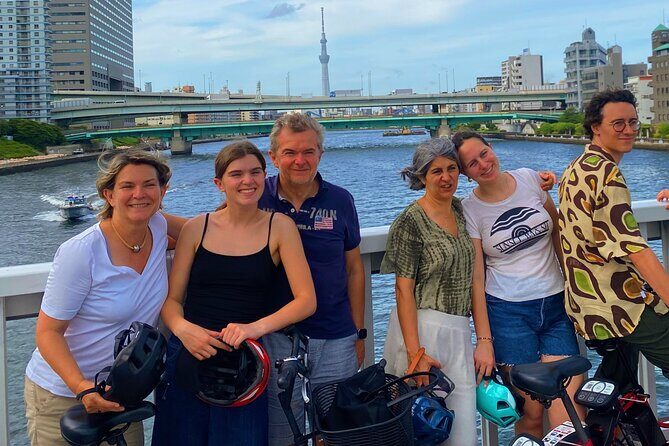
- Electric assist makes long city blocks feel shorter (the bike does the heavy lifting for you).
- Small groups, capped at 7 people, so you’re not lost in a crowd.
- You’ll hit major bayside stops fast, with quick, focused time at each place.
- Kiyosumi Gardens is a real walking break, not just a photo stop.
- Guides Sho and Nao are praised for safety and street-smart routes.
- The optional Fukagawa Fudō-dō add-on costs ¥1000 in cash (and is optional).
The ride plan: what this 3-hour e-bike tour is really good at
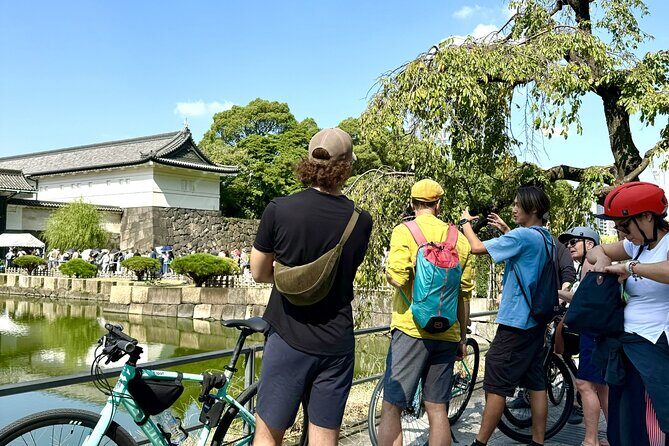
This tour is built for one thing: seeing Tokyo’s bayside highlights in a way that feels active, but not exhausting. Three hours sounds short until you realize how much Tokyo you can cover when you’re on an electric bike. You glide between areas that normally require multiple train rides or long walks.
The structure is also smart. You get a series of short stops—usually about 10 to 20 minutes—so you can look, learn a bit, and then move on while the route stays flowing. Then there’s one longer break at Kiyosumi Gardens where you’ll actually slow down and walk.
The pace is ideal if you’re the kind of traveler who likes a plan, but still wants the streets to surprise you. Multiple guides get mentioned as taking riders through backstreets, which is where Tokyo often feels most interesting.
You can also read our reviews of more cycling tours in Tokyo
Ginza stop: luxury district vibes with a quick, useful introduction
Your tour kicks off in Ginza, where you get an easy way to orient yourself. You cycle through the area rather than just viewing it from a distance, so you start the day with momentum and perspective.
The stop time is about 10 minutes and admission is free. That short window is a feature, not a bug. It’s enough time to appreciate the feel of Ginza—clean streets, high-end stores, polished city energy—without letting it eat your schedule. You’ll leave Ginza with your bearings and a sense of how the route will handle both wide roads and tighter streets.
If Ginza is on your “I’m definitely going there” list, this is a good way to experience it without spending precious time fighting transit timing.
Kabuki-za: a classic landmark, handled in a light-touch way
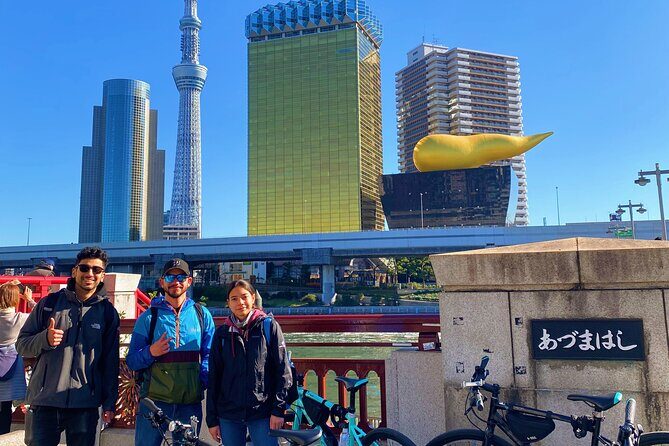
Next comes Kabuki-za. This is one of those places that can feel intimidating if you’re not sure what to do with the time. Here, you get about 10 minutes. It’s focused and simple: visit the famous theater area, look around, and then get back on the bike.
Admission is listed as free for this stop, and the schedule keeps the visit short on purpose. That matters on a bike tour. You want quick cultural context, not a long detour that breaks the day’s flow.
It’s also a good stop for photos and orientation. From there, the tour shifts toward Tsukiji—where the atmosphere becomes more market-and-temple focused.
Tsukiji Hongwanji Temple and the Tsukiji Fish Market snack break
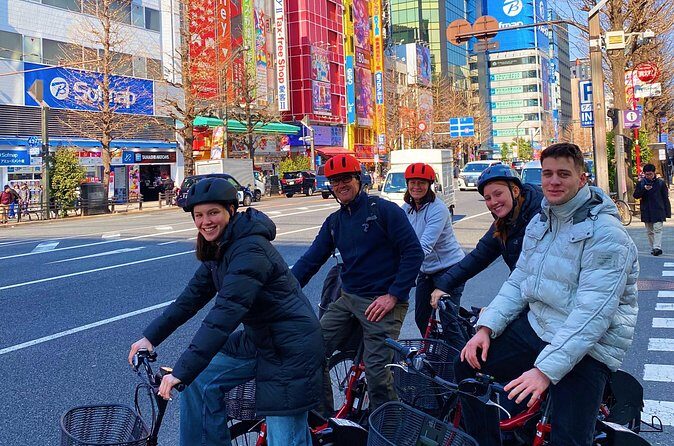
You’ll pass through Tsukiji’s temple area next, with a 15-minute stop at Tsukiji Hongwanji Temple (Hongan-ji Temple). This time slot works well because it interrupts the “always moving” feeling and gives your legs a reset. You’ll get a calmer moment in the middle of one of Tokyo’s most active districts.
Then the tour moves to Tsukiji Fish Market, with about 20 minutes for walking around and a quick snack break. This is where a bike tour becomes more than sightseeing. You get a short, guided window to experience the market area without having to commit to an all-day plan.
In particular, several descriptions mention enjoying snacks and even sashimi during this pause. Even if you don’t go for seafood, it’s a smart time to grab something small, hydrate, and use the route to beat the “where do I even start?” problem that market areas can cause.
Practical note: market zones can mean crowds and narrow walking areas. The tour’s short, guided timing helps you stay comfortable.
Tsukishima Monja Street: the part you’d miss without a route
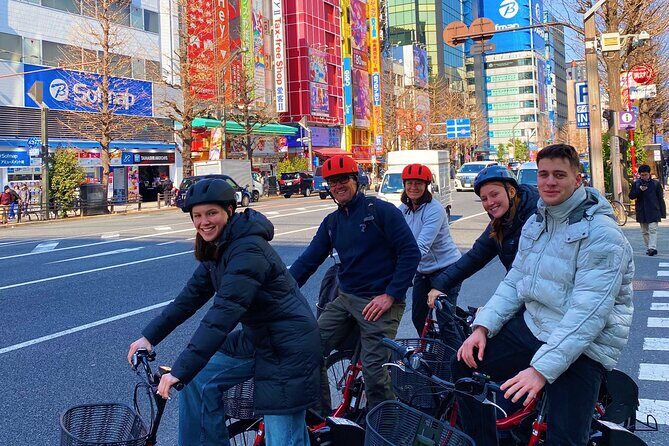
Then you cycle through Tsukishima Monja Street. The stop is about 10 minutes, and admission is free. This portion of the tour is one of the most memorable for many riders because it feels different from the major tourist magnets.
One recurring theme in feedback is how unique Tsukishima feels—like a mini fisherman’s island—especially when you’re moving through it on an electric bike. You’re not stuck outside looking in from a distance. You’re part of the street scene as it changes block by block.
This is also a good spot for casual curiosity. You’ll see side-street Tokyo in a way that’s hard to recreate with trains and walking loops. If you like everyday Tokyo more than only famous viewpoints, Tsukishima is your reward.
You can also read our reviews of more city tours in Tokyo



Sumiyoshi Jinja: a local shrine pause that breaks the big-city pattern
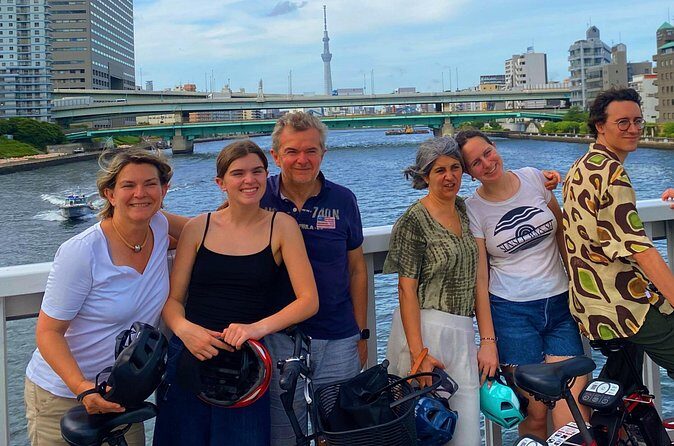
After Tsukishima, you’ll stop at Sumiyoshi Jinja for about 10 minutes. It’s another free, quick cultural stop that helps balance the day. You’re not just going from one famous site to the next; you’re adding a local rhythm.
Short shrine visits can feel like filler on some tours, but on a bike route they actually work. You need small breaks from riding, and shrines are the kind of place where you can take a breath, look around, and absorb Tokyo’s texture.
It’s also a nice moment to slow your thinking before the final big stop on the schedule.
Kiyosumi Gardens: the walk segment that makes the tour feel complete
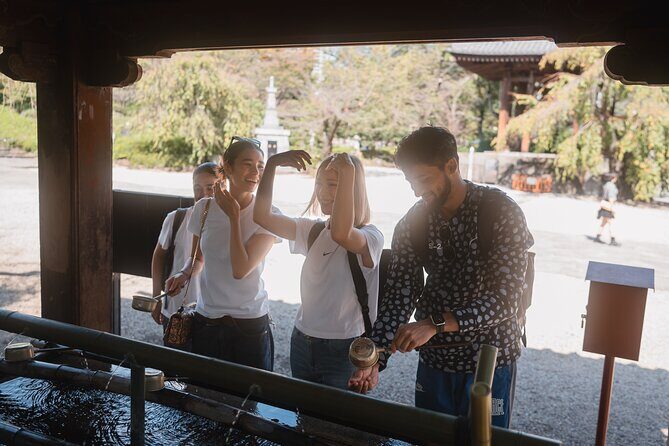
This is the “stop what you’re doing” highlight: Kiyosumi Gardens. You’ll stop the bikes and walk through the gardens for about 25 minutes. Entrance is included here, so you’re not juggling extra payments at this point.
This matters because a lot of e-bike tours stay in motion the entire time. Here, you get a real pause where the experience turns from cycling-and-seeing into wandering-and-feeling. The garden stop also gives your body a break from the saddle while still staying part of the guided plan.
If you’ve been relying on Tokyo’s temples and streets all week, Kiyosumi adds a different tone—more reflective, slower, and ideal for couples, friends, and solo travelers who want a breather.
Optional Naritasan Fukagawa Fudodo Honden: pay if you want, skip if you don’t
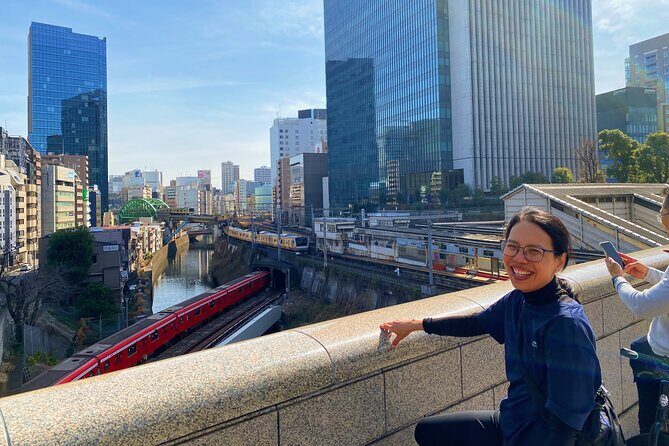
Toward the end, the tour includes an optional entrance to Naritasan Fukagawa Fudō-dō (Naritasan Tokyo branch temple). This is listed at about 20 minutes and has an entrance fee of ¥1000, paid in cash only.
Here’s the key detail: it’s truly optional. If you don’t want to enter, that’s fine, and the tour ends here anyway. That makes it easier to plan your spending and energy level. You won’t feel forced to make the payment just because it’s on the itinerary.
If you do choose to enter, it’s a satisfying final chapter—adding a spiritual stop after market energy and neighborhood streets. If not, you still get the ride experience and the route ending point without losing time.
Bikes, safety, and guides: what makes this feel easy in practice
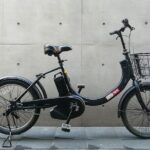
The e-bikes are a core part of the value. You get use of the electric bike, and multiple notes mention the bikes as being easy to ride. Some also mention Bianchi bikes, which signals the operator isn’t cutting corners on ride quality.
On top of that, the guides’ approach seems to matter. Several descriptions highlight that routes are handled safely, even when cycling through busier streets. That’s a big deal because Tokyo traffic isn’t something you want to “figure out” while also trying to enjoy the view.
If you’re moderately fit, this should work well. The tour doesn’t ask you to do a long endurance workout, but it does assume you can ride and maneuver comfortably for a few hours.
Guide names you might meet include Sho and Nao, and both are described as informative and kind, with good energy throughout. That combination—helpful guidance plus a smooth, safe route—is what turns an e-bike tour from a gimmick into a real travel day.
Price and value: is $87.96 a smart trade in Tokyo?
At $87.96 per person for about 3 hours, this isn’t the cheapest activity in Tokyo—but it also isn’t trying to be. The value comes from mixing several paid and complicated elements into one simple package.
Here’s how I’d judge it:
- You’re paying for the electric bike and the guided route (that’s the biggest cost driver in any e-bike tour).
- You’re also getting guided time at multiple major areas: Ginza, Kabuki-za area, Tsukiji temple, Tsukiji Fish Market, Tsukishima, Sumiyoshi Jinja.
- Entrance is included for Kiyosumi Gardens, which helps offset what would otherwise become scattered small fees.
- Food isn’t included, but the market stop is a built-in moment to grab something quickly (and it’s an easy place to treat yourself).
If you were doing this day solo, you’d likely spend time coordinating transit, then walking more than you expect, then trying to cover a spread of neighborhoods efficiently. The bike makes the schedule workable without turning your day into a training session.
So for many people, the price feels like a trade for convenience, speed, and a less stressful way to cover Tokyo’s bayside.
Getting started in Hibiyakōen and ending at Fukagawa Fudō-dō
You’ll meet at 1-3 Hibiyakōen, Chiyoda City, Tokyo 100-0012, Japan. The tour ends at Fukagawa Fudō-dō, 1-chōme-17-13 Tomioka, Koto City, Tokyo 135-0047, Japan.
That end point matters. Since you don’t return to the start, you should plan your next activity based on where the tour finishes. This is especially important if you’re pairing it with dinner reservations, an evening show, or a specific train connection.
The meeting point is described as near public transportation, and you’ll have a mobile ticket, so it should be straightforward once you’re in the right area.
Who this tour suits best (and who should think twice)
This works best if you:
- want to cover a lot of Tokyo bayside in a short time
- like guided city riding through real streets (including backstreets)
- enjoy a balanced mix of famous sights and more local-feeling pauses
- want an active day without going full workout mode
It might be less ideal if you:
- hate the idea of riding through busy areas at all (even with safety guidance)
- strongly prefer a round-trip tour that ends where it starts
- don’t want any optional fees or cash handling (the optional ¥1000 temple entrance is cash-only)
Should you book this Tokyo bayside e-bike tour?
If your goal is simple—see the bayside highlights, enjoy a guided ride, and get one real walking stop in Kiyosumi Gardens—then I’d say yes. The electric bikes make it feel doable, and the itinerary is tight enough that you don’t waste time. The guide style (including Sho and Nao) seems to be a big reason people have a great time, especially when cycling through busier streets.
My final nudge: check your plan for the ending location at Fukagawa Fudō-dō and decide ahead of time whether you want the optional cash-only entrance. If you do that, this is a genuinely fun way to experience Tokyo that you can’t easily replicate on your own in the same time window.
FAQ
How long is the Tokyo 3 Hour E Bike Tour?
It runs for about 3 hours.
How much does the tour cost?
The price is listed as $87.96 per person.
Where does the tour start?
The meeting point is 1-3 Hibiyakōen, Chiyoda City, Tokyo 100-0012, Japan.
Where does the tour end?
The tour ends at Fukagawa Fudō-dō (Naritasan Tokyo branch temple), 1-chōme-17-13 Tomioka, Koto City, Tokyo 135-0047, Japan.
What sights are included in the itinerary?
You’ll cycle through and stop at Ginza, Kabuki-za, Tsukiji Hongwanji Temple, Tsukiji Fish Market, Tsukishima Monja Street, Sumiyoshi Jinja, Kiyosumi Gardens, and there is an optional stop at Naritasan Fukagawa Fudō-dō.
Is Kiyosumi Gardens entrance included?
Yes. Entrance fee for Kiyosumi Gardens is included.
Do you have to pay for the optional temple stop?
The optional entrance to Naritasan Fukagawa Fudō-dō has a fee of ¥1000, and it is cash only. It is optional, and you can skip it without affecting the tour ending.
Does the tour include an English-speaking guide?
Yes, the guide is listed as English speaking.
How many people are in the group?
The tour has a maximum of 7 travelers.
What should I do if weather is poor?
The experience requires good weather. If it’s canceled due to poor weather, you’ll be offered a different date or a full refund.