REVIEW · TOKYO
Tokyo Castle & Imperial PalaceーShogun Walking Tour
Book on GetYourGuide →Operated by Local Guide Stars · Bookable on GetYourGuide
Tokyo is full of history, but this walk makes it legible. You connect the dots between Edo Castle (once Japan’s massive stronghold) and today’s Imperial Palace in just two hours. I like that the tour leans on real layout clues—gates, moats, and surviving traces—so the story doesn’t stay abstract.
One consideration: the Imperial Palace area includes a security check, and the experience is mostly outdoors, so you’ll want weather-ready clothes.
In This Review
- Key highlights worth getting excited about
- Edo Castle to Imperial Palace: why this walk feels different
- Meeting point at Starbucks: easy start, low stress
- Sakurada Tatsumi Yagura: a short stop with big meaning
- Ote-Mon Gate: where scale becomes real
- Tokyo Imperial Palace grounds: samurai power meets 2,600 years of emperors
- Ninomaru Garden: a Japanese garden with a specific kind of prestige
- Edo Castle Ruins: the “almost gone” places that explain everything
- Imperial Palace East Gardens: moats, views, and a living touch
- Price and value: why $23 makes sense for this kind of access
- Language, pacing, and what to wear for a smooth experience
- Who should book this Shogun and Imperial Palace walking tour
- Should you book this tour?
- FAQ
- What’s the duration of the Tokyo Castle & Imperial Palace Shogun Walking Tour?
- How big is the group?
- Is the tour offered in English?
- Where do I meet the guide?
- Are there any rules for entering the Imperial Palace area?
- Is there time for photography?
- Will I be able to use a wheelchair during the tour?
Key highlights worth getting excited about

- Small group up to 10 people for a calmer pace and better chances to ask questions
- Edo Castle to Imperial Palace context, showing how the same ground shifted roles over centuries
- Photo stops at major points like Sakurada Tatsumi Yagura and Ote-Mon Gate
- Ninomaru Garden and its Japanese garden style admired by the Emperor
- Tiny history details that feel real, including a miniature structure of the former palace
- Koi fish encounters and trees from across Japan, adding a distinctly seasonal, living-feel touch
Edo Castle to Imperial Palace: why this walk feels different

Edo Castle is the kind of place you can’t truly picture from a brochure. The scale is the trick. This tour helps you see it by pointing out what still survives in Tokyo today—stone and spatial clues that explain how the defenses worked and why the shogun’s world could last so long.
What I like best is that you don’t just get a timeline. You get cause-and-effect. How did layered defenses hold up? Why did samurai-era power rely on more than brute force? And how does an imperial institution keep going after centuries of political change? The tour uses the ground itself as your textbook.
There’s also a practical payoff: once you understand the palace layout, your photos look better. You’ll be aiming at specific spots for reasons, not just for pretty walls and gates.
You can also read our reviews of more walking tours in Tokyo


Meeting point at Starbucks: easy start, low stress

You meet at Starbucks Coffee Kōkyo Gaien Wadakura Fountain Park Store, at 3-1 Kōkyo Gaien, Chiyoda City, Tokyo. It’s a handy landmark in a part of the city where directions can get tricky fast, especially if you’re arriving by train and walking a few blocks.
The guide is identified with a sign that says Local Guide Stars. In past tours, guides such as Anju, Yuuka, and Tomo have been praised for clear explanations and keeping a comfortable pace. That matters here because the area is big—your first job is to orient, and the guide helps with that immediately.
Tip that pays off: arrive a few minutes early. With small groups, start-time punctuality keeps things smooth, especially before the Imperial area security checks.
Sakurada Tatsumi Yagura: a short stop with big meaning

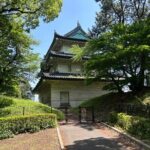
Your first historic stop is Sakurada Tatsumi Yagura, around a 5-minute photo stop plus quick guided context.
Yagura are watchtowers, and even when you only get a brief look, the guide’s explanation helps you connect dots. You start to understand why these structures weren’t decorative. They were functional points in a defensive system, placed for visibility and control. It’s the same theme you’ll keep seeing later: power was engineered into the design.
For photographers, this is a quick “reset moment.” You get a clean visual reference early, so when you move to the gates and palace grounds, you’ll notice alignments and spacing instead of just collecting random shots.
Ote-Mon Gate: where scale becomes real

Next is Ote-Mon Gate (about 15 minutes), another photo stop with guided touring.
Gates are where storytelling clicks. A gate isn’t just an entrance—it’s a bottleneck. It’s where you’d expect movement, monitoring, and control. The guide explains how massive Edo Castle was and how its defenses made it extremely difficult to breach.
This is also where the small-group format helps. A group of up to 10 means you’re more likely to get direct answers rather than “we’ll cover that later” pacing. In multiple examples, guides like Yuuka and Tomo have been singled out for answering questions and pointing out details people might otherwise overlook.
If you’re a fan of samurai-era fiction or have watched period dramas, this is the stop where the setting stops being background and starts being strategy.
Tokyo Imperial Palace grounds: samurai power meets 2,600 years of emperors
The tour then moves into Tokyo Imperial Palace area for around 20 minutes, again with a photo stop, guided tour, and sightseeing walking.
Here’s the interesting twist: Edo Castle was the shogun’s world, but today it functions as the emperor’s residence. You’re standing on ground that shifted roles without disappearing. That’s the heart of the tour’s appeal: you learn how a long imperial system continued through major political shifts and why the tradition survived.
In the process, you’ll likely pick up a few practical mental models:
- The shogun-era world was about control through structure and security.
- The imperial system is about continuity through institutions and tradition.
- The same “bones” of the city can serve different rulers across time.
You may notice lots of visitors slowing down simply to look, but the guide usually keeps you from doing the passive sightseeing thing. Instead of wandering, you’re “reading” the grounds as you go.
Important note: there’s a security check when entering the Imperial Palace area. The tour data specifically says don’t bring knives or alcohol. Plan for the possibility of a brief pause at the checkpoint.






Ninomaru Garden: a Japanese garden with a specific kind of prestige

Your next highlight is Ninomaru Garden (about 15 minutes). This is where the tour balances military history with a calmer, aesthetic side of power.
The tour description calls out the Japanese garden admired by the Emperor. Even if you don’t know garden terminology, you can feel what the guide is aiming for: gardens weren’t only for leisure. In Japanese culture, they also communicate taste, order, and status—quiet messages that fit right alongside the idea of refined court life.
What I love about this stop is that it slows your brain down. You go from gates and defensive logic to stone, trees, and arranged views. And it gives you a needed break from straight walking.
The photo potential is strong, but the real value is learning to spot what the guide points to: lines of sight, seasonal elements, and how the garden’s design guides where your eyes go.
Edo Castle Ruins: the “almost gone” places that explain everything

Next is Edo Castle Ruins for about 10 minutes—a shorter stop, but one that can feel like a payoff.
Ruins are tricky. From a distance, they can look like “leftover stone.” With the guide’s framing, you start to see them as functional pieces of a bigger system. This is where the tour leans hardest into explanation of defenses and scale. If you’ve ever walked past something old and wondered why it mattered, this stop is designed to answer that question quickly.
It also helps that many guides have been praised for pointing out what’s easy to miss. For example, Fuma has been mentioned as noticing details people would walk right past, while Xin Yan has been noted for explaining layered defense ideas clearly. Even with a brief stop, those explanations tend to linger.
Imperial Palace East Gardens: moats, views, and a living touch

Your final outdoor section is Imperial Palace East Gardens for around 20 minutes, covering more photo-worthy walking and guided sightseeing.
This is where you see the palace grounds in a more spacious, scenic way. The tour includes mentions of meticulously preserved moats and gates, plus seasonal gardens and ancient stone walls that create panoramic views.
You’ll also get the more “you can see it right now” surprises: the tour data includes encounters with special koi fish and diverse trees from across Japan. That matters because it changes the texture of the tour from historical lecture to living atmosphere. You’re not only learning; you’re experiencing a slice of nature and tradition at the same time.
If your schedule is tight and you still want a lot of context, this last garden stretch is where you feel the most satisfied. It’s the point where the whole story can settle into place.
Price and value: why $23 makes sense for this kind of access

At $23 per person for about 2 hours, this isn’t a fancy splurge. It’s a straightforward value play—especially because the tour includes more than just “stand and listen.”
You’re paying for:
- English live guide throughout
- Imperial Palace grounds and the eastern garden as part of the guided experience
- Context that ties Edo Castle defenses to what’s visible today
- A guided approach that focuses your time on the best photo and learning points
- Extra sensory stops like koi and trees from across Japan, plus a miniature structure showing what the former palace looked like
That last point is underrated. A miniature structure gives you a mental map when real buildings are partially restricted or not fully viewable from every angle. It helps you build a more accurate picture rather than relying on guesswork.
Also, with a small group limited to 10, you’re not fighting for attention. Guides named like Tomo, Yuki, Fuma, and Anju have received praise for pacing, clarity, and friendliness, which is exactly what you want for a history-heavy walking experience.
In plain terms: for the price, you’re getting guide time plus on-the-ground interpretation, not just entry-level sightseeing.
Language, pacing, and what to wear for a smooth experience
This tour is English only. There’s no Japanese language support, so if you rely on translation for nuance, plan accordingly.
A large portion of the walk is outdoors, so dress for the day. The Imperial area involves walking and can include slopes. Wheelchairs are available and can be used within the grounds, but there are areas where guests will need to walk or go down on foot. If mobility is a concern, I’d think about comfortable footwear first.
And bring a camera. The tour description encourages photography, and the itinerary clearly includes multiple photo stops—so it’s built for visual sightseeing, not just listening.
Who should book this Shogun and Imperial Palace walking tour
This tour fits best if you want:
- Edo-period context without feeling lost
- A guided route that explains gates, ruins, and garden design as part of one story
- A small-group experience where questions are likely to get answered
- A 2-hour plan that mixes history and calmer garden moments
It may be less ideal if you:
- Need Japanese language support
- Prefer long museum-style time instead of walking-and-looking
- Want a low-footprint tour with minimal outdoor exposure
Should you book this tour?
Yes, if you’re the type of traveler who likes to understand what you’re looking at, not just pass through it. The value is strong for the price: you get Imperial Palace grounds, a guide-led explanation of how Edo Castle’s defenses relate to what you see today, plus scenic breaks at places like Ninomaru Garden and the East Gardens koi area.
I’d say book it especially if you’ve watched or read about the shogun and want your memory to match real geography. The tour’s real strength is making the space feel meaningful.
If that’s not your goal and you’d rather explore on your own without a structured route, you might find it less necessary. But for most history-minded visitors working within a short Tokyo window, this is a practical, good-value way to see the emperor’s grounds with Edo Castle context in your head.
FAQ
What’s the duration of the Tokyo Castle & Imperial Palace Shogun Walking Tour?
The tour lasts about 2 hours.
How big is the group?
It’s a small group with a maximum of 10 participants.
Is the tour offered in English?
Yes. The tour is conducted in English only, with no Japanese language support.
Where do I meet the guide?
Meet in front of Starbucks Coffee Kōkyo Gaien Wadakura Fountain Park Store (3-1 Kōkyo Gaien, Chiyoda City, Tokyo). The guide will hold a sign that says Local Guide Stars.
Are there any rules for entering the Imperial Palace area?
There is a security check, and the tour data says not to bring knives or alcohol.
Is there time for photography?
Yes. The route includes photo stops, and photography is encouraged.
Will I be able to use a wheelchair during the tour?
Wheelchairs are available and can be used within the Imperial Palace grounds, but there are some slopes and areas where you may need to walk or go down on foot.